7/23/2026 at 7:41:21 PM
Nice. Here's MP Minerals' plant for doing that, in Alliance, TX.[1] It's a modest sized plant in an industrial park. It's fed by a huge mine in California, which has an onsite beneficiation plant. Beneficiation is the first step of separation - sorting the good stuff out from the unwanted dirt, with rock crushers, screens, and flotation. This being "rare" earth mining, the amount of good stuff is tiny relative to the unwanted dirt. This new technology works on the separated good stuff.Although these separation plants aren't big compared to mines, US mines had been sending rare earth ores to China for processing. That's gradually moving back to the US as more separating plants are built.
by Animats
7/23/2026 at 10:10:35 PM
Is that mine in California the one powered by burning sulfur? If I recall correctly, they need sulfuric acid to extract the minerals, and they need power, and burning sulfur to make sulfuric acid produces steam, and sulfur is easier to ship than the acid, so...by pfdietz
7/24/2026 at 5:32:08 PM
(I could be confusing this with a hard rock lithium mine.)by pfdietz
7/24/2026 at 6:14:36 PM
Yes: the planned Thacker Pass Lithium Mine in Nevada.by pfdietz
7/24/2026 at 3:07:41 AM
What's the general process for the initial separation of unwanted dirt? I've worked in a zinc smelter a long time ago, the initial stage was roasting, heating the ore to 900C to burn off unwanted components (such as sulfur, which went on to become sulfuric acid), and to melt other components.I guess I'm surprised at the absence of flue stacks and cooling towers at the facility shown in the video.
Perhaps the facility in the video only shows "cleaner" downstream processing for marketing appeal, or separation processes are fundamentally different?
by merek
7/24/2026 at 3:29:06 AM
60 Minutes had some coverage of the beneficiation plant.[1] For rare earths, that's mostly grinding and sorting by density and magnetic properties. It's a large plant near the mine. Bags of rare earth ore worth about $120,000 per pallet come out, and those are transported to the Texas location for the next step, which has a lot more heat and chemistry.[1] https://www.linkedin.com/posts/60-minutes_rareearths-activit...
by Animats
7/24/2026 at 5:10:20 AM
MP is well positioned in the REE processing space -- now if the share price would stop collapsing then companies in the critical minerals sector would be able to raise capital more easily (MP is the bellwether for the sector)by virtualwhys
7/26/2026 at 5:54:40 PM
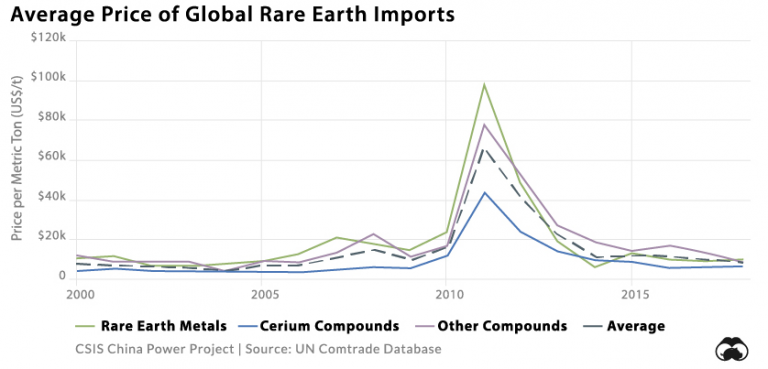
Right. Since the 1980s, the Mountain Pass mine has gone bankrupt and shut down twice. Not because they did anything wrong, but because the prices of rare earths temporarily dropped below their production cost. Here's a general rare earth price graph.[1] It's tough having a business with fixed costs with a 10:1 price variation.MP Minerals is now getting subsidies from both the U.S. Government and General Motors, both of which want a reliable source of magnets outside China. There are other sites in the US and Australia which could be developed if it was profitable. (Operating in Greenland, per Trump, is silly. The costs of operating anything big there are very high. No roads, no infrastructure, only a few months a year of ice-free construction time...)
[1] https://www.mining.com/wp-content/uploads/2021/01/image-9-76...
by Animats
7/24/2026 at 8:29:59 AM
Thanks. Now MP is on my radar.by ksec
7/24/2026 at 8:26:20 PM
Certainly at $41, a 52 week low, it's a fire sale (hit $100 back in October.by virtualwhys
7/23/2026 at 10:02:33 PM
That's one of those corporate videos that's totally useless. Lot's of "pretty" pictures with drone footage, but there's no there there. Who do videos like this work on?by dylan604
7/23/2026 at 10:15:42 PM
Gloss for potential investors / capital raisers wanting a bit more than the dry quarterlies and annual reports as they prep for raising 50 or a 100 million in more forward capital loans for processing expansion.It's literal lube for the grinding wheels of commerce.
Some can get by on the technical reports and capex and projected returns, others want a bit of "a vision" / proof of big shed and machinery.
by defrost
7/23/2026 at 10:47:01 PM
Just one nitpick.Literal lube is lube. This is not lube. This is a video.
by cadamsdotcom
7/24/2026 at 12:11:01 AM
https://www.merriam-webster.com/grammar/misuse-of-literallyby kirubakaran
7/23/2026 at 10:57:16 PM
Literally a video for lubricating acceptance of a project. Literally.by defrost
7/24/2026 at 1:06:03 AM
If by "literally" in the original post you mean the modern "pay attention to these words in particular".. why leave that in?We are literally already paying attention. It's literally redundant.
by cadamsdotcom
7/24/2026 at 1:28:08 AM
And yet you missed the the double the.by cwillu
7/24/2026 at 12:09:49 AM
Literal video, metaphorical lube.by BigTTYGothGF
7/24/2026 at 12:13:44 AM
> The new approach relies on a layered form of manganese oxide—a mineral material with the right size layers to allow ions to slip in and out and to differentiate rare earth elements.Seems literal to me!
https://en.wikipedia.org/wiki/Bentonite#Drilling_mud
by ButlerianJihad
7/24/2026 at 1:49:25 AM
It's a video about literal lube!But a video isn't literally lube :) it's a video.
by cadamsdotcom
7/24/2026 at 12:23:20 AM
By Oxford English Dictionary literal definition, not all lubricants are fluids. Etiquette is a mere lubricant of the order of society.
Fine music‥has a sensible effect in‥animating and as it were, lubricating my inventive faculty.
Lube also used for cash - greasing palms, etc.
by defrost
7/24/2026 at 7:36:50 AM
Using the a non-lube to lubricate is still metaphorical.But, I just ignore the word literally and english still works just fine
by throwaway27448
7/26/2026 at 2:53:02 AM
Ignoring literally is A-Ok in my book (and forum comments) but I would point out that a "non lube" used to ease a transition, smooth an action, or remove friction is <cough>literally</cough> a lubricant (by definition and hundreds of years of common usage).by defrost
7/24/2026 at 7:31:46 PM
There's something to be said for that. If the Slate electric car people had a picture of their factory, they'd be more credible.by Animats