6/23/2026 at 8:08:53 PM
The survey in the article that assessed vitamin D deficiency was a bit odd:>Because physical exams are performed in mobile vans in NHANES, data could not be collected in northern latitudes during the winter; instead data were collected in northern latitudes during summer and in southern latitudes in winter. To address this season-latitude aspect of the NHANES design, we stratified the sample into two seasonal subpopulations (winter/lower latitude and summer/higher latitude) before examining vitamin D status.
Yeah, I'm not surprised that the rates for vitamin D deficiency were low.
>Less than 1% of the winter/lower latitude subpopulation had vitamin D deficiency (25-OHD <17.5 nmol/L). However, the prevalence of vitamin D insufficiency in this group ranged from 1%–5% with 25-OHD <25 nmol/L /.../, even though the median latitude for this subsample (32°N) was considerably lower than the latitude at which vitamin D is not synthesized during winter months (∽42°N).
and the more northern latitude in summer:
>With the exception of elderly women, prevalence rates of vitamin D insufficiency were lower in the summer/higher latitude subpopulation (<1%–3% with 25-OHD <25 nmol/L)
Now imagine if you lived in northern Europe around the 60th parallel, where the sun doesn't get high enough in winter to produce vitamin D.
by Aerroon
6/23/2026 at 8:18:57 PM
Not to mention, northern latitudes get more sun that average in summer, and most northern countries have more reasonable working hours so people actually do go outside.by qurren
6/23/2026 at 9:43:15 PM
More hours of sun, but it's less intense.by HPsquared
6/24/2026 at 9:50:47 AM
Is it really less intense? When I go out on a sunny day in Denmark it is murder. When I go out on a sunny day in Italy it's generally just overall warm.At any rate another factor is that in the Northern regions it's my experience people do their best to soak up as much sun as possible.
by bryanrasmussen
6/24/2026 at 10:27:55 AM
I could believe that if you were near the coast.I grew up in central Michigan and thought the same about the sun until I spent a few years in southern Arizona. The sun there feels like a heat lamp in summer. The low humidity makes the atmosphere absorb less energy. Although it feels like it's about 5 C cooler than it actually is because sweat evaporates so quickly, but once it gets to 43 C you actually just feel vaguely ill just going outside. Standing in the sun is just not something you do. It's a very unique experience to lick your lips and have your tongue feel cold.
Of course, neither of those were as bad as Houston in August. It was 38 C and 98 % relative humidity. And, I will point out, it had not rained. That's just what it's like. You walk outside and your glasses instantly fog up and you feel like you desperately need to shower.
by da_chicken
6/24/2026 at 3:24:04 PM
I live in Dallas and remember going hiking in Arizona and then getting in the car and the windows fogged up from sweat evaporating. Someone from a humid summer climate being outdoors in a dry summer climate has to really watch their water intake. It doesn't feel as hot because it's sucking all the moisture out of you and by the time you realize what's happening you're already not feeling so great. If you're 5 miles from water you're in a bad spot.by chasd00
6/24/2026 at 10:06:47 AM
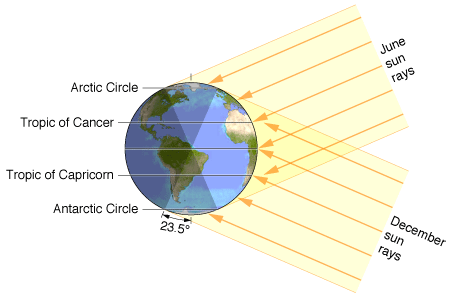
The sun is at a lower angle from the horizon at higher latitudes. It passes through more atmosphere, losing some UV, and also the surface irradiance on the ground (energy per unit land area) is lower.by HPsquared
6/24/2026 at 11:30:01 AM
This. What I've learned for VitD conversion in the skin the sun needs to be more than 45° "high". Below that it's not much effective.Those long summer evenings in northern Europe are thus not all that useful for VitD.
by flossly
6/24/2026 at 2:14:57 PM
I think it's because further north the Sun is at a lower angle in the sky. So high frequency waves like UV (needed for Vitamin D production) get filtered out by passing through more of the atmosphere.Lower wavelengths like IR (heat) can more easily pass through the atmosphere. And since the Sun is lower in the sky, it hits more of your body. So you might feel more of the heat, while still getting less UV.
by wtetzner
6/24/2026 at 2:49:09 PM
Its about the angle yes, but the main thing is basically for every square unit of solar radiation gets projected onto a larger surface because of the angle- meaning radiation per unit area is lower. The secondary effect is that sunlight has to travel through more atmosphere, and gets scattered somewhat.by jodleif
6/24/2026 at 10:55:01 AM
Sit in the sun for a bit closer to the equator. You'll feel it very quicklyby bluedino
6/23/2026 at 11:29:43 PM
Sure but i hide a lot more from the intense sun in spain then i do for the softer sun in sweden. In general i think it balances out quite well.by calgoo
6/24/2026 at 4:11:39 AM
Does vitamin D synthesis require direct sunlight, or does it work with scattered light as well?by fluoridation
6/24/2026 at 8:30:11 AM
Not really, it requires direct sunlight above 45 degree, so northern sweden for example gets plenty of sun in summer, but only for a very short time intense enough sun.by lukan
6/23/2026 at 11:09:02 PM
The sun in northern countries in summer is less intense?by codethief
6/24/2026 at 3:40:02 AM
Yeah, kinda.I moved from Indiana to Norway - Trondheim, which is about in the middle of the length of Norway. During the summer, I can read outside at night even though the sun technically goes down for about 4 hours in June. It never gets darker than twilight. A few clouds means you might just have sunset all night. The sun does get surprisingly hot and very warming if we happen to have a sunny day. Jacket in the shade, short sleeves in the sun even though it is 18C/65F.
The reason for this is that the sun is at a low angle, so it hits more of your body than it does when the sun is overhead - like you'd get in Australia. This also means that while you need some sunscreen during the day - from about 10 to 5 - it doesn't burn as much. It is less intense in that way - but it just feels different.
During December, days are 4 hours of very weak light.
by Broken_Hippo
6/24/2026 at 5:44:33 AM
> The reason for this is that the sun is at a low angle, so it hits more of your body than it does when the sun is overhead - like you'd get in Australia. This also means that while you need some sunscreen during the day - from about 10 to 5 - it doesn't burn as much.Not sure if I parse this correctly - I'd imagine you need more sunscreen at "low angles" due to more severe and longer exposure? Low angle -> more body surface area exposed directly at near-right angle to Sun -> more direct absorption -> more sunscreen needed?
by TeMPOraL
6/24/2026 at 10:21:28 AM
I’ve found the UV index forecasts to generally be a good metric, so try looking at those for various locations. The main factor here is that the lower the sun is from the horizon, the more its light will be absorbed by the atmosphere due to the longer path. The maximum altitude that the sun will ever reach is (90° – (latitude – 23.4°)), so at the 60°-ish of Scandinavia it’s rarely more than 50° in the sky. It’s a very noticeable difference even in the summer. In my experience (born in southern Italy, pale-average, currently living in Sweden) it’s almost impossible for me to get sunburn in daily life in Sweden even without sunscreen. Definitely not so further south.by dgfl
6/24/2026 at 2:25:33 PM
> it’s almost impossible for me to get sunburn in daily life in Sweden even without sunscreen.Um most Swedes, even with not-super-pale skin get a sunburn every june. Just being outside in the sunshine for 2-3 hours without any protection and they turn "kräftröd" as they say.
by teiferer
6/24/2026 at 8:32:51 AM
No, because the sun at low angles passes so much atmosphere, that filters most out.The exposure angle of your body also has a effect, but much weaker.
by lukan
6/24/2026 at 3:28:55 PM
Today in Stockholm the UV index peaked at 6.3. And it is just a few days after the summer solstice, and the sky was largely clear today.(Yet I can feel that I got slight sunburn being out for about 15 minutes today. So you still need to be careful.)
In winter the UV index might often peak at 1-2 on a clear day.
by VorpalWay
6/24/2026 at 6:07:43 AM
at lower angles the sun light needs to go through a much bigger "cross section" of atmosphere which greatly reduces its energy.This is why noon sun is the most dangerous.
by Dansvidania
6/24/2026 at 5:29:51 AM
Huh now I know why I never liked living in Washington and Oregon, especially at higher altitudes. The sun always felt hotter.by picofarad
6/24/2026 at 6:13:29 AM
I summer in California and winter in Washington for that reason!by zippyman55
6/24/2026 at 7:38:15 AM
This low angle situation must have been experienced by every adult I imagine, its just about being outside before dawn and feeling how sun's warming effect on the body is much stronger than few hours ago even though air temperature itself might have been higher before.Since it hits body more perpendicular its not rocket science, I realized this around age 10 myself and I am not the brightest in the pack.
by kakacik
6/24/2026 at 8:52:09 AM
I found this resource which shows that sun intensity in June in northern Europe is similar to that in sub-Saharan Africa (in June).https://physics.weber.edu/schroeder/ua/EarthCirclesAndSunRay...
by ludicrousdispla
6/24/2026 at 10:13:49 AM
At the equator, the sun is highest at the equinoxes (March and September) and lowest at the solstices. Outside the tropics, the sun is highest at the summer solstice (June or December) and lowest at the winter solstice.by HPsquared
6/24/2026 at 1:14:17 PM
Exactly at the equator the sun is directly overhead (90 degrees) at a single time point (close to 12 on depending on where you are within the time zone) every single dayThe only thing that varies over the year is the path it takes to get there. At the solstices (summer/winter) the path curvature is maximal while t the equinoxes (spring/fall) it is a straight line.
by SJC_Hacker
6/24/2026 at 2:29:35 PM
Sorry that's just obviously false. It's only directly above you at the equinoxes, so twice a year. Otherwise it has traveled further north or south.Before everything was an app, people had physical globes at home which could illustrate this very well.
by teiferer
6/23/2026 at 11:26:22 PM
Come to Australia during the summer and watch how quickly you burn outside without sunscreen.by NoPicklez
6/24/2026 at 12:59:04 AM
Yes, it's crazy to consider how far north Earth's entire land mass is skewed. Australia is basically the southernmost landmass (apart from Tierra del fuego), yet it is located squarely under the Tropic of Capricorn; at the same distance north of the equator (Tropic of Cancer), you've merely reached Mexico, the Sahara desert, and the Himalayas.by tremon
6/24/2026 at 2:31:53 PM
That'a not just the angle though, it's an issue with the ozone layer too, right?by teiferer
6/24/2026 at 3:06:14 AM
For non-Australians, that's burn as in "burst into flames", not "your skin goes red". Go to somewhere like Cairns and you can hear people crackling as they walk down the street.by pseudohadamard
6/24/2026 at 1:15:08 PM
Only for fair skinned individualsby SJC_Hacker
6/24/2026 at 2:40:38 PM
Dark skin typically provides a protection equivalent to a ~10 SPF. Meaning some protection, but tons of the actual damaging UVB still going through.by folkrav
6/24/2026 at 3:43:22 PM
which is like 2/3 of the Oz -- rampant skin cancer happens when you export the palest people on earth, anglo-irish-scots, to an unrelenting desertby red-iron-pine
6/23/2026 at 11:20:02 PM
Yes, because it's lower in the sky so more of the UV in it gets absorbed by the atmosphere before reaching the ground.For example, in Florida in the summer, the sun is close to directly overhead at noon. In Scandinavia in the summer, the sun is only about halfway up the sky from the horizon at noon.
by pdonis
6/24/2026 at 12:01:17 AM
less intense than in countries near equator, not less intense than winterby xdavidliu
6/24/2026 at 6:34:49 AM
> Now imagine if you lived in northern Europe around the 60th parallel, where the sun doesn't get high enough in winter to produce vitamin D.Like... all of Finland? And most of Norway?
Both countries where the answer to "when does the sun rise?" can be "at the end of January".
by bostik
6/24/2026 at 10:22:34 AM
> data were collected in northern latitudes during summer and in southern latitudes in winterAnd what were they doing for the other 9 months of the year?
by normie3000
6/23/2026 at 9:44:09 PM
Could this be why evidence suggests that redheads synthesize Vitamin D more efficiently? Red hair is more prevalent at higher latitudes (I think).Can redheads produce Vitamin D in these darker conditions while others cannot do so effectively?
https://www.sciencealert.com/evolution-favored-genes-linked-...
by galleywest200
6/23/2026 at 9:47:18 PM
Pale skin in general helps synthesize Vitamin D. The less melanin you have the more you absorb, this is why lighter skin happens at northern latitudes. Darker skinned people are more likely to need to supplement it.by annzabelle
6/23/2026 at 10:24:46 PM
Darker skinned people in northern latitudes. Made worse for vegetarians like Ramanujan in England.by bakul
6/24/2026 at 11:49:05 AM
"vegetarians" relevance?by chrisweekly
6/24/2026 at 2:47:46 PM
Strict Vegetarians don’t eat eggs. No D vitamin fortified milk in his days. Many vegetarians don’t eat mushrooms, the only plant based source of vitamin D.by bakul
6/24/2026 at 11:54:30 AM
Animal products are the primary natural dietary source of Vitamin D3by niels8472
6/23/2026 at 9:50:50 PM
Makes sense, thanks for the reply and clarification!by galleywest200
6/24/2026 at 1:28:21 PM
That sounds like a hypothesis that brown folks migrated north and evolved to be light as opposed to "light skinned peopled moved to the north". The latter is the historically accurate situation.by economistbob
6/24/2026 at 9:57:12 AM
This is why you're supposed to fatten up in the summer. In nature, mammals fatten up all summer long, and fat soluable vitamins such as D, are stored in your fat.As animals basically slowly starve over the winter, they consume their fat and also get some vitamin D back. It helps shore up the lack of sun in the winter.
by b112