6/24/2026 at 5:12:07 AM
I really like what https://www.deepfission.com/ is trying to do. They have the absolute simplest model for nuclear fission that I can imagine. They’re digging one mile (1.6 km) holes dropping low enriched nuclear fuel to the bottom, and filling them with water. The pressure from the one mile column of water is perfect for the reactor. From there, it’s basically a geothermal well.No need for an expensive containment dome, or expensive plumbing. If anything goes wrong, the nuclear fuel is already a mile underground. When the fuel is used up, they can leave it where it is since it’s below the water table. No need for expensive and hard to source highly enriched uranium.
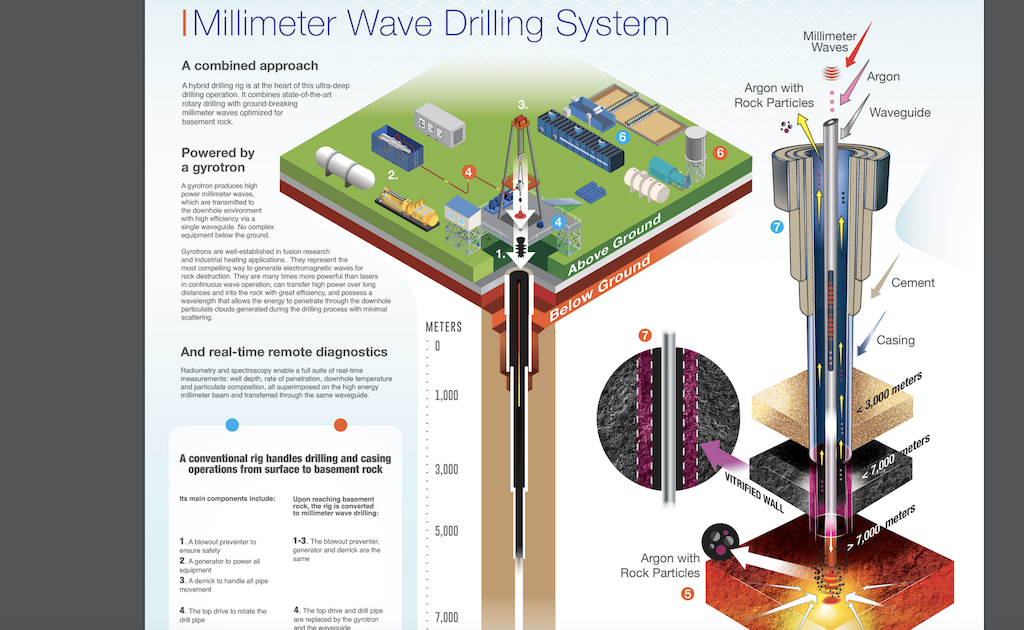
The hard part is digging the wells, but that seems trivial compared to Quaise, who’s trying to dig 3-20km wells. The Deep Fission wells can just go anywhere (perhaps next to a disused former coal turbine?).
by baron816
6/24/2026 at 11:25:11 AM
> They’re digging one mile (1.6 km) holes dropping low enriched nuclear fuel to the bottom, and filling them with water.> When the fuel is used up, they can leave it where it is since it’s below the water table.
To do both, they’ll have to guarantee that that column of water stays isolated from groundwater for a long time after the fuel is used up.
Reading https://www.deepfission.com/faq, they answer that question with
“Importantly, the mile-deep column of water in the borehole is expected to provide the pressure conditions required for safe reactor operation. Water within the borehole is also intended to contribute to the reactor’s thermal management system”. So, what do they do if their drill hole starts leaking, and they lose pressure?
and
“Our boreholes are expected to be lined with multiple layers of casing, including steel casing and concrete intended to maintain structural integrity and isolate surrounding geological formations”
I don’t think those are good answers. They say what they want to do, but almost nothing about how they’ll do that, and try to avoid making hard statements on the what by using “is expected” and “is intended”.
by Someone
6/24/2026 at 3:09:30 PM
What a waste of perfectly good reprocessing input. "Spent" convention nuclear fuel retains 95% of its energy. Discarding "spent" fuel is a shamefully profligate energy practice we can get away with because we're using not nearly enough nuclear power, making and virgin fissiles are dirt cheap.by quotemstr
6/24/2026 at 12:06:48 PM
> To do both, they’ll have to guarantee that that column of water stays isolated from groundwater for a long time after the fuel is used up.I wonder if just letting the water gradually dissolve the uranium might not be fine, actually. If it is done far from wells and rivers used for drinking water, then the small amount of radioactive minerals that slowly seep out might not pose a danger. I can't find any studies to back it up, but I imagine there are places on Earth at which enriched uranium buried 1.6km underground poses no threat. I am no expert, so I would love to hear what others think.
by Asooka
6/24/2026 at 2:03:49 PM
Of the all the radioactive elements in a nuclear reactor, uranium is one of the least dangerous (is very weakly radioactive, but it's toxic, it's a heavy metal). It's all the radioactive fission products (many have short half-life and in process of decay produces lot of ionizing radiation) and trans-uranic elements (because they have very long half-life and produce a bit small bits of ionizing radiation for very long time).One possible of measure of danger is median lethal dose LD50:
Uranium LD50 in mice 114 mg/kg (about the same as Cocaine LD50 96 mg/kg)
Plutonium LD50 in dog 320 μg/kg
Caesium-137 LD50 245 μg/kg
Polonium-210 LD50 10 ng/kg (estimated)
https://en.wikipedia.org/wiki/Median_lethal_dose
There are places underground with high concentration of uranium, they are called uranium ore and sometimes they are mined for uranium.
"The deposit is located at depth of 450 m (1,480 ft), surrounded by and isolated within a layer of water-impermeable illite-chlorite clay, within the Athabasca Sandstone formation. Its age is estimated to be 1.3 billion years. Due to natural containment and lack of any traces of radioactive elements on the surface, the deposit is used as an example of an effective natural deep geological repository."
by leonidasrup
6/24/2026 at 11:37:35 AM
>I don’t think those are good answers.Steel and concrete are what we use above ground so.....
>They say what they want to do, but almost nothing about how they’ll do that, and try to avoid making hard statements on the what by using “is expected” and “is intended”.
They say nothing about how because those are trivial problems in the well (and oil) drilling industry.
by cucumber3732842
6/24/2026 at 3:20:05 PM
We use steel and concrete. We don't usually expect them to last 10,000 years, though.by AnimalMuppet
6/24/2026 at 10:22:19 AM
I'm sorry, I've worked in advertising for much of my life, and I just can't get past the top line "Advanced Nuclear for the AI Era". That reads as an extremely desperate or opportunistic marketing pitch to me. Kind of like when you get a brochure for a condo in a high rise that will never be built...except even more shameless?by noduerme
6/24/2026 at 10:58:03 AM
I think it’s a nod to the idea that AI is set to boil off the oceans unless some seriously novel ideas about power generation take hold.by hyperbovine
6/24/2026 at 10:44:06 AM
They kind of have to shoehorn “AI” in there have any hope of raising capital these days.by mjhay
6/24/2026 at 10:41:32 AM
Probably because AI datacenters would benefit from tech like that.by veltas
6/24/2026 at 9:04:25 AM
Create a small sun a mile under the ground, what could go wrong?Also the actual article it seems has nothing to do with fission, they are focusing on extracting the heat already down there. "superhot rock needed for next-generation geothermal power"
by trashb
6/24/2026 at 10:04:27 AM
There many kinds of geothermal power and if you don't have access to hot fluids found naturally in basement rock, you have use hot dry rock geothermal energy.https://en.wikipedia.org/wiki/Hot_dry_rock_geothermal_energy
Here the biggest obstacle to economy of the geothermal power is the very low heat conductivity of rock.
"The conductive heat flux averages 0.1 MW/km2. These values are much higher near tectonic plate boundaries where the crust is thinner. They may be further augmented by combinations of fluid circulation, either through magma conduits, hot springs, hydrothermal circulation. "
https://en.wikipedia.org/wiki/Geothermal_energy#Resources
For comparison: Thus the solar energy arriving at the surface with the sun directly overhead can vary from 550 MW/km2 with cirrus clouds to 1025 MW/km2 with a clear sky
by leonidasrup
6/24/2026 at 9:31:53 AM
The sun performs fusion, not fission.by da-x
6/24/2026 at 1:06:35 PM
This echoes 'safe fracking' claims - and now many people in proximity have gas coming out of their facets. Digging hazardous materials out of sight into a potentially unstable or potentially becoming leaky structure is never a sound strategy.by mentalgear
6/24/2026 at 3:14:08 PM
>They have the absolute simplest model for nuclear fission that I can imagineAgree. What I don't understand is: why has it never been done before? They can't possibly be the first to come up with this idea, which doesn't seem to rely on any novel technology.
by Dibby053
6/24/2026 at 5:46:57 AM
That sounds like an absolute nightmare to get approvals for.by rgmerk
6/24/2026 at 6:49:38 AM
Quite the opposite. They use proven reactor tech, and they are now going straight to commercial, vs other startups that need to go supercritical first.by simonebrunozzi
6/24/2026 at 8:31:34 AM
I'm not sure that makes the approvals that much cheaper and easier. As I understand it, the slight differences between existing nuclear power plants that are for the most part the same design is already one of the reasons why they are so expensive to build.by rcxdude
6/24/2026 at 9:37:34 AM
Building nuclear power plant underground could save significant costs, because the massive containment building is made from nuclear grade steel and nuclear grade concrete and is very expensive. But you need a low cost excavation technology.https://ifp.org/nuclear-power-plant-construction-costs/
"Nuclear-grade components don’t necessarily have higher performance requirements than conventional components. Reinforcing steel in nuclear-grade concrete, for instance, is the same material used in conventional concrete. Instead, the additional cost often comes from the additional documentation and testing required. Documentation requirements also increase costs indirectly, by reducing market competition among manufacturers. Because these requirements are difficult for manufacturers to implement, many simply don’t bother to manufacture nuclear-grade components."
"Sources of Cost Overrun in Nuclear Power Plant Construction Call for a New Approach to Engineering Design"
https://www.sciencedirect.com/science/article/pii/S254243512...
"Similarly, while our analysis identifies the rebar density in reinforced concrete as the most influential variable for cost decrease, changes to the amount and composition of containment concrete are constrained by safety regulations, most notably the requirement for containment structures to withstand commercial aircraft impacts. New plant designs with underground (embedded) reactors could allow for thinner containment walls. However, these designs are still under development and pose the risk of high excavation costs in areas or at sites with low productivity."
by leonidasrup
6/24/2026 at 6:12:55 AM
It's an extremely stupid idea. Your whole water column is going to be contaminated with fission products. And you won't be able to get any reasonable amount of power out of that contraption.And even if you are stupid enough to actually do this, the fuel efficiency will be terrible. Your only negative feedback for fission is the Doppler effect and thermal expansion. So you will only be able to utilize a tiny percentage of the fissionable materials.
by cyberax
6/24/2026 at 8:27:41 AM
Would the fuel efficiency be sufficiently bad to make the fuel costs relevant to the cost of running the plant, though?by rcxdude
6/24/2026 at 4:23:42 PM
Yes, it would. Fuel is around 2-4% of the total costs for a regular nuclear power plant, but that's because regular reactors can burn it deeply. This reactor will only burn a couple of percents of the available fuel, so the fuel costs will probably be around 10-20 times higher.BTW, this tradeoff can be acceptable for some very specific applications. Kilopower ( https://en.wikipedia.org/wiki/Kilopower ) is designed to use passive regulation.
by cyberax
6/24/2026 at 8:50:04 AM
The water column is isolated fron the fuel. The weight of the water column just allows for a cheaper enclosure.by UltraSane
6/24/2026 at 11:29:02 AM
Presumably once you are finished with it you could just fill it with concrete.Or partially fill it and drop another reactor on top.
The only projects that overrun more than nuclear is nuclear waste disposal. This kills two birds with one stone.
by tonyedgecombe
6/24/2026 at 4:24:33 PM
So it's a regular reactor BUT IN A MINESHAFT!! The reactors yearn for the mines!It's even _more_ stupid!
by cyberax
6/24/2026 at 5:39:25 PM
No. Being at the bottom of a mile deep hole in bedrock makes a very effective isolation.by UltraSane
6/24/2026 at 6:15:21 PM
Isolation from _what_? If you reactor melts down, it will contaminate the water column above it. And by having it inside the shaft, you won't be able to do any maintenance on it.It's a stupid idea designed to filter out investors who are stupid enough to fall for it.
by cyberax
6/24/2026 at 6:09:55 AM
below and penetrating the water table with the potential for short and long half-life transuranic fissile products and a path of least resistance for any runaway conditions which is directly to an uncontained well head... with the extra bonus of installation proposed in 'spent' hydrocarbon bearing regions which implies reduced density substrates with all the tiny seismic outcomes and risks.perfectly safe /s
by notrustincloud
6/24/2026 at 11:48:07 AM
I greatly dislike this sort of "doesn't work perfectly everywhere by default therefore doesn't work" take. The steam engine didn't replace all the mules at once.It should be pretty trivial to pick and choose geologies and depth where it is safe. Maybe that's a lot of places. Maybe that's a few. But it should be trivial regardless.
by cucumber3732842
6/24/2026 at 6:13:57 AM
We can then build a primary school on top! And use the water from the well for heating directly.What could possibly go wrong!?!?
by cyberax
6/24/2026 at 10:15:15 AM
For example in Finland there is research done for nuclear district heating.https://www.world-nuclear-news.org/articles/fourth-finnish-m...
"Feasibility of small modular reactors for decarbonizing district heating systems: a case study of the Helsinki metropolitan area"
https://www.sciencedirect.com/science/article/pii/S002954932...
Haiyang’s District Heating Project in China
https://www.iaea.org/newscenter/news/carbon-free-heating-kee...
by leonidasrup
6/24/2026 at 6:12:16 PM
The USSR built a nuclear district heating system in Gorky (now Nizhny Novgorod) but never commissioned it because of the general anti-nuclear sentiment at that time.It's certainly possible and not even very hard (by nuclear standards) because the reactor can operate at ambient pressure.
The biggest issue is inefficiency and cost of district heating except for places like Finland. It's now cheaper to install heatpumps instead.
by cyberax
6/24/2026 at 9:29:00 AM
Omg there are things that can go wrong? We should definitely not build it then, do we even need energy anyway?Seriously, what's wrong with the world is people who go "omg what about the one in a million chance the water table is damaged" when right now Europe is dying from the heat that centuries of burning fossil fuels has caused.
by stavros
6/24/2026 at 10:19:58 AM
We don’t need any new and untested technology to solve to stop spewing out greenhouse gases. We just need to scale up current green tech. It’s not know how and technology that is lacking, it is political will.by Ma8ee
6/24/2026 at 10:29:40 AM
If by "we" you mean the whole world, then we have to do a gigantic scale up of the current green tech, as current green tech produces on minuscule part of the global primary energy.by leonidasrup
6/24/2026 at 10:27:25 AM
"We don't need to research any more potential solutions to this existential problem we're facing" is certainly a take.by stavros
6/24/2026 at 1:27:15 PM
I don't say we shouldn't do research. What I do say is that we do have all the technology we need. And more importantly, we don't have the time to wait for some future technology that potentially could solve all our problems. The climate disaster has already started (and this [0] is not "the new normal", this is just the beginning, a hint of what we should expect).The only reason we are in this shithole is because of the lack of political will. It would have been comparable trivial to solve if we just had started 30 years ago when scientists started to yell about that it was getting urgent.
[0] https://www.theguardian.com/world/live/2026/jun/24/europe-he...
by Ma8ee
6/24/2026 at 2:31:30 PM
We don't need new technology, it took France only about 20 years to replace it's coal and oil based electric generation with nuclear power generation (between 1976 and 2000).Because of lack of political will in US and many European countries we continued to burn fuels to generate electric energy.
https://world-nuclear.org/information-library/country-profil...
Developing countries like China and India prioritized cheap coal power generation.
by leonidasrup
6/24/2026 at 1:53:55 PM
Only if the primary school is exclusively for the children of oligarchs.by CuriouslyC
6/24/2026 at 8:51:02 AM
The nuclear fuel is contained inside a reactor vessel. The water pressure just allows it to be much cheaper.by UltraSane
6/24/2026 at 9:28:12 AM
Page 7 looks like a single point of failure in an unmaintainable device that would result in a well of contaminated water a mile deep that passes through the water table that could never be fixed.This sounds like the worst idea I've ever heard.
by willis936
6/24/2026 at 11:54:07 AM
Also, I want to add on that if you lined the well to be single fault tolerant you will still be vulnerable to a high likelihood common mode failure from a single seismic event. Truly just the worst. The founders should pivot hard and fast.by willis936
6/24/2026 at 12:53:28 PM
There are plenty of places with very little seismic activity.by UltraSane
6/24/2026 at 12:58:05 PM
And how many of those places have we dug 100 mile deep holes in and verified nothing has changed? It doesn't take a long look at fracking research to see that this line of reasoning doesn't hold.by willis936
6/24/2026 at 5:24:20 PM
100 miles deep? What are you even talking about?by UltraSane
6/24/2026 at 11:37:09 AM
Yeah, 76cm (30 inch) bore hole drilling with standard oil&grass rig.Fill with unshielded nuclear reactor of novel type: super skinny.
Gently lower down until depth of 1 mile is reached.
Repeat 1000x for a 1 GWe power plant.
What could possibly go wrong? Best horror story of the year in 15 slides.
by synctext
6/24/2026 at 12:54:58 PM
Please explain exactly what you think can go wrong.by UltraSane
6/24/2026 at 1:32:13 PM
Seismic activity collapses the well, trapping the nuke underground, pressure find a way to escape via polluting a "faraway" aquifer, or it doesn't escape and you have a man-made volcano in the worksby pphysch
6/24/2026 at 5:40:44 PM
Not a plausible scenario. The entire point is that by putting these a mile deep that they will self seal if they meltdown. They can't create a volcano because they are only 15MW. If the reactor cracks the radioactive fuel can only contaminate the water at the very bottom of the shaft because it is a mile deep.by UltraSane
6/24/2026 at 7:23:51 PM
I thought the whole point was that the reactor would deliver heated water to the surface for utilization...? But it will magically stop trying to do that if the main shaft is obstructed and there is a separate egress?Or are you also burying the turbine and power lines a mile deep?
by pphysch
6/24/2026 at 12:52:19 PM
A mile is much deeper than the water table is almost everywhere. It is normally solid bedrock. So you can just fill the hole with concrete and dirt.by UltraSane
6/24/2026 at 12:56:29 PM
How does this look in practice? You need the water to transfer the heat, so in response to a disaster that has already poisoned the water table you need to extract the water, put it somewhere, and backfill with concrete, all while you've already poisoned miles of water table and fighting from spreading further and damning all workers involved? For what gain?by willis936
6/24/2026 at 5:42:04 PM
How exactly will it poison the water table? A mile is in bedrock much deeper than the water table and any radioactive material will stay at the bottom because it is heavy.by UltraSane
6/24/2026 at 6:01:49 AM
What are the side-effects of regularly detonating nuclear bombs at that depth?by noja
6/24/2026 at 7:28:04 AM
https://en.wikipedia.org/wiki/Underground_nuclear_weapons_te...seems it usually happened at lesser depths, and for ones deep enough to contain debris, the main effects were geological, from the actual explosion? not what i expected tbh
by throawayonthe
6/24/2026 at 8:28:15 AM
I'm not sure how this question would be relevant. Nuclear bombs are impractical for power generation and a nuclear reactor is not ever going to turn into a nuclear bomb.by rcxdude
6/24/2026 at 9:43:17 AM
"Project PACER, carried out at Los Alamos National Laboratory (LANL) in the mid-1970s, explored the possibility of a fusion power system that would involve exploding small hydrogen bombs"by leonidasrup