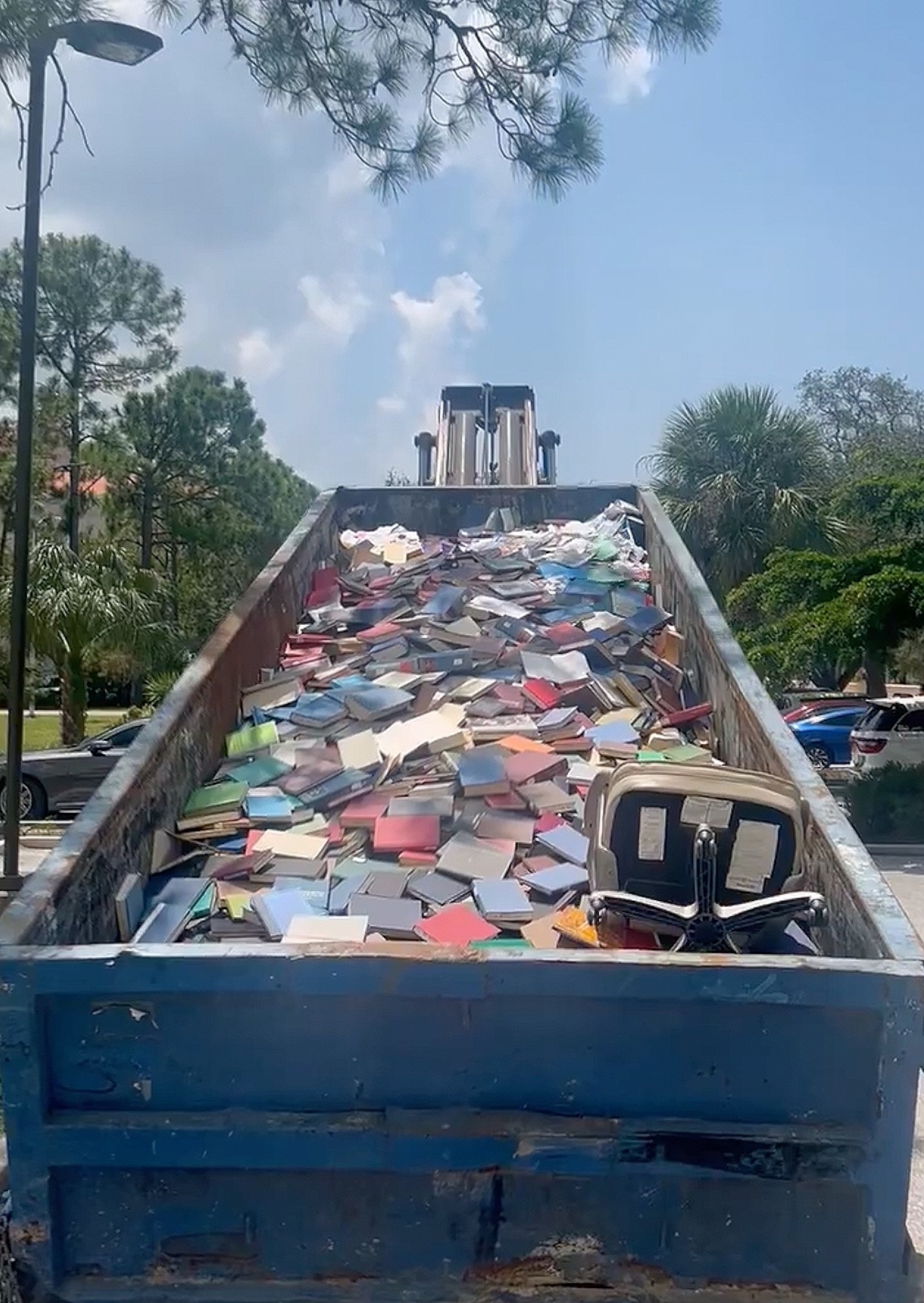
6/12/2026 at 4:19:51 PM
My first thought is how accessible these books are. If a book hasn't been checked out in years, and there's another library in the interlibrary loan network that has a copy, there's no practical reason to keep another copy. If you can request a book and have it arrive in a few days, that's not an issue in any real sense, especially for books that nobody is checking out in the first place.I used to work in a library, and this was often the case. Our basement was stuffed to the gills with romance novels that nobody was reading anymore, mysteries published decades ago, and kids books that probably related to kids from a previous generation more. A yearly sale would see the collection trimmed. Almost across the board, you could still get those books through interlibrary loan. If not from the county network, from another library in the state. In my time, I never heard of anyone missing a book that had been disposed of.
by bastawhiz
6/12/2026 at 4:26:36 PM
40 years ago, my public middle school would periodically pick books that weren't checked out for a couple decades. They'd rubberstamp "discard" over the library's ownership mark and put them in a pile that said "free books" with the implicit declaration that those books were headed for the landfill.I ended up with a nice selection of books on nuclear energy and radioactivity including a nice non-fiction Asimov book on the neutrino and particle physics.
Libraries are always filled to the rafters. The only way to fit new books in is to take old books out. If they didn't, they would only ever have books from the 1940s when they first built that library.
by fhdkweig
6/12/2026 at 4:48:49 PM
I picked up a fun university library discard the other day (month). This one is about Lunar geology. The concept of the book is so inspiring to me: "it's 1975, we brought home a lot of samples from the moon now; so what did we learn". It was fun to look through that one - a snapshot of a very exciting time.(Taylor, Lunar Science: A post-Apollo view)
by kzrdude
6/12/2026 at 6:58:10 PM
Yeah, this part of the article made me sad:> a state university’s property, even if it’s been deemed trash, cannot be transferred to private individuals.
What a waste! Sure, allowing something like this could (and probably would) be abused, but I think the waste is worse.
I'm glad your middle school was able to do what they did!
by kelnos
6/12/2026 at 7:24:00 PM
I wonder if they could have transferred it to a separate nonprofit, and then that nonprofit has no restrictions on whom it is transferred or sold to?by eutropia
6/12/2026 at 11:16:43 PM
Many libraries have a Friends organization that receives books culled from the library's collections. https://en.wikipedia.org/wiki/Friends_of_LibrariesThe Friends are a separate nonprofit from the library, usually run by volunteers. They can also accept donations from the public, keeping books out of dumpsters. They organize regular book sales which are generally popular with the reading public. https://action.everylibrary.org/from_book_sales_to_big_impac...
If you think that books should be kept out of the landfill or the shredder, please consider starting a Friends group for your local library. https://www.ala.org/united/friends
National Friends of Libraries Week is usually the third week of October every year. https://www.ala.org/united/events_conferences/folweek
by e15ctr0n
6/12/2026 at 10:03:53 PM
One trick state legislatures hate!by cwmoore
6/12/2026 at 7:16:35 PM
My local town library has a book sale every fall and you can take away a paper bag of books for $10. It's not practical for every small library, in particular, to hold onto every book forever.by ghaff
6/12/2026 at 10:44:12 PM
They don't have surplus sales?I know the universe I went to did. Price it all at a penny each.
by themaninthedark
6/13/2026 at 2:31:48 AM
Even libraries that go to the trouble of doing this throw away probably a thousand books for every one they can sell.by etempleton
6/13/2026 at 1:54:09 PM
That depends on the structure and scale of the sale. Our local library sells most of the books at the biannual sales. Granted, many of those sell for very little; prices decline over several weeks so the things discarded wouldn't sell even for pennies.by pfdietz
6/12/2026 at 11:36:08 PM
they do and it's usually an auction but at a penny each is not worth the time to even post it. Also, not many people are buying old books unless they are collectibles. So more than just books go straight into the dump.by fhn
6/12/2026 at 7:46:00 PM
In the town where I live, surplus books from the library, and donated books, are sold twice a year over several weekends. As time goes on at these events the price drops, until on the last day it's $1 for a paper grocery bag full. Those that remain go into a dumpster for pulping and recycling.It's quite an event with long lines to get in and is loved by all. The money raised is used to buy more books for the library.
by pfdietz
6/12/2026 at 4:45:17 PM
That is what deep basement storage is for.A last copy policy will ensure that when one wants to compare a first edition of _The Fellowship of the Ring_ against a second, one can get the full weight of Aragorn's snark:
>What did you fear that I should say? That I have here a rascal of a rebel dwarf that I would gladly exchange for a serviceable orc?'
by WillAdams
6/12/2026 at 4:49:38 PM
Schools in poor towns don't have multiple levels or basements or even extra storage rooms. What you see is all you get.If there is enough space to have a room full of books, it would be better used as a publicly accessible set of stacks. The only real reason to have a librarian-only room is for books that are rare and valuable.
by fhdkweig
6/12/2026 at 4:56:14 PM
As I implied elsethread, the solution for that is better funding.Someone needs to take up Carnegie's mantle and finish the job which he began.
by WillAdams
6/12/2026 at 5:06:55 PM
You need a limiting principle or there is no limit to the "better funding" you're asking for until you have a Library of Congress in every small town in America, to no positive effect.What's the limiting principle you propose? It has to be something real libraries and library funding sources can take action on, because they have to take real-world actions on them. So this is not a time for aspirational speeches or vague exhortations to "do more", which is the exact opposite of a limiting principle anyhow. What is "enough"?
by jerf
6/12/2026 at 6:05:12 PM
The limiting principle should be that for a given ILL region/system, there is at least one copy of each book/edition which entered that system which can be loaned out.As I noted, it's a pain for me to have to drive down to DC to get access to a book which _used_ to be in the local library system, but isn't anymore, or to purchase my own copy (which wasn't previously necessary).
by WillAdams
6/12/2026 at 11:25:40 PM
> to no positive effect.This is a REALLY bold assumption you’re making here, and frankly until we’ve tried it I don’t think you can argue that it has no positive effect to put tons of books in every small town everywhere.
by throwaway173738
6/12/2026 at 5:07:53 PM
Most books are not worth saving.by bluGill
6/12/2026 at 6:50:23 PM
I used to work in a bookstore, and I've been working in libraries almost my entire career. Most books have no value. I've probably thrown out a million books in my life; most of them have been diet books, cook books, and political biographies.My current library is around 2000 square feet and I acquire around 1000 books a year, so I have to toss around 1000 books a year, because they're made of matter and take up space.
by S_Bear
6/13/2026 at 7:42:58 PM
It's a bit less of a thing than it used to be, but disposable books on technology were a thing for quite a while too. Think titles like "iPhone 6 for Dummies", "Learn Flash in 24 Hours", or "Windows 8 for Seniors" - there are a lot of books which were written (usually on the cheap) for a specific audience at a specific time, and which have no enduring value.Also along these lines: test prep and study guide books. Same deal really.
by duskwuff
6/12/2026 at 11:36:07 PM
Goodwill is a much more accurate slice of “what is published” than any library is.by bombcar
6/12/2026 at 6:59:53 PM
Sure, there are always solutions, and many of them usually involve more money. But that money usually doesn't just magically appear, even with plenty of Carnegie-types these days looking to whitewash their reputations through philanthropy. The money often is the problem that needs to be solved, and there's just no source for those funds.by kelnos
6/12/2026 at 7:35:21 PM
What's stopping you?by webnrrd2k
6/12/2026 at 5:50:08 PM
Someone can ask for a copy in the mail, cheaper than pre-emptively printing and storing thousands of copies of every version of every book.https://www.abebooks.com/servlet/SearchResults?ref_=search_f...
by gowld
6/12/2026 at 7:48:52 PM
Society is completely overloaded with a vast surplus of commercial property. Something can be doneby AtlasBarfed
6/12/2026 at 5:07:15 PM
That is what big national central libraries are for. Hopefully government funded libraries actually properly archiving everything printed in the country.by Ekaros
6/12/2026 at 9:33:02 PM
> That is what deep basement storage is for.That's what scanned books are for. Didn't google already scan them all? And then the book publishers shut that down?
by WalterBright
6/12/2026 at 5:23:23 PM
This is a brilliant observation, in regards to the first edition's depiction of Gollum.In the first edition, he was depicted as a large creature, and Tolkien was upset about it, and in the second edition, changed the description to small.
This information was gathered by a rare book seller who's videos I find immensely interesting.
by ForOldHack
6/12/2026 at 6:13:43 PM
A big problem with accessibility is that interlibrary loan is awful for browsing.I rarely go to a library to loan a specific work - I go there to find a work. This means going through dozens of potentially-relevant titles, taking them off the shelf, quickly browsing through them, and taking the one or two best ones home. This entire workflow becomes impossible if the book isn't readily available.
A book hidden in a box in the basement, or which arrives after only a few days, might as well not exist at all. I'm simply not going to scroll through a list, order several dozen books solely by their title alone, and come back a few days later (if this is even allowed at all): it's just not worth my time.
The whole "we keep a copy in a central archive" approach only works for historical purposes, not for actually making it available for reading. If you do that you have to also make digital scans trivially available for browsing - and in practice that rarely happens!
by crote
6/12/2026 at 8:32:42 PM
Whenever I am attending university, or live near one, I try to walk every aisle and every shelf at least once per year. Maybe things are much better these days, but all too often I would find books that were not in the card catalog (or cataloged incorrectly). The "adjacent shelf" method of research was one secret that grad students tended to learn.by Tangurena2
6/12/2026 at 7:20:14 PM
You're browsing for whatever piques your interest, and the library wants to curate the collection based on what people are interested in. The books that collect interest get placed on the shelves and the ones that don't get archived. If it's in the archive it probably wouldn't have interested you.by Cycl0ps
6/13/2026 at 12:29:10 AM
You say that but the author mentioned On Grammatology getting purged. That's a pretty important and influential book. It's a very difficult read which probably contributes to it not being checked out very often and it should definitely stay there.by sapphicsnail
6/12/2026 at 6:23:32 PM
Expecting libraries to maintain digital scans of every book they have had or anything to that effect is a little laughable. These organizations do more for communities with less money and you expect them do now navigate the legal and ethical quagmire of digital ownership because you can't handle knowledge and books becoming less valuable with time.If you are a software dev, go volunteer at a library and offer up your time to do this. Do something for your community, do something for yourself.
by elictronic
6/12/2026 at 7:32:33 PM
> If you are a software dev, go volunteer at a library and offer up your time to do this.You misunderstand the environment, "offering" doesn't work if the library haven't asked for help, in that case you're just ignored. You see, whatever you do for them would require participation and at least some effort on their side.
Some other organization could help here, but going to the library and begging them to let you help them is a non starter.
by bigbadfeline
6/12/2026 at 10:27:50 PM
Public libraries are public institutions and are controlled by towns and counties, in a few different common ways. To affect change in the town or county's library, you can participate in that process.by Blackthorn
6/12/2026 at 5:01:26 PM
Our basement was stuffed to the gills with romance novels that nobody was reading anymore, mysteries published decades ago, and kids books that probably related to kids from a previous generation more.This is hardly comparable to difficult philosophy books as mentioned in the article, though. To my mind, the poin of libraries is to house and make accessible difficult or challenging books that might not necessarily be popular. I was shocked when I first visited an American library and found large numbers of mass-market paperbacks and magazines. When I say 'large numbers' I mean 10 or 20 copies of books by Oprah or other celebrity authors. Librarians would have it that they're serving the community by making these books available in the library around the same time they're available in bookstores, ignoring the fact that once the publisher's marketing drive is over all those extra copies are going to be surplus. I do not understand why you would buy 20 copies of one book when you could have it and 19 other books.
by anigbrowl
6/12/2026 at 8:13:06 PM
My local library wasn't meant for academics, but the problem is exactly the same. In fact, I'd expect a library with those kinds of books to be more amenable to trimming the collection: you often don't have a romance novel in mind, you browse for one that piques your interest. I'd be surprised if anyone was actively browsing shelves for philosophy books that seemed fun. That's the sort of stuff you go to the card catalog for.> I do not understand why you would buy 20 copies of one book when you could have it and 19 other books.
Easy answer. Libraries know what their clients will check out. Often, because books are requested. If fifty people wait-listed the last big Dan Brown book, the library buys enough so that those people aren't waiting months to get their turn.
And yes, it's frustrating for librarians. Nobody likes buying lots of books that are not especially good. But that's literally the whole point of the library. Providing access to books that people actually want to read.
by bastawhiz
6/12/2026 at 10:45:16 PM
That actually is not at all why most American libraries were founded. They were very explicit about this and it was not so people would have fun books to read.If we needed public entertainment centers, then let's be clear what they are and advertise them as such. Personally I have no interest in the public funding of entertainment.
by Amezarak
6/12/2026 at 11:39:17 PM
[dead]by bombcar
6/12/2026 at 5:11:06 PM
Probably because there is demand. Could be that there was very deep waiting list at some point. Or there has been deep waiting list for specific author before. Fulfilling these demands does require multiple copies or it could take years for people to get popular book.by Ekaros
6/12/2026 at 5:28:25 PM
Sorry, I don't think popularity should be a factor in library decision-making. Extremely popular books driven by massive marketing campaigns predictably translate into the same book being available for only a few dollars months later. This all sounds like it's driven much more by the needs of publishers than library users; consider that the more reduced the selection, the fewer people will come to use the library because they can't find enough interesting material to read.My local Half-Price Books (a second-hand bookstore chain) has a vastly better selection than my local library.
by anigbrowl
6/12/2026 at 6:17:02 PM
This is a great way to lose what's left of public support for libraries. Going (more?) elitist is really not the way to go here. Your average person should be able to find utility in a library.University libraries of course might be a good exception to this rule. But your local public library should be a way to make reading accessible to the average middle to lower class family. And that means providing the materials they want to read - not what you think they should.
It's always going to be a balance for librarians. They don't get to operate in ivory towers disconnected from those local taxpayers whom fund them.
by phil21
6/13/2026 at 1:09:39 AM
Utility is in having a big selection of books. If a large chunk of the library is just multiple copies of previously popular books, then you are cutting people off from discover the range of books that are available. I would never have found authors like Stanislaw Lem or or Robert Heinlein as a teenager if it hadn't been for the library; the science fiction sections in bookstores at the time were clogged with movie adaptation novellas and mostly forgettable trilogies/franchise works.As a library-funding taxpayer myself, I find it very depressing that the selection in my local libraries is so lacking. Hence my remark about the vast superiority of second-hand bookstores for just about any topic.
by anigbrowl
6/13/2026 at 12:35:26 AM
> But your local public library should be a way to make reading accessible to the average middle to lower class family. And that means providing the materials they want to read - not what you think they should.It's pretty classicist to assume that only rich people are reading those kinds of books. I have plenty of friends who struggle to pay rent who read dense stuff like philosophy, lit. theory, etc. This whole David Brooks style paternalism drives me crazy.
by sapphicsnail
6/12/2026 at 10:49:32 PM
> This is a great way to lose what's left of public support for libraries. Going (more?) elitist is really not the way to go here.Why should I support a public entertainment center? The original American libraries were created to make valuable and educational works accessible to the public, not pulp. Library systems all over the country have discarded most of this stuff in favor of political, romance, mysteries and kids books. Abandoning their original mission is exactly why their public support has collapsed. Nobody cares about a place for homeless people to browse the Internet or to check out video games and movies.
> But your local public library should be a way to make reading accessible to the average middle to lower class family.
"Reading" is already maximally accessible, nobody needs a library to do this. Kids are reading reams and reams of web fiction. If anything, the increasingly low quality of library fare is related to the poor reading level of Americans generally - children's books have become especially atrocious, but even pulp mystery fiction is written on a very low reading level. “We have to get them to READ” is a completely pointless and meaningless goal if the public benefit is to keep up romance fiction publisher profits.
by Amezarak
6/13/2026 at 1:30:23 AM
Speaking of children's books being atrocious, more and more people are turning up examples of AI-generated books in libraries. I know Librarians aim to screen out this sort of stuff but they seem to be missing the mark. Part of the problem is that some publishers appear to mix AI stuff into their catalogs and some libraries are just buying based on the cover and summary text.https://www.reddit.com/r/antiai/comments/1rnjx1e/i_found_thi...
https://www.governing.com/artificial-intelligence/how-local-...
by anigbrowl
6/12/2026 at 9:16:32 PM
Yours seems to be an unpopular opinion. Perhaps you could partner with Bertrand Russell: <https://openlibrary.org/books/OL13524206M/Unpopular_essays>.I'm also reminded by an observation of the late Robert K. Merton, on latent vs. manifest functions. Originally coined in the context of sociology, but far more broadly applicable. In discussing these, Merton makes the perceptive observation that because latent functions are not immediately apparent, obvious, or significant, they represent a greater increment of knowledge and understanding than manifest functions, which are obvious, evident, easily understood and communicated, etc.
Popular works, or opinions, tend to be more accessible, yes. But they are also frequently a lower increment of knowledge or utility.
I too am pained by book and other information collections which pander to easy accessibility at a cost to insight and significance. That isn't to say that libraries should discount popularity at all, but I cringe when it seems to be the primary consideration.
By extension, other mass-context systems (markets, mass media, etc.) also tend toward minimum viable standards (often mis-stated as "least common denominator", problematic in several ways), and discount both long-term (non-obvious, non-apparent) benefits and costs.
by dredmorbius
6/12/2026 at 7:34:01 PM
> I don't think popularity should be a factor in library decision-making.How dare librarians... give the people the books they want to read???
by jubilanti
6/13/2026 at 1:35:10 AM
Well, I should have said the overriding factor, but my reasoning is that a lot of what appears to be 'popularity' is just the result of marketing campaigns by publishers, as opposed to the sort of enduring popularity that comes from being loved by readers (which can't be determined until some time after a book's release).That said, I would still prioritize variety over pure popularity. For example, I can see a library having 2 or 3 copies of all the Harry Potter books because people keep checking them out, but I don't think they need 10 copies.
by anigbrowl
6/13/2026 at 4:36:14 PM
And your sense of what books are truly quality is in no way impacted by "marketing" to you? Let me guess, are you one of those people who thinks that ads work on other people, but not them?Your idea of what makes a book good or bad is as much influenced by the marketing you are exposed to. You're just subjected to a different kind of marketing than the general public.
by jubilanti
6/13/2026 at 1:18:56 PM
It’s very simple: Because people go to the library looking for those books. If the library consistently doesn’t have the books people went there for, they stop going. If people stop going to the library, it eventually gets shut down.by ungreased0675
6/12/2026 at 5:43:30 PM
The point of libraries is to help people access the books they want. If someone wants Oprah's book then why should the library not help them access it? If a lot of people want it, then why should the library not stock many copies so that more those people can access it? They don't exist to gatekeep books and ensure people read whatever you think are the right kind of books.by wat10000
6/12/2026 at 6:52:05 PM
I have a bit of a problem with the all or nothing framing this discourse usually has. I think that libraries should make an effort to stock evergreen classics in addition to the recent, hot, and in demand. The new ones will be checked out a lot, then fall off, and then the library eventually gets a new batch of new hits.They do serve a lot of people with this method, but am a different cohort. If a library is to serve a diverse group of people it should also remember book snobs like me. When I visit my local library it is as if anything remotely classic is hidden in a secret area, you can’t find hardly any of them.
by bashmelek
6/12/2026 at 11:41:29 PM
The libraries actually do this, even if it’s not entirely visible or advertised- most librarians are rabid book-lovers and would love nothing more than to stock great books and similar.They just provide cover with the DVDs and the pulp.
by bombcar
6/12/2026 at 7:01:33 PM
I totally agree. People who want evergreen classics count too, and the library should do its best to ensure they can get the books they want as well. They shouldn't stock nothing but bestsellers, any more than they should stock no bestsellers at all.by wat10000
6/12/2026 at 7:26:43 PM
And, with the Internet (e.g. Gutenberg), evergreen classics are less of an issue. Speaking for myself, I've gotten rid of most of my books in the public domain unless they have other characteristics like illustrations that make me want to hold onto them.by ghaff
6/13/2026 at 1:43:48 AM
If a lot of people want it, it will be widely available through other channels. If you buy too many copies, you end up with what we see in many libraries, multiple copies of last/previous years' flavors-of-the-month that nobody cares about any more. Great for publishers who want to maximize library sales at $80/unit, not so great for readers who want a wider selections of books to choose from.by anigbrowl
6/12/2026 at 4:48:42 PM
That only works if all the libraries coordinate to determine which one will hold the last copy, and if the expense of moving such books around on request does not exceed that of storage.Given the number of books I've been unable to find when I wanted them save in the Library of Congress (which won't loan, necessitating a trip to DC, or finding and purchasing my own copy), and the number of times my ILL requests have been turned down, a last copy per system mechanism seems the best for preserving access.
by WillAdams
6/12/2026 at 5:19:23 PM
> That only works if all the libraries coordinate to determine which one will hold the last copy, and if the expense of moving such books around on request does not exceed that of storage.Yale, Columbia, Harvard, Princeton, and NYPL coordinate on exactly this https://recap.princeton.edu/
by rdmond
6/12/2026 at 8:16:53 PM
> That only works if all the libraries coordinate to determine which one will hold the last copy, and if the expense of moving such books around on request does not exceed that of storage.This is actually a mostly-solved problem in many cases. Many librarians have great SQL skills (or at least the ones I've met) and can query this easily. Most regional library systems have a centralized catalog. And the cost of moving books on demand is fixed: a van with one book and a van with fifty books costs the same to drive between branches.
Most colleges and universities have agreements with each other for exactly these systems and they're actively used. My partner considered completing his U Chicago PhD from San Francisco by way of the Stanford library.
by bastawhiz
6/13/2026 at 11:57:06 AM
You need to move those skills and agreements down to the smaller regional level.There have been numerous cases where I checked out a book, and later went to refer to it again and it was not just no longer in the stacks, but not available in the system.
by WillAdams
6/13/2026 at 9:53:44 PM
What books are you curious for that you're unable to find? I'm really curious about this as I, an avid horror book reader, have never had significant trouble even when buying very niche/indie work.by KittenInABox
6/14/2026 at 2:51:03 AM
Texts on typography, history, and folklore for various research efforts.It's not that I can't find them, it's that a couple were available locally, but aren't currently (due to being discarded) and the nearest copies are in the Library of Congress (which does not lend), requiring a drive. Mostly I've been buying them.
by WillAdams
6/12/2026 at 9:39:15 PM
Anyone remember this story about two librarians (hackers?) accused of creating fake borrowers in order to prevent books from being weed out? https://www.theguardian.com/books/2017/jan/06/florida-librar...by lgvld
6/12/2026 at 4:49:30 PM
I fear that the availability of e-books will lead to more libraries getting rid of their last copy, not just the penultimate one.by kzrdude
6/12/2026 at 8:09:10 PM
It seems like they just don't really plan inventory in a logical way but in a sort of rigid first in first out way. For example I just checked out a recent addition of a classical book, one of those original classical translations that were reprinted in the 2010s with some new forward I will skip over as the only thing different than the 1990 edition, or the 1960 edition for that matter.The library had probably 30 copies of this edition, most all sitting on shelves, while maybe 1 or 2 each of all other older editions. I'm guessing solely because this edition is "new" therefore they ordered a case of these books from the publisher when they came out whether there was demand for it or not, and the quantities of the older editions are much more likely to be matched to true demand of this book.
And eventually, they will have to destroy what probably 29 copies of this book in some years time.
Seems kind of stupid right? Why order such an excess of books?
Then I also wonder if they could sunset these quantities better. Rather than destroy the excess copy after I return it, maybe just let me keep it?
by asdff
6/12/2026 at 11:40:35 PM
> Rather than destroy the excess copy after I return it, maybe just let me keep it?This is pretty much what they do with children’s board books. Toddlers pretty much wreck any book you give them. But the library wants kids to learn to read. So they check them out and then they accept them back in whatever condition, no fees.
by throwaway173738
6/13/2026 at 8:05:26 PM
Eventually they will throw out the book though right? This is what I am getting at. Rather than throw out the book, give the last person who is getting to use it the option to keep it. Saves on incineration costs and hey maybe some would appreciate a book in whatever condition it is in.by asdff
6/12/2026 at 9:58:20 PM
"If you can request a book and have it arrive in a few days"That means two trips to the library. And it means you can't use the book that same day. This is fine for fiction, but not if you want a book because you're going to study it to aid your learning or your work.
If it's fine for a book to arrive in a few days why have a library with publicly browsable shelves at all?
by rahimnathwani
6/13/2026 at 3:40:27 AM
I live in Seattle and we have a fairly large library system.They have none of the fraggle rock books. A once huge series, now gone.
Same for the Mr Men series. Just may as well not exist.
My son very much enjoys my old fraggle rock books, but my library system apparently threw all of their copies away years ago.
by com2kid
6/13/2026 at 4:10:34 AM
Do you keep track of what was deaccessioned and compare that against ILL requests? Otherwise how would you know, unless you happen to remember all the books that have been disposed of?by goldfishgold
6/12/2026 at 5:19:21 PM
The Internet Archive accepts media they do not have on hand yet.Resources:
https://archive.org/want/?mode=donation_book
https://help.archive.org/help/does-the-internet-archive-have...
https://help.archive.org/help/donate-books-app-for-ios-and-a...
https://help.archive.org/help/how-do-i-make-a-physical-donat...
by toomuchtodo
6/12/2026 at 6:50:25 PM
and there's another library in the interlibrary loan network that has a copy, there's no practical reason to keep another copy. If you can request a book and have it arrive in a few daysI've done ILL in three major cities. The shortest time it took to get the books requested was 14 days. Some have taken over 60.
by reaperducer
6/12/2026 at 11:44:19 PM
There’s different levels of interlibrary loan - around here all the little local libraries can loan from each other in a matter of days (they ship to a central location each day). But they can also pull from a much wider distribution via media mail if needed.by bombcar
6/12/2026 at 8:18:15 PM
You can request a book from another library that's already checked out in some cases, which means you have to wait for it to be returned first. In my experience, a week is usually the norm.by bastawhiz
6/12/2026 at 7:29:25 PM
That seems like a very reasonable timeframe for a physical book. Certainly used to take longer than that to special-order something.by ghaff
6/12/2026 at 9:27:35 PM
In 1897 the US Library of Congress moved off-site from the Capitol building to an adjacent property. A key concern of its patronage (Congress itself) was how long it would take to retrieve books from this remote location.The annual Librarian's letter details the results: an unannounced test of five arbitrarily-selected works was made via pneumatic tube (later supplemented with a telephone), and the requested works arrived within 10m5s, 8m11s, 10m, and with the longest delay, 12 minutes from receipt of the request.
See p. 7 of the annual Librarian's Report: <https://babel.hathitrust.org/cgi/pt?id=mdp.39015036735044&vi...>.
One would hope that 2026 technolgies would be capable of results within at least the same order of magnitude, even at a greater physical separation.
One of my tremendous disappointments of today's Internet is the haste with which it delivers drek, but the reluctance with which it provides useful information, often for utterly outdated concerns with copyright. I'll note that HathiTrust itself, here the source of what was originally a public-domain US government publication, well outside any possible extant of copyright, still only permits one-page-at-a-time downloading of the original document.
by dredmorbius
6/12/2026 at 5:14:57 PM
I was walking down the street, and I saw a art/documentary style picture of a book seller, wearing a Fez, it seemed interesting, so I took a picture of it, and later fawned on it... until I realized that his books were on display, so I rotated the picture, and scanned the titles. There were three Greek tarot decks, which were interesting, and a book, that was about an old technology. I went to the library to see where I could check it out. No were in the city library, no where in the State University or State colleges, no where in the county collection... and then the librarian/Super-genius, suggested scanning the local library database, and found the book, in a small library, in the far corner of the state, and I filled out a form to request a two week loan... but two days to get here, and two days return, I would have the book for 10 solid days.When I got it, I read through it, solid for three days. Wow. Stunning look at a technology in its infancy.
The name of the Bookseller was Luma Kunda. Thank you Mr Kunda. I later learned from someone at the nearby bus stop, that Mr Kunda possessed an eidetic memory.
I would have loved to hear him tell stories about what he saw in the tarot cards.
by ForOldHack
6/12/2026 at 8:13:33 PM
You could have renewed that book though right? I haven't actually ever done an interlibrary loan but for "in network" books seems I can continue renewing them indefinitely until the end of time.by asdff
6/12/2026 at 5:25:14 PM
If you have a list of ISBNs (in a github gist, pastebin, or similar), I am happy to purchase any the Internet Archive does not yet have in their collection for long term preservation and eventual lending. Thank you for sharing.by toomuchtodo
6/12/2026 at 8:58:09 PM
I think librarians tend to become creatures-that-shovel-books. Librarians come to think of books as this sort of continuum, an ooze that they just pipe from one stack to another. Housing the books and following the proper procedures becomes the important thing, not the words on the pages.But that's completely the wrong attitude. Books are NOT all created equal. A schlocky romance novel is not equivalent to a book by Kierkegaard, or Vonnegut, or Plath, despite the fact that they are just a bunch of leaves between bindings with an ISBN stamped on the back.
So it's telling when the top comment on a story about professors fighting to save books from being carelessly thrown away is that there exists a basement full of romance novels. The narrator is faulty in this story.
by phendrenad2
6/12/2026 at 4:26:53 PM
And if you're lucky, your library may do frequent book sales!by calvinmorrison
6/12/2026 at 5:56:02 PM
>My first thought is how accessible these books are. If a book hasn't been checked out in years, and there's another library in the interlibrary loan network that has a copy, there's no practical reason to keep another copy.These libraries do not coordinate the deaccessioning. If it ever gets down to 2 copies, there's a non-zero chance that they will deaccession their copies simultaneously, and then there are none.
You worked for a library. Did they ever check first to make sure some other library had a copy? Did they warn that other library "we're getting rid of ours, please don't get rid of yours"?
by NoMoreNicksLeft
6/12/2026 at 6:53:00 PM
You’re so wrong.‘“I think some faculty worry that everyone is going to discard willy nilly and then before you know it there won’t be anything left,” Walker said. “No, libraries have gotten together, research libraries and others, and joined a consortium called LOCKSS – Lots of Copies Keep Stuff Safe – and people have agreements like Harvard is the place that will always keep a print copy of x. And there’s multiple ones of all of it. So there’s backup in case Harvard gets blown away by a nor’easter or something.”’
https://dakotastudent.com/wp-content/uploads/2019/07/Apr-10....
by ciscoriordan
6/12/2026 at 8:19:17 PM
> Did they ever check first to make sure some other library had a copy? Did they warn that other library "we're getting rid of ours, please don't get rid of yours"?Yes. They have a shared catalog. All of this is coordinated. It's literally the whole point of being a librarian.
by bastawhiz
6/12/2026 at 10:31:18 PM
>They have a shared catalog.Yes. I have my nose in it constantly. It's a fallacy to ascribe more coordination to this than actually exists. What mechanism is it that you think exists that would sound the red alert when the last library (or even the second to last) is about to get rid of the very last copy?
by NoMoreNicksLeft
6/12/2026 at 11:46:00 PM
> What mechanism is it that you think exists that would sound the red alert when the last library (or even the second to last) is about to get rid of the very last copy?Doesn't need much coordination. Before getting rid of a book, search for it in that shared catalog you allegedly have your nose in constantly. If you're the last or second to last copy, then you know. Unless two libraries are independently doing this at the exact same time.
by jubilanti
6/12/2026 at 5:15:04 PM
this sounds a bit different than a university library situationby timcobb