5/29/2026 at 2:11:29 AM
A question about prefab construction came up at a talk this year in Sydney with Lucy Turnbull (Former Sydney Mayor) and Alain Bertaud (planner and author order without design), Lucy mentioned someone tried this in Sydney and went under and they never heard from them again despite promising the world. Alain mentioned that tastes (think in terms of from finishes to floor plans) change often enough where prefabricating an entire house doesn't really make sense. Not to mention construction codes can change as well (I know in the US it can vary on a county level), they mentioned they saw more success with prefabricating components like windows or fireplaces or whatever.Something like a factory requires an intensive upfront captial investment, if tastes change often enough the process would need to be amendable to adapt to changing tastes.
Combined with that, I think the fact there is no uniform standards for acceptable floor plans, compliant layouts and construction codes across the different jurisdictions really makes it hard for there to be economies of scale.
> note I don’t think construction codes are strictly a problem within the US, there’s apparently a manufactured housing code. However planning controls are a seperate thing and possibly still an issue.
An example from Sydney (which likely relates to other jurisdictions) Outsides construction code, in Sydney there is a quasi instrument called the apartment design guide which issues requirements on floor plans, floorspace, how far a bedroom wall can be from a window in a bedroom, ceiling heights a lot of things that act as constraints on the possible layouts of a home, and I have no doubt some form of this exists in other jurisdictions as well. I imagine when there is so much variation in different legislative constraints in different jurisdictions there isn't really economies of scales as there are actually several different non homogenous market segments with incompatible set of constraints, and where there's overlap it may not be a high demand end product.
I don't think this as much of a problem but I imagine there are cases where some unionised construction industries may refuse to use work on site using prefab components. I haven't really heard of such cases so I'm not convinced this is a real blocker.
by akst
5/29/2026 at 2:19:18 AM
> think the fact there is no uniform standards for acceptable floor plans, compliant layouts and construction codes across the different jurisdictionsFTA: “Conventional homebuilding is subject to different building code requirements in different jurisdictions, depending on what version of the code has been adopted. But manufactured homes are built to one set of national requirements, the federal HUD code.”
by JumpCrisscross
5/29/2026 at 2:34:00 AM
Cheers I missed that… Updated my commentEven with that still leaves planning controls, which dictates a lot constraint’s on development. In some jurisdictions you can effectively have planning controls that ban some floor plans. Admittedly I’ve just heard of federal HUD maybe this is some unprecedented case where it overalls local government planning and state laws, though I think that’s unlikely, I do know there’s plenty of fragmentation of planning regimes.
Point being, you may be able to construct something and it to tick the construction code boxes, whether the building you can make with it is permitted under planning is a different matter. Which can implicit ban those buildings
For example the zoning code could limits the type of dwelling to something and that thing has a pedantic definition which unique to that jurisdiction, or there’s a combination of max floor space controls and height controls that makes off the shelf prefab components ineffective at making the most of the allowed building envelope. Or a jurisdictions could require design contests for buildings at certain sites or a certain area so it may not be a given you can even use available prefab.
by akst
5/29/2026 at 4:33:51 AM
"Manufactured home" probably isn't what you're thinking of.It's what we used to call a mobile home or trailer. They get around a lot of zoning restrictions because they aren't permanent construction.
by TylerE
5/29/2026 at 5:31:02 AM
I think you're right, I wrote my comment after skimming for stuff on planning and before getting the mobile home part. I hadn't considered trailers> The comment from here onwards is about Sydney specifically, so if you're not interested this is your chance to get off.
Unfortunately in Sydney Australia this is almost certainly also regulated https://www.planning.nsw.gov.au/policy-and-legislation/housi...
It seems if you want you're allowed to set it up on your own property, which is surprising reasonable for Sydney standards. Just no more than 6 months after which you need to make a permit, possibly make a development application or something as it may be viewed as a permanent increase in floor space which tends to be tied infrastructure levies and maybe rates (think property tax). You can't set it up in the middle of the outback without some kind of planning proposal to rezone it to permit it.
At least with NSW (the state Sydney is in) the criteria are likely consistent across the state)
In Sydney Trailers likely aren't subject to Development control plans (DCPs) but other kinds of prefab/manufactured homes definitely are. Here's an example of a DCP, here is an example one from Randwick (one of 20-30 councils sydney is compromised of): https://hdp-au-prod-app-rcc-yoursay-files.s3.ap-southeast-2....
It regulates room size relative to floor ceiling distance, solar and privacy impacts on adjacent sites, minimum privacy and solar inside the dwelling (such as the amount of sunlight during the least sunny hour of the least sunniest day of the year), setbacks, etc, etc. If its next a heritage item it can't mimic it, it also can't take attention from it, has to confirm with some abstraction notion of sympathy to the heritage item
by akst
5/29/2026 at 8:34:01 AM
This Czech company produces pre-fabricated wooden houses and is locally fairly successful.https://www.rdrymarov.cz/en/all-about-building
I witnessed this process with a friend, a freshly-happily-divorced doctor who moved away with her two kids and wanted a fast solution. Damn, they were quick. It took a few months to produce the components (they have a backlog), then something like 4 days to put together.
And the house is genuinely nice to be in.
by inglor_cz
5/30/2026 at 4:39:59 AM
One problem with prefab is that it isn't less expensive.https://www.construction-physics.com/p/the-elusive-cost-savi...
by anamax
5/30/2026 at 11:48:02 PM
Not disagreeing and the inability to obtain economies of scale like other manufacturing processes is part of the reason why.by akst
5/29/2026 at 8:10:45 PM
Idk, but it seems like you could attempt to use this argument for absolutely anything that is manufactured.Why do people buy manufactured cars instead of custom ones? Is it because they dont care or is it because a custom car would be 10x more expensive?
If they could actually manufacture a house that is 1/10th or less the cost but the tradeoff is its a little outdated or the layout isnt exactly what they want, i have a hard time beliving people wouldnt take that trade.
by anthonypasq
5/29/2026 at 4:21:45 AM
communist countries before 1989 did this en masse producing large concrete panels with each wall being basically one, they could erect apartment blocks very fast and build thousands of apartments, they also used unified prefab "core" for bathroom/toiletbut it's difficult to say how economical it would be in market economy since they did it in centrally planned economy
use translate https://panelaky.info/vyvoj_panelaku/
by Markoff
5/29/2026 at 9:24:15 AM
Paneláks work, in the sense that after the necessary fixes and improvements, plenty of people still live in them happily.Some comments from the Commie era, though:
* quality of work used to be shoddy in a legal environment where firing a drunkard was illegal and there were no competing firms. In a competitive market, this can only work if the people doing the building are reliable and competent,
* some level of personalization, if only decorative, goes a long way. If all the buildings look identical, it wears down on people:
https://historie.ovajih.cz/wp-content/uploads/2019/02/G-OS-K...
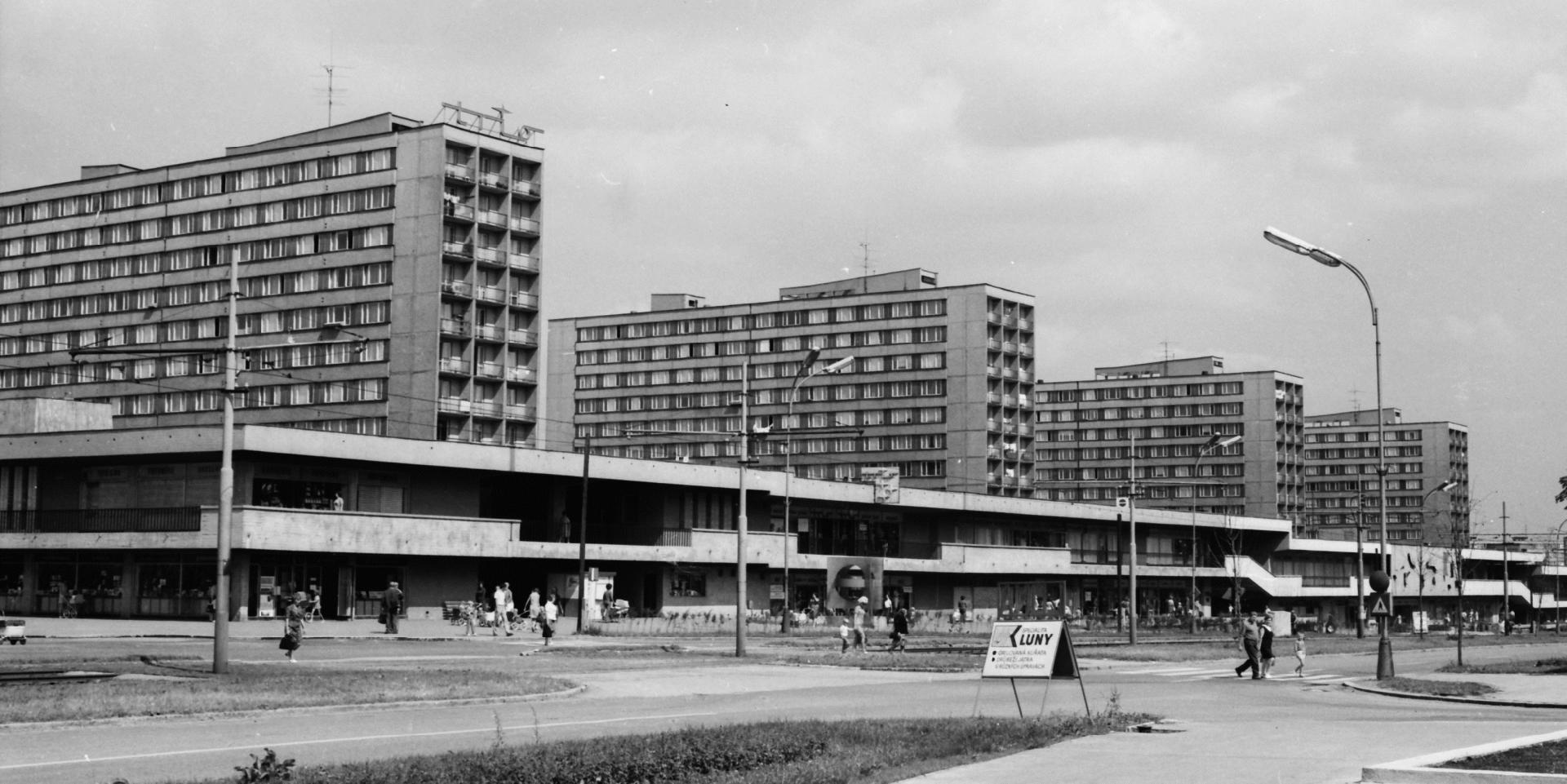
* you really, really have to think about how people will use the resulting architecture. Some such buildings had a lot of various empty corners and dead ends where people would piss and worse, thus developing an extremely disgusting smell.
by inglor_cz
5/29/2026 at 10:11:16 AM
I don't think quality of work actually improved that much, people like to bash these commie buildings, but when you look at new buildings it's not really much better. Now you have competitive market, but the result in race to the bottom (price) is the same, they jsut hire the cheapest Ukrainian and you will get the expected result.I have good examples, we had vote in our building who will upgrade our roof, we had offers for like 1.2M CZK, 1.8M CZK and 4-5M CZK, while they all had space specs, same warranty, I was the only one who voted for cheapest option, the rest of the people used logic "won't vote for the cheapest" option and the result was exactly as I expected, instead of the cheapest Ukrainians we paid 50% extra for very same Ukrainians doing the job under different company with bigger margin. Of course the roof which didn't leak before "upgrade" started to leak in my apartment, so much for the quality of work. When we asked them to fix it, they claimed it's leaking because of my A/C on the roof (which didnt leak for years before their "upgrade"), but 3rd party inspection confirmed they glued insulation wrong and surprise surprise after fixing it stopped leaking while nothing was done about my A/C. There was not a single Czech speaking person working on the roof since I could hear them shouting until very late and had to climb to roof at one instance when they kept working still around 9PM, why would they care when they go to dormitory without families...
Building across the road was fixing the roof as well, done by usual non-local suspects as well and the quality? Immediately after they "finished" their job I could see objects slowly falling from under the roof, which is now going on for years, but most of the residentof the building seem to not care or are unaware of this since it's empty wall without windows, which my kitchen window faces.
So yes, quality of work on panelaks was very inconsistent (there was no 90 degree corner in my bathroom/toilet when I was remodeling, my panelak has even concrete walls in toilet/bathroom unlike the cheaper prefab core in most newer panelak buildings, prefab with 90 degree corners would be in this aspect improvement), but so is quality of the work on new buildings by my experiences and I could add more.
by Markoff
5/30/2026 at 12:07:16 PM
I want to say from thousands of miles and an ocean between us, the roofing market is the same. Most contractors bid the work by hiring the same groups of people that have either low/no skill or are displaced/not exactly legal immigrants.I was able to hire a company that employed locals and you know what, the price was 25% higher, they took twice the time to finish, and the roof still leaked. I've had one fixed and now have another leak to get fixed. I won't let them back on my property.
Lol, the illusion of choice
by randochatter
5/29/2026 at 5:42:00 AM
Yeah these are definitely some of the more well known examples, these early communist countries tended to have a lot of state capacity so if there were such things like local planning controls and they got in the way of state priorities they were simply rewritten or appealed.The USA, and Australia actually use to have far greater state capacity.
Besides political will, the structure of institutions and distribution of authority in both Australia and USA act against the federal governments of either country enacting this.
by akst
5/29/2026 at 7:13:10 AM
Not only communist countries, Sweden had Miljonprogrammet[0] between 1965-1975, Wikipedia's page about it is a good read for more details:> At the time, the intention to build one million new homes in a nation with a population of eight million made the Million Programme the most ambitious building programme in the world. In contrast to the social housing proposals of many other developed countries, which is targeted at those with low incomes, the Million Programme was a universal program intended to provide housing to Swedish people at a variety of income levels.
I currently live in a townhouse built during that period, the house is from 1974, around me in the same neighbourhood there are many houses of the exact same floorplan. Each row has 4-5 townhouses, 3-4 rows are built around a central playground where each row faces each other, this pattern repeats spreading across a 2km stretch between two lakes and a forest, there are around 200-300 of these townhouses in the neighbourhood. Closer to the metro station there are higher density buildings, the low-density ones (like mine) are built on the edges of the suburb, still a short 10-15 min walk to the station.
They are all based on pre-fabricated concrete structures, the finishing varying a bit (wooden panels, different colours). Also they were built in a way to make renovations and reconfigurations easy, accessing utilities is straightforward and it was easy to upgrade my house's electrical systems to have many more outlets in different rooms than it was originally planned for.
I wish similar programs would be discussed these days, it was an effective way to improve the housing stock in a short period of time.
by piva00
5/29/2026 at 4:49:16 AM
This kind of capture the point tbh> For many sectors of construction, difficulty in achieving economies of scale could be attributed to the fact that only a small number of buildings of a particular type get built in the US each year. There were, for instance, only 10 skyscrapers taller than 200 meters built in the US in 2025
But so on production productivity generally, relating to that
In New Zealand Auckland they did a board upzoning in 2016, it was the largest metro governed under the same planning regieme, they allowed many dwelling types by right, and increased planning controls. Economist Matt Maltman did some research on construction productivity during this period
https://papers.ssrn.com/sol3/papers.cfm?abstract_id=5386023
His research (which showed productivity did increased) this is consistent with the idea the point above being productivity gains comes from the ability to repeat the same process over and over which was possible Auckland after they uniformly upzoned the city, after which most lots had higher zoned capacity than its existing built capacity (almost certainly with homogeneous allowed heights and floor space), allowing for this process of repeatedly building the same type of unit over and over. Matt has written more about construction productivity here in
https://inflectionpoints.work/articles/best-practice-for-sup...
Anyways if you'll note that the number of firms providing homes also increased, meaning the process of repeating construction over and over isn't isolated to a few firms. While the size of the industry almost certainly grew, the same number of builders likely were working more and more of similar buildings, and they are repeating similar processes over and over consuming similar inputs over and over.
- Those different housing projects due to some level of homogeneity will encounter similar hurdles where which creates a sufficiently large incentive and market for someone to sell solutions tailored to those problems which likely improves productivity (compliance is likely a big one).
- There was likely a greater rate of interaction of different people in these industries interacting with one another allowing for a greater distribution of construction related ideas, some more efficient than others. Think when you have a new coworker who introduces a new tool and suddenly every starts using, this process is able to happen more frequently.
- Likewise some of those inputs likely had an opportunity to efficient. Inputs from industries with fewer players would have been greater incentivised to sell as many units as possible and find ways to reduce their costs. If they performed price 2nd/3rd discrimination previously due to that market being insufficiently large relative others, they have an incentive to act otherwise.
by akst