5/17/2026 at 10:13:34 PM
It's not AI. Like the layoffs AI is a convenient scapegoat for the economy creaking to a halt, real world income across most sectors won't buy a house in the state where the job is. It's hate, but it's only "against AI" because AI is being trotted out why people can't get their first home until they are 50 if they are lucky..by Avicebron
5/17/2026 at 11:42:39 PM
I think that the creepiness of the tech CEOs that show up in media has a ton to do with this too, as they seem like cartoonish villians.Alex Karp, in particular, has some of the most absolutely horrifying clips of his TV appearances circulating all over video social media. But Musk has broader reach, and is even more oblivious and has tied himself to someone who he himself accused of pedophilia.
Andreesen, Thiel, Sam Altman, and the above are great at raising valuations for investors but they are doing it incredibly stupidly in a way that leads to massive backlash. California is voting for a billionaire tax this year, and I think that these tech CEOs only have themselves to blame for the backlash they are causing.
by epistasis
5/17/2026 at 11:48:35 PM
It might not be your intention, but your comment seems to imply that the problem here is more image than substance.The problem isn't that these people are simply inarticulate and incapable of expressing their views in ways that appeal to people. It's that their views are unappealing (if not downright objectionable) to most people.
by ElProlactin
5/18/2026 at 12:12:16 AM
Right on.It's a sign of how disempowered the populace is that these selfish ghouls don't even feel the need to pretend to be decent functioning adults anymore. Because, why bother? What is anyone gonna do about it?
by munificent
5/18/2026 at 12:01:17 AM
I agree fully with your second paragraph. But regardless of what the core ideas are, they way they have been presented has been abominable, and the politics is judged on the presentation, because the US media largely presents these words unfiltered and without context and completely along the lines of the message that the US tech CEOs want to present.by epistasis
5/18/2026 at 12:07:25 AM
It's both. A view people do not like, but are unaware of, is one they are not mad about.by xboxnolifes
5/18/2026 at 3:42:06 AM
I think you are both right. It is true that people only hate these people because of their actual views, but also it doesn't help that they made themselves celebrities and go on social media for attention.I bet you there are people equally repulsive and influential but face little public backlash because they never show up in front of a camera.
by pibaker
5/17/2026 at 11:58:31 PM
As I understand it, the last sentence stems from the fact that too large of a share of the total wealth is in the hands of those that don't benefit from more homes. AI is what's prioritised by them and what will lead to even smaller flow from the efficient wealth aggregators to those needing homes, once most of the simpler office work becomes obsolete, because, let's be real, average person's reasoning, work-pay efficiency, obedience and meticulousness shouldn't be too hard to surpass with AI in a few years. AI also makes it easier to prevent a change in status quo, while being harmful to the environment and decreasing the share of current-level-of-above-average-quality-user-oriented output.So yeah, money becoming less of a proxy of "how much someone contributed to society" and more "how much someone contributed to the oligarchs' goals", while those goals are for AI and for peoples' detriment, makes the situation actually about AI.
The technology that helps extract wealth improves, while most of the purely consumer-oriented products are becoming a con and a scam, especially if US companies are involved. The Mirabell's "original" recipe turned the best treat in the world into a generic candy, all are just palm oil + sugar + shrinkflation. There is also non-repairable tech with non-standard components, non-removable batteries, meat gets filled with water, washing machines die right after warranty ends, every digital service is trying to steal data instead of taking only the necessary or at least being transparent about what's taken and why, entertainment like Reddit and streaming services also get worse... AI slop is just another example, but a bit more visible and with a bit more side-effects.
by gljiva
5/18/2026 at 1:09:00 AM
> AI also makes it easier to prevent a change in status quoThis seems like the polar opposite of what the "AI safety" people are worried about and it seems unlikely that they could both be true at once.
> As I understand it, the last sentence stems from the fact that too large of a share of the total wealth is in the hands of those that don't benefit from more homes. AI is what's prioritised by them and what will lead to even smaller flow from the efficient wealth aggregators to those needing homes
These are both two independent things and two independent sets of people.
The main group of people opposing housing construction is landlords and existing homeowners. The ones doing AI have almost no overlap with that. Moreover, "you get paid less" and "housing costs more due to artificial scarcity" are only tied together in the sense that money going to landlords and banks isn't going to workers, which again isn't the AI thing.
Or to put it a different way, you could mitigate a lot of the "AI problems" by building more housing and the AI people would be pretty fine with that.
by AnthonyMouse
5/18/2026 at 1:07:44 AM
I remember reading about superstitious behavior in pigeons.You feed pigeons randomly, and if they happened to be standing on one foot when they got fed, they will associate that behavior with what happened. So they will stand on one foot while feeding.
In the same way, they economy goes bad, they might blame what they read about the government, or AI, or standing on one foot.
by m463
5/17/2026 at 11:49:40 PM
I have to wonder sometimes if the people of the US will ever realize that their housing shortages are self-inflicted. It seems like a massive number of people have somehow been hypnotized into thinking that building more homes increases home prices.by crooked-v
5/17/2026 at 11:55:39 PM
Its not self inflicted. It does have many causes, zoning being one of them, but the reluctance to build a they do in eg China is a problemby xyzsparetimexyz
5/18/2026 at 12:14:18 AM
By coincidence the United States isn’t the only country Great Britain, Ireland, Canada, Australia, and New Zealand have the same problem lack of affordability for people between 18 and 35 who can’t afford to buy a house/home.Notice that all these countries are English speaking countries? Aside from speaking English they also have lots in common when it comes to the way the economy and society is run. I can only speak for the United States, but I’ve noticed unfordable not luxury apartments going up everywhere and starter homes are not.
by Danox
5/18/2026 at 12:34:14 AM
> Notice that all these countries are English speaking countries?It looks more like you only read English-language news which is concerned about the happenings in English-speaking countries.
https://www.numbeo.com/property-investment/rankings_by_count...
These are current average houseprice-to-income ratios per country. The first English-speaking country on that list is in 87th rank.
by amiga386
5/18/2026 at 1:43:51 AM
The price to income ratio is influenced more by income than housing prices, because housing prices have a floor in terms of construction materials costs, and then countries in deep poverty are going to have a grisly ratio. For example, Cuba has some of the lowest housing costs in the world, but it's #4 on the list for worst price to income ratio. Nigeria is at #1 because their median income is $825/year rather than because they inhibit housing construction.The issue is, why does it cost several times as much to add a housing unit in the US as it does in Mexico? That can't be explained by the cost of lumber or copper since they're tradable commodities and if it was labor then prefabricated components should be driving down the price unless it's some kind of a racket. Which implies that it's mainly rackets and zoning restrictions.
by AnthonyMouse
5/18/2026 at 12:53:08 AM
The "average" is "median", correct?I suppose the message is that although housing (and health care and higher education) costs in the US (and elsewhere) have outpaced wage growth for the last half century or so, it could still be worse living in a country with much lower wages to begin with.
by musicale
5/17/2026 at 11:58:41 PM
Reluctance to build makes it a self inflicted problem, no?by LPisGood
5/17/2026 at 11:59:40 PM
It is absolutely self-inflicted. Most major US cities made the choice to massively limit dense housing construction through zoning and permitting in the 70s-80s, and then shifted into complete amnesia mode and/or active denialism about why population numbers were suddenly growing much faster than housing construction rates.by crooked-v
5/17/2026 at 11:19:08 PM
Right. It's not AI. It's the corporations behavior in relation to AI. But most people have no experience or interaction with AI outside of corporate services or AI features in things that shouldn't have AI or make it worse (like phone support). So in their lived experience all AI sucks and you can't blame 'em for that perception.But the real villains here are the same as ever, the most dangerous non-human persons: corporate persons.
by superkuh
5/18/2026 at 12:01:27 AM
People also hard slop imagesby xyzsparetimexyz
5/17/2026 at 10:25:50 PM
[dead]by black_13
5/17/2026 at 11:26:01 PM
Fortunately the complaints about the economy and homeownership are also just folk wisdom that doesn't really reflect reality https://www.cnbc.com/2024/09/05/how-gen-z-outpaces-past-gene...The economy, real wages, etc are basically higher than ever (despite idiot Trump's best efforts).
People are mad because being mad is fun and we're all on being mad machines 24/7.
by wilg
5/17/2026 at 11:28:51 PM
This has nothing to do with reality, where reality means "what people have", rather than "the economy".by happytoexplain
5/17/2026 at 11:34:36 PM
"What people have" is robustly measured, well-understood, and pretty much all available evidence suggests that people (at least in the US and developed countries) are doing better than ever on most important metrics. But it is not as seductive as "everything is terrible"!by wilg
5/18/2026 at 4:00:58 AM
> doing better than ever on most important metricsI'd say the most important metrics are those that matter to people, not those that other people say should matter to them. Births are going down, suicide is going up, but they're just drama queens, we ran the numbers... that is what turns mere criticism into hatred.
Less and less people own a bigger and bigger share of wealth, and they're too often not decent people who respect democracy and the fact that they're still just one person, not a particularly special one, and still only have one vote. No, many of them are not content with that, and have assaulted the people ever since they successfully fought for the few worker's rights they have now. That is bad enough, and not even close to the full picture. That "it used to be worse" in some metrics isn't relevant, what matters is now, how it is because of robber barons, and how it would be without them.
If someone steals most of your shit but leave you with more than "people used to have, on average, in historic times", you wouldn't be placated by that. Because, weirdly enough, you don't view yourself as a mere abstraction to be talked about that way, and billions of other people don't view themselves that way either.
by customguy
5/17/2026 at 11:58:08 PM
Home ownership being one of them? What about % of people turning to sex work (either in person or online) for income?by xyzsparetimexyz
5/18/2026 at 12:09:24 AM
Sorry to sound harsh, but you are out of touch. Many social metrics are very complex objectively and are not accounted for by "robust measuring", and this is the biggest example there ever was. Data is king where it can describe reality - but the elephant in the room is that data can't describe reality in some very high-profile societal contexts, and pretending it can is dangerous with a capital D.by happytoexplain
5/18/2026 at 12:13:48 AM
What are you relying on if not information about reality?by wilg
5/17/2026 at 11:59:54 PM
You are out of touch with realityby edgyquant
5/18/2026 at 12:24:46 AM
You will never break through the thousands of hours of doomer bullshit people are fed on TikTok all day. The post you first responded to, for instance, is talking about not being able to afford a home in the entire state they work in, which is obviously ridiculous, but it feeds the same "woe is me" bullshit from people whose only outlet for existential angst is now bitching about how poor they think they'll be in five years when they turn 18.by jmye
5/18/2026 at 1:32:49 AM
Some people are regurgitating social media. Most people are expressing the actual reality they are experiencing first- or second-hand.Give a shit.
by happytoexplain
5/18/2026 at 12:27:25 AM
Who are you going to believe? Your lying bank balance or statistics?by marcus_holmes
5/17/2026 at 11:29:23 PM
Where are you getting your numbers from because the stock market has ceased to be linked to reality for the last decade. Trump fired the stats and numbers office. The only numbers we have are "trust me" numbers which are completely false. Most people would agree that the economy has ground to a halt and everyone I know complains about the gas prices and grocery prices. The reality is there are a lot of people out of work that aren't factored into unemployment numbers because we can't accurately calculate unemployment numbers anymore.by reactordev
5/17/2026 at 11:35:35 PM
Whether most people agree is irrelevant to whether it's right. You can look at all kinds of numbers which are not the stock market to determine how well people are doing and whether things are getting better or worse. Your conspiracy theories about unemployment numbers are wrong.by wilg
5/18/2026 at 12:01:21 AM
The job market is objectively terrible, groceries are insanely expensive and people can’t afford to buy homes until they’re 50. Your attempts at gaslighting aren’t going to work anymore buddyby edgyquant
5/18/2026 at 12:27:12 AM
> people can’t afford to buy homes until they’re 50.Objectively bullshit. Good god. Get a fucking grip, speaking of "gaslighting".
by jmye
5/18/2026 at 1:34:20 AM
Don't speak to people like this.by happytoexplain
5/17/2026 at 11:16:44 PM
This seems to be a problem limited to specific metros. On the whole, Gen Z is more likely than millennials to be a homeowner at their age. Millennials in turn were more likely than Gen-X to own a home when Boomers were at that age. The idea that living standards and financial milestones have gone down for more recent generations doesn't seem to bear out, this Economist piece digs into detail: https://www.economist.com/finance-and-economics/2024/04/16/g...Hopefully non-logged in users can at lease see the income-by-age graph: https://www.economist.com/cdn-cgi/image/width=480,quality=10...

by Manuel_D
5/17/2026 at 11:28:48 PM
I thought that was nicely rebutted years ago..https://prospect.org/2024/05/14/2024-05-14-trendy-nonsense-g...
by Avicebron
5/18/2026 at 12:46:54 AM
The piece doesn't seem to refute the key claims made by The Economist, namely that Gen-Z has higher inflation-adjusted incomes than previous generations. It's biggest criticism seems to be:> The Economist piece and kindred articles are good examples of how to lie with statistics. You can show that the typical 25-year-old’s income outpaces boomers’ income when they were 25 only by failing to adjust for inflation and the rising costs of life’s necessities, or using averages rather than medians.
But the Economist did use inflation-adjusted median earnings in its analysis of incomes by age among different generations. The Economist cited the median after-tax income, adjusted for inflation. (https://www.economist.com/cdn-cgi/image/width=600,quality=10...) I'm not sure why this author seems to think that the Economist is failing to adjust for inflation or not using medians, when it says so quite clearly in their graphs.

The Prospect article also says that home ownership among under-35s has gone down, and links to data on the home ownership rates grouped by age (https://www.prb.org/wp-content/uploads/2020/02/a-02132020-ar...) but the data ends in 2017. The oldest of Gen-Z would only be 20 years old at the time this data ends. When we look at the Economist's wrote:
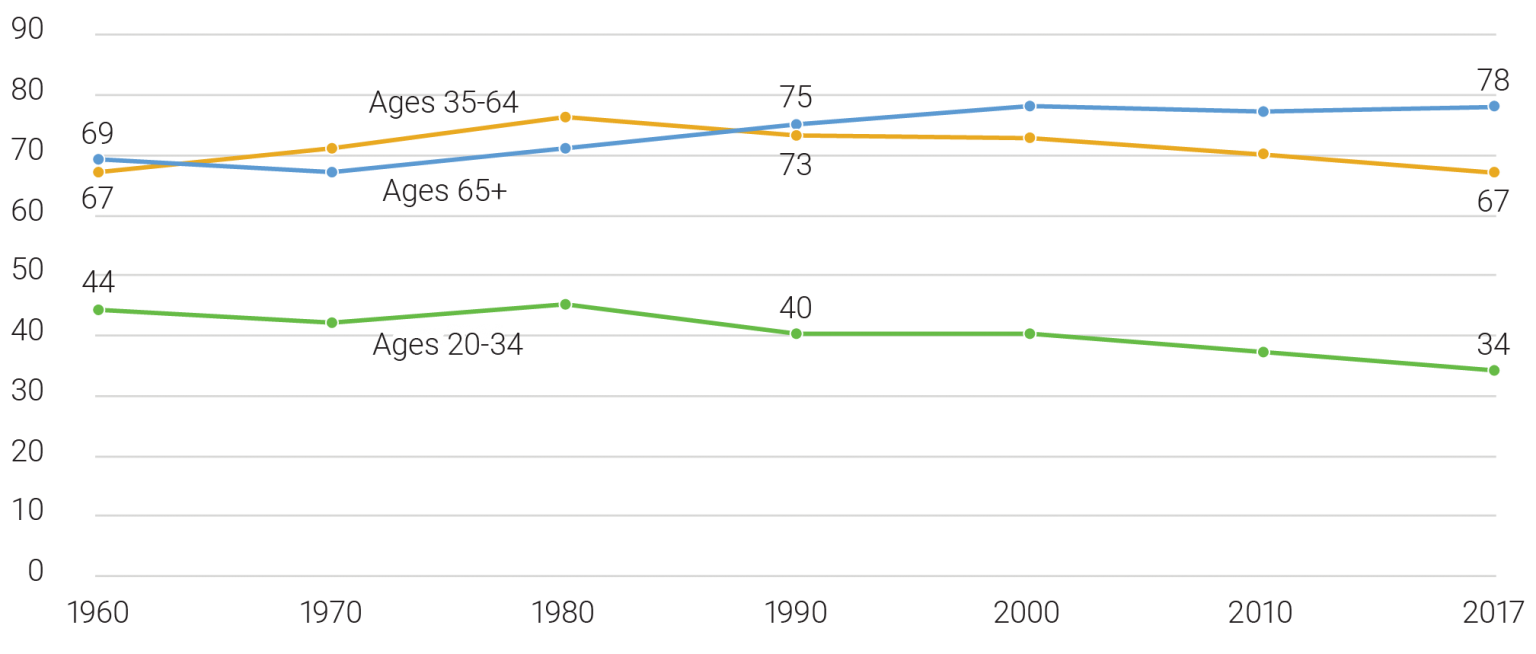
> Bolstered by high incomes, American Zoomers’ home-ownership rates are higher than millennials’ at the same age (even if they are lower than previous generations’).
A chart of home ownership rates that end in 2017 could not possibly refute this claim given that Gen-Z would be too young to buy homes around the time that the data's source ends. The home ownership rate among under-35s increased from 34% in 2017 to 39% in 2023 (https://www.census.gov/library/stories/2023/07/younger-house...), so when Gen-Z started to enter their earliest feasible home-buying years the ownership rate was in a period of recovery. The Economist's claims seem to bear out.
The rest of the piece goes off on tangents largely unrelated to the financial outcomes related to Gen-Z relative to previous generations. For instance, it cites a pew survey on the percentage of young adults that support their parents. But it does not compare that against earlier decades, so there's no evidence in any change in rate over time. In fact the bulk of the piece shares data that aren't relevant. E.g. how does the racial breakdown of the subprime mortgages relate to incomes by age and birth year?
by Manuel_D