5/8/2026 at 7:03:42 AM
Oddly, the article doesn't mention the most interesting part. Most scholars believe that Cyril and Methodius did not design Cyrillic, but instead something called Glagolitic.[0]Glagolitic very quickly got pushed out by what were essentially Greek letters. If you look at Bulgarian and Byzantine manuscripts from the time, they are almost impossible to tell apart, unless you know the languages.
The reason for that is pretty obvious if you look at the Glagolitic letters themselves: they are horrible UX. You need a lot more strokes than for something like Greek or Latin to record the same information. Because Glagolitic was contrived and not polished with use over the centuries, there was very little reason to use it over Greek.
-----
by Antibabelic
5/8/2026 at 8:48:06 AM
Cyrillic is probably a successor to Glagolitic. Glagolitic was the first Slavic alphabet, but when they tried to use it in Bulgaria, it had all the UX problems you mentioned. What they did is replace most of the characters with their Greek counterparts, while keeping the Glagolitic writing system and some of the characters with no counterparts. Bulgaria was close to Byzantium, and people were more likely to know and use Greek letters already. Nevertheless, Cyril and Methodius should still get some recognition, as the shape of the letters is not as important as having the system to write down the Slavic language into letters.by matusp
5/8/2026 at 8:57:32 AM
Bosančica, or Bosnian Cycillic is also an interesting take on this.by elAhmo
5/8/2026 at 7:31:52 AM
Interestingly, it was also a derivative of Greek, but the cursive version. It's harder to write, but apart from that, I like it. Ⱂⱃⰺⰲⰵⱅ, ⱂⰺⱎⰺⱅⰵ Ⰳⰾⰰⰳⱁⰾⰺⱌⰵⰻ!by culebron21
5/8/2026 at 7:41:59 AM
This is a novel claim to me. I don't think Glagolitic looks particularly like cursive Greek, and I haven't seen this idea in scholarship. What is your source for it?by Antibabelic
5/8/2026 at 7:55:44 AM
Селищев А.М. Старославянский язык, 1951, страница 39 https://maxbooks.ru/images/slavimg/52.jpg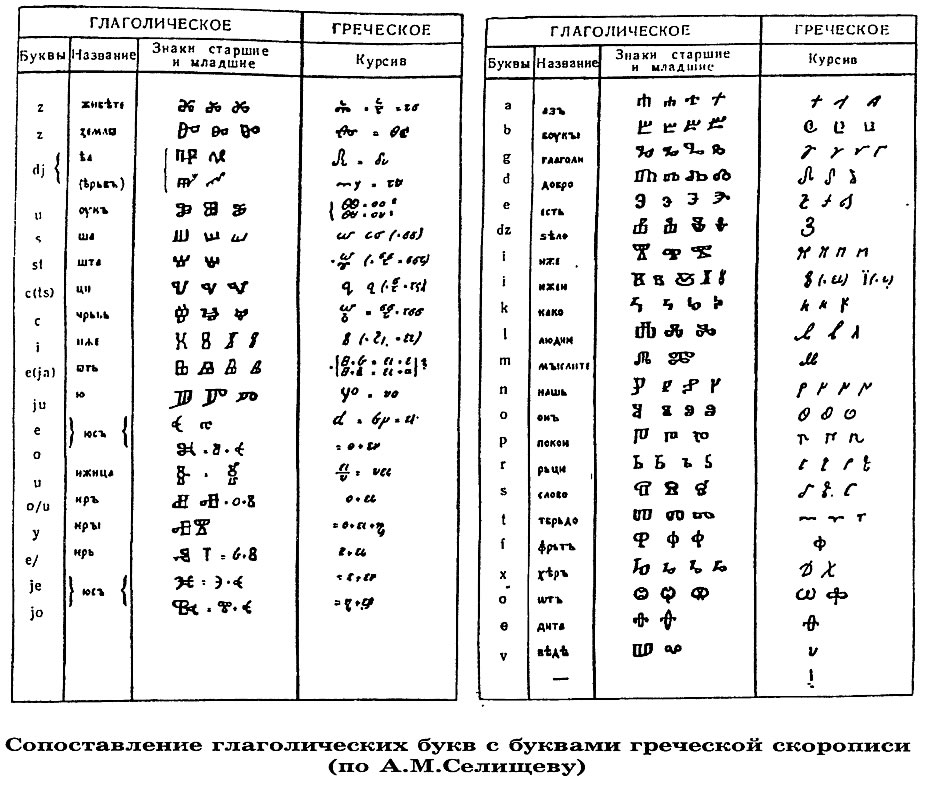
Selischev A.M. Old Slavonic Language, 1951. Page 39. https://www.academia.edu/126241874/%D0%90_%D0%9C_%D0%A1%D0%B... (PDF downloadable)
by culebron21
5/8/2026 at 8:02:10 AM
I guess I don't see this idea around because it wasn't good enough to survive the early 1950s? I am looking at the tables, and while I can see the resemblance in some places, it's quite a significant stretch in others. The fact that the Glagolitic and Greek examples are cherry-picked from different manuscripts with different styles doesn't help.by Antibabelic
5/8/2026 at 8:07:04 AM
Oh, I see. Good point, thanks.by culebron21