5/4/2026 at 6:33:47 AM
The power of money.I spent some time on legged locomotion back in the 1990s. It was clear then that you wanted torque control, and I did some work on the theory for that, trying to solve it from first principles, not machine learning. Got some nice theory and a patent out. But the parts just weren't there to build such things. As the article points out, the key to this is motor back-drivability. The final drive has to survive shock loads, and it has to dump forces into the motor, where the magnetic fields can take it. As I've quoted before, "you cannot strip the teeth of a magnetic field", a comment from early General Electric locomotive sales. (Locomotives are Diesel-electric, not Diesel with a clutch and shifting gearbox, because the clutch required is huge. Yes, it's been tried.) That's something few areas of engineering cared about, with the exception of aircraft flight control systems with mechanical backup.
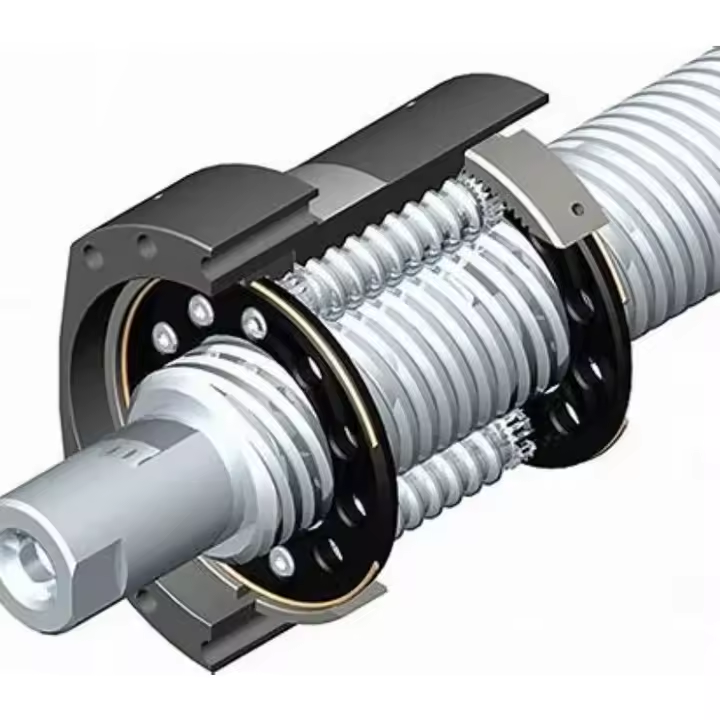
Pneumatic actuators looked promising, but proportional dynamic valves were big, heavy, and about $1000 each. Linear motors (not ball screws) looked like the coming thing back then, as 10:1 power/weight ratio had been achieved. But that technology never got much further, and Aura, the biggest player, collapsed in a financial scandal. Series elastic actuators were (and still are) a race between the spring compressing and the ball screw motor starting up. Hydraulics were too clunky; Boston Dynamics built a 400 pound mule, but the Diesel power pack never worked. Direct drive pancake motors were used by some SCARA industrial robots, but those were too big for leg joints. I thought someone would crack the direct drive problem eventually, but nobody ever did. We're still stuck with some gear reduction.
Some of the exotic ideas for muscles mentioned in this article go back that far. The McKinney muscle is old, and not too useful. There was some interest in electrorheological fluids, fluids whose mechanical properties change when an electric field is applied. That didn't become useful either. Shape-memory alloys were a dead end; liquid cooling can overcome the slowness problem, but not the inefficiency problem. Everybody went back to good old electric motors, although they became 3-phase AC instead of DC. It helped that the drone industry made 3-phase motors and their controllers small, cheap, and powerful.
Academic robotics groups were tiny. MIT and Stanford had less than a dozen people each. Progress required hundreds of millions of dollars for all that custom engineering and R&D. The level of effort just wasn't there. Nor would throwing money at the problem prior to machine learning have led to useful products.
It's impressive what's been accomplished in the last five years. It took a lot of money.
by Animats
5/4/2026 at 7:07:42 AM
Silly question maybe, but didn’t Boston Dynamics have videos of bipedal robots doing acrobatics / running ~7/8 years ago? Kinda looked like they “solved” locomotion thenby Fraterkes
5/4/2026 at 7:15:58 AM
Their approach required pre-computation and simulation before execution. If you watch their videos carefully, you can see the advance planning work on some of the screens.by Animats
5/4/2026 at 11:49:38 AM
Some of it was pre-computed. The middle layer, if you like. The Boston Dynamics group had walking gait of a sort nailed in the 80's; the trotting-on-the-spot that BigDog did was essentially a continuation of those mechanics and that's all based on a conceptually simple balance problem which is intrinsically reactive and not pre-planned. So that's what was going on at the lowest level.At the top level you have the actual environment, with those meme videos of the robot trotting through a car park, getting kicked off balance, and recovering. The whole point of those tests was to demonstrate how robust their tech was to non-precomputed disturbances.
And between the two you've got the direction and planning layer, telling the robot to go from A to B with some set of suitably convoluted parameters that nobody but the operators would have understood. That planning layer might do all sorts of pre-computation and simulation but it needs to do it in the context of a noisy and possibly adversarial environment. That's equally true for Atlas as much as it was for BigDog, even when there's nobody actually kicking it. What I suspect the precompute and simulation is doing at that layer is a) checking for physical viability of the requested route, and b) parameter tuning in response to sensor readings over a number of runs. Not telling the robot the exact sequence of motions. But I'm nowhere near those teams (oh, I wish) to comment on whether that's true - maybe someone else round here is.
by regularfry
5/4/2026 at 7:20:33 AM
I can understand pre-computation making the “software” problem of locomotion easier, but how does it help with the hardware problems laid out in the article, ie repeated very high load over a very short amount of time?by Fraterkes
5/4/2026 at 7:25:00 AM
BD used hydraulics for a long time. Works, but inefficient. You have to carry the actuators, the tank, probably a hydraulic accumulator, the pump, valves, and the power source for the pump. That's why BD's machines were so big. Someone at Google said "We need to have a conversation about hydraulics", and the dog robot in 2019 was the first all-electric machine.by Animats
5/4/2026 at 8:28:29 AM
plenty BD clips of old atlas include oil lines bursting and showing the room with oil.it's indeed a mess.
by aDyslecticCrow
5/4/2026 at 7:50:27 AM
BD was under business pressures, and a computerized automaton doing baked ninja back-flips with servos is more impressive than inexpensive FK/IK demos dead-lifting 1000lbs. Google broke that company with their opinions.Even if private labs have a viable platform solution, people won't care unless they can clone it for free. Not a lot of incentive for design change, but building Kryten 2X4B-523P would be hilarious. =3
by Joel_Mckay
5/4/2026 at 8:41:13 AM
overclocking a CPU might make it seem that you solved something and gotten better performance, but sooner or later it breaks down, as I read the article I believe that pre-computation essentially allows you to "overclock" the hardware, and make it seem that you have solved the problem of locomotion when what you have actually done is made something that looks impressive for a very much shorter of time than is usually used to calculate what the hardware can bear.on edit: apologies if my analogy is not the best.
by bryanrasmussen
5/4/2026 at 6:53:42 AM
I feel like the loads would suit electrostatic motors quite well if those could be made appropriately compact.by snovv_crash