3/30/2026 at 4:01:57 PM
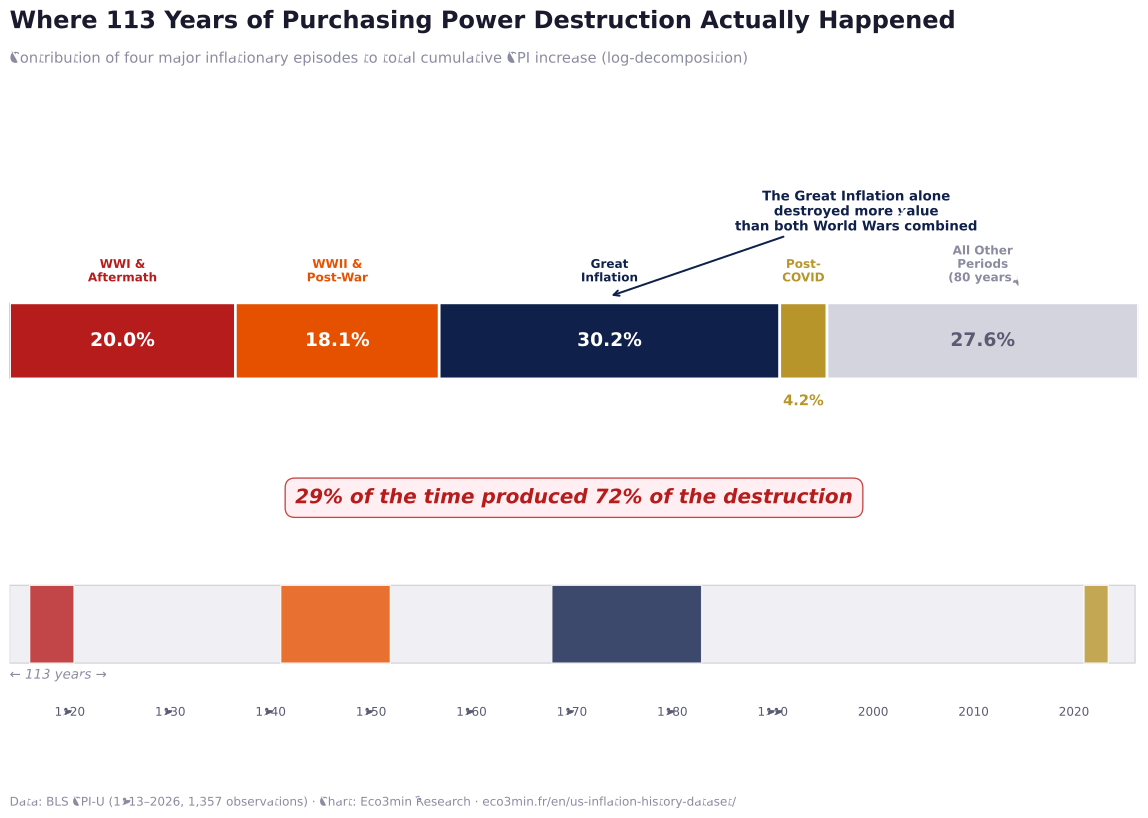
This study doesn't correct for baseline exponential decay due to inflation, to better highlight the meaningful variations. By comparing based on 1914 dollars it also causes old variations to be relatively more extreme and newer inflationary events to look less extreme. You must compare apples to apples.Finally the events are quite cherry-picked. It is a conclusion looking for a result, when the statistical reason for choosing those 4 events simply isn't evident when you look at the data itself. There is no mathematical rule you could apply to your dataset that would distinctly highlight those 4 periods.
by probablypower
3/30/2026 at 5:16:29 PM
Yes, a log chart would be better. That said, apples cannot be compared in this case; probably very few of us would choose to go back to 1914. A Tesla model Y would cost $1,680 in 1901 dollars, but would have been worth millions of those same 1901 dollars. Or nothing, depending on how much charging tech you could fit in the frunk. Many quality of life items are not covered by PPP (or money supply or other measures) adjustments.by vessenes
3/30/2026 at 5:49:08 PM
Why would anyone pay millions of dollars - that would be the equivalent to a billionaire's entire fortune - for a Tesla Model Y in 1901?You'd have nowhere to charge it. Electricity would be more expensive than gas even if you did.
You'd benefit almost nothing from the technology. There's no internet. Not much of it would work. And it wouldn't really help move you forward technologically, as it's just too advanced.
by onlyrealcuzzo
3/30/2026 at 8:16:23 PM
I think you are interpreting the comment too literally. The point is just this: calculating inflation is an art and depending on what kinds of assumptions you make, the results will vary wildly.Before the printing press, very few people in Europe owned even a single book. But even a lower class, modern European might easily own several dozen books. Depending on how you account for this, you might conclude that the given lower class, modern person is among the richest people in Europe in 1400. Or you might not properly account for the wealth of a 1400 European noble and rank them as middle class by modern standards.
It's simpler with commodities like a bushel of wheat, but still complicated. Depending on what you are trying to explain, you can use different methods but there is not straightforward way to convert the cost of something in one time period to another time period.
by jaredklewis
3/30/2026 at 5:55:55 PM
Right. Many, many reasons why the dollar that bought the Tesla in 2026 is not quite so disadvantaged against the dollar of 1901 it’s being compared to by CPI.by twoodfin
3/30/2026 at 7:00:43 PM
There was little reasons for anybody to buy a Model T either. The reason they did is that the government picked winners, let people drive cars through city roads. Commute times have only gotten longer, GDP growth has been more than offset by cost of roads and road deaths.by casey2
3/30/2026 at 5:03:55 PM
I think this graph shows the "apples to apples" comparison:https://www.officialdata.org/us/inflation/1800?amount=1
Doing a spot check, this means $1 in in 1913 is equivalent to roughly $32.83 today.
by abetusk
3/30/2026 at 5:53:22 PM
That’s ~3.17% compounded annually.Modest, stable inflation is good. It encourages investment & discourages deferring consumption for indirect monetary reasons.
“Stable” is the hard part.
by twoodfin
3/30/2026 at 9:16:56 PM
That seems pretty bad if the Fed target is 2%.by xboxnolifes
3/30/2026 at 6:35:08 PM
This is dogma, but I'm not sure it's possible or even ideal. Booms and busts seem endemic to any economy that targets inflation, and of course most entities (that don't understand the balance) want to encourage booms and limit busts. Meanwhile, there's another way to think of inflation (and also deflation):Inflation obfuscates the value of money and therefore of goods, services, etc. In an environment where value is volatile, it makes sense to keep moving, keep trading, because you might come into possession of something that was undervalued before you owned it, or that you'll need in a future when it would otherwise be too expensive. The people who skim off the top of all of this activity love this environment.
Deflation, on the other hand, makes value readily and immediately apparent. What was speculative and risky goes to zero and people hold onto things with intrinsic value. Those who skim profit off of economic activity hate the slowdown, obviously, but maybe you need periods of this to reset when valuations becomes too far removed from reality.
Is it a bad thing for people to buy what they need, when they need it, instead of being forced by inflation to anticipate their needs further and further out?
by underlipton
3/30/2026 at 6:04:23 PM
Also we’re looking at periods that involve dramatically different monetary policy (gold standard before WWII, Bretton Woods from 1944-1976, then the current regime).by rayiner
3/30/2026 at 6:23:36 PM
One could argue that the defining aspect of each of those shifts in monetary policy has been to devalue the dollar further. I have a relatively basic understanding of economics though, and do understand the arguments that even if that's the outcome it's not an inherently bad one as an american, though a notable effect appears to have been massively widening inequality.by simplyluke
3/30/2026 at 5:30:11 PM
Exactly, it doesn't matter to me how much COVID contributed to the erosion of 1901 100 Dollars.by elzbardico
3/30/2026 at 6:24:14 PM
It (presumably) does matter to you how much COVID policy contributed to houses doubling in cost, though.by simplyluke
3/30/2026 at 5:35:33 PM
You're basically critiquing a chart showing how purchasing power is decayed due to inflation because it isn't adjusted for "baseline" inflation. That doesn't make sense.And yes, earlier variations are more impactful because compounding.
I will say that a better representation would be a logarithm of the inverse. The problem with doing it this way is that later changes look very small. $1.00 to $.99 is the same y-axis delta as $0.05 to $0.04 but the latter is very different.
by jmyeet