3/30/2026 at 9:47:16 PM
I am always pleasantly amused that many HN folks share with me a love for weaving, knitting and knotting; not to mention ropes.Dang had once posted a long list of HN discussions on these topics.
I think there is something about them that squirts a little bit of dopamine in our pattern seeking, puzzle solving brains.
For me, one of draws was how does the symmetry of the woven pattern get weft into the cloth. Multi-shaft looms does it differently from, say, a Kashmiri rug.
When I had joined HN decades ago I had no idea that there would be this shared interest. Frankly, there were no reason for this to be the case.
Then one day this happened
by srean
3/31/2026 at 3:03:53 AM
Jaquard loom was one of the first machines that could operate based on a set of symbols / patterns encoded on a punched card. Computers ran on punched cards until the 1970s. Voting machines used punched cards until pretty recently (infamous "hanging chad" from 2000 US election).by don-bright
3/31/2026 at 12:04:46 AM
I have heard it said that the word "technology" shares its roots with the word "textiles". Maybe it's not so surprising that there would be a shared interest as well!by mitthrowaway2
3/31/2026 at 12:13:51 AM
https://www.etymonline.com/word/*teks-> Proto-Indo-European root meaning "to weave," also "to fabricate," especially with an ax, also "to make wicker or wattle fabric for (mud-covered) house walls."
> It might form all or part of: architect; context; dachshund; polytechnic; pretext; subtle; technical; techno-; technology; tectonic; tete; text; textile; tiller (n.1) "bar to turn the rudder of a boat;" tissue; toil (n.2) "net, snare."
> It might also be the source of: Sanskrit taksati "he fashions, constructs," taksan "carpenter;" Avestan taša "ax, hatchet," thwaxš- "be busy;" Old Persian taxš- "be active;" Latin texere "to weave, fabricate," tela "web, net, warp of a fabric;" Greek tekton "carpenter," tekhnē "art;" Old Church Slavonic tesla "ax, hatchet;" ...
by shagie
3/31/2026 at 6:47:56 AM
According to William Dalrymple, India was once responsible for a third of the world's GDP, with the most advanced textile industry in the world before the East India Company dismantled it.A Sanskrit origin is intriguing.
by echelon_musk
3/31/2026 at 2:02:21 PM
As a note, Sanskrit is a "sibling" or cousin of Latin or Greek in the family tree of languages ( https://upload.wikimedia.org/wikipedia/commons/4/4f/IndoEuro... ). Neither Latin nor Greek grew from Sanskrit but rather each (and many other languages) grew from Proto-Indo-European that was believed to exist somewhere in 4500 to 2500 BC.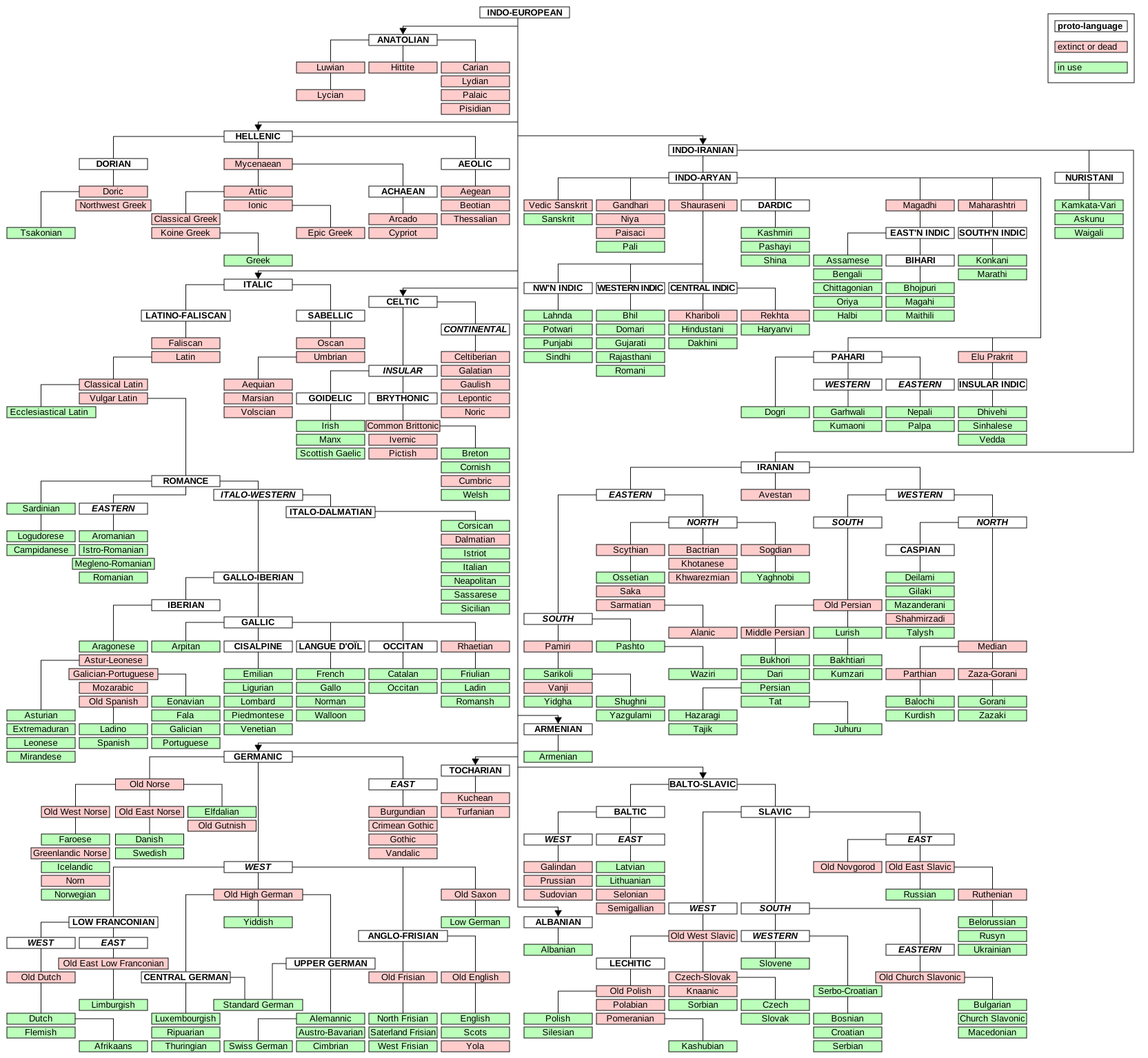
https://en.wikipedia.org/wiki/Indo-European_vocabulary (the "Construction, fabrication" section includes *teks)
by shagie
3/31/2026 at 2:20:23 PM
As a novice in the history of languages and being k-lingual in a couple of Indian languages and English, the Farsi language is such a delightful stream of discoveries.Regardless of which k of my languages I restrict myself to, I end up discovering words that are same between Farsi and that language.
I understand that this should not be surprising given their roots in Indo-Iranian languages, the largest branches of Indo-European.
Nonetheless it is delightful everytime I discover a new one by accident.
by srean
3/31/2026 at 7:40:14 AM
Hmm, Finnish has "tehdä" (to do,make,fabricate) with forms like "tekee" and "teko-".by euroderf
3/31/2026 at 7:50:54 AM
Huh; that seems like a way better etymology for the "tada!" flourish than any of the explanations in this rather heated discussion: https://english.stackexchange.com/questions/33564/origin-of-...by Schmerika
3/31/2026 at 2:59:26 AM
where did you think punch cards came from? you know, the punch cards that we use to represent the first computer programs?https://en.wikipedia.org/wiki/Punched_card. read the precursor section.
Basile Bouchon developed the control of a loom by punched holes in paper tape in 1725. The design was improved by his assistant Jean-Baptiste Falcon and by Jacques Vaucanson.[5] Although these improvements controlled the patterns woven, they still required an assistant to operate the mechanism.
In 1804 Joseph Marie Jacquard demonstrated a mechanism to automate loom operation. A number of punched cards were linked into a chain of any length. Each card held the instructions for shedding (raising and lowering the warp) and selecting the shuttle for a single pass.[6]
by segmondy
3/31/2026 at 12:34:44 PM
Indeed.To help debug the occasional 'dropped all the cards on the floor' accident, was the diagonal stripe across the side, after the cards have been stacked right.
This was used for computers for sure, not sure about the Jacquard looms.
With complete freedom in addressing (raising) any subset of the warps, these looms were very expressive. My favorite are multi shaft looms.
In a k-shaft loom you can only define k elementary subsets of all the warps. Makes for more interesting problem solving instances and mathematical structure.
by srean
3/31/2026 at 6:24:29 AM
Since you asked: That's exactly where I thought punch cards come from.by mitthrowaway2
3/30/2026 at 11:31:13 PM
Always good to learn more about the timeline of techniques lost in the mists of time. Some of the finest works of art were 'coded' in fibers, much more durable that most other media!by 8bitsrule
3/31/2026 at 4:01:58 AM
Including, inasmuch as you can consider it fine art, the ROM for the Apollo onboard computer! https://en.wikipedia.org/wiki/Core_rope_memoryby bitwize
3/31/2026 at 2:22:07 AM
The creator of SNOBOL and Icon programming languages, Ralph Griswold, also developed an interest in weaving and wrote about it; see for instance https://www.thelacebee.com/the-lace-notes/tess-the-professor...by shrubble
3/31/2026 at 7:05:36 AM
Thanks for the link. I did not know about this before. I have been to the bibliography page linked from there many times before but did not know the Icon connection.Got reminded of Durer's exquisite knot works.
by srean
3/30/2026 at 11:41:49 PM
I think it's not just puzzle solving - for me it's the idea of creating something from raw materials where that something is itself a standard building block. it appeals to the same part of me that programming does.by zem