3/19/2026 at 1:51:35 AM
Its wild how the solution to housing costs is really just:Build more housing. Keep law and order.
No it doesn’t need to be “affordable”. Yes rent control is a terrible idea.
Just build more housing.
Note: that the US already has plenty of housing and housing costs basically go up in areas of low crime relative to economic opportunity. If you build housing, but allow crime to rise, you have wasted everybody’s time.
by pclowes
3/19/2026 at 10:57:33 AM
It’s a difficult problem not because we don’t know the simple solutions (supply and demand). It’s difficult because the people who have the majority vote also typically own the houses and they obviously don’t want the prices to go down. This is not just speaking about the US, many countries are facing this issueby left-struck
3/19/2026 at 12:41:46 PM
But people who only own 1 house at most are still disadvantaged by this - sure, the value of their apt goes up, but if they want to switch to a larger house, the difference they're paying also increases, so do the property and wealth taxes, if applicable.There are many stories of solidly low-to-middle class families who lived in an area where property prices soared, and had to choose between bankruptcy or moving out, because they could no longer.
The only people who benefit from this are the investors and landlords. So allowing housing prices to surge is literally taxing the poor for the benefit of the rich.
Buildings also deteroriate - ask a civil engineer. Building something that lasts 50-100 years is much cheaper than something that can be maintained economically indefinitely. If you own a house with copper or PVC plumbing, that they go bad after 40-50 years, and fixing burst pipes quickly gets expensive.
Why do countries allow housing prices to rise then? Simple, it allows banks to have a massive portfolio of loans, where they get a steady source of income for literally decades, while also getting a massive portfolio of real estate they can use as basis for leverage to grant loans (which they profit off of).
Governments can then tax the banks and get some of that money without the dreaded specter of increasing income taxes.
The only problem is that the everyman gets stuck with a 10,25, and now 50 year old loan (with a similar increase in price) for the very same median house.
by torginus
3/19/2026 at 12:51:22 PM
> So allowing housing prices to surge is literally taxing the poor for the benefit of the rich.How do we limit home prices increasing? I see your point but solving this isn't trivial.
by lenwood
3/19/2026 at 4:20:11 PM
There are a bunch of successful models, people usually mention Vienna as having a particularly effective housing policy - what they did is the city bought up a bunch of land, and built housing on top of it in various government subsidy programs, from non-profit public benefit corporations, to social housing for the poor.They have strong renters rights, protections against rent increases, and high standards to which dwellings must conform to.
So while you can be a landlord in Vienna, you have to compete with affordable housing options, and you're forced to maintain a high quality yourself.
So that means that unless you can offer something the market's willing to pay extra for, being a landlord is not particularly lucrative thing.
Notice nowhere in my post did I mention the typical 'landlords are evil and must be taxed to death' approach.
Which is in stark contrast to most places where you're paying through the nose, the standard of rented dwellings is low and your rent can be increased or you can be kicked out on moments notice.
by torginus
3/19/2026 at 1:06:44 PM
Build more housingby exabrial
3/19/2026 at 2:17:00 PM
If investment companies that already own tens of thousands of homes buy them and keep increasing the rent, the problem has not been solved.by testing22321
3/19/2026 at 5:27:09 PM
Investment companies own only about 2% of the housing market, and most of these are rented out. Investment companies aren't really the cause of housing prices remaining high - in moderate- and high-demand areas, we simply aren't building enough to keep up with demand.by Windchaser
3/19/2026 at 3:32:34 PM
land value tax would fix thisby idbnstra
3/19/2026 at 6:00:05 PM
No, build more housing.by exabrial
3/19/2026 at 7:35:38 PM
That's not a different choice. LVT makes it more expensive to hold land that's less productive than it could be, the result of which is that development is encouraged.by CWuestefeld
3/19/2026 at 8:55:18 PM
No, building more housing. Read the article.by exabrial
3/19/2026 at 5:59:52 PM
You literally didn't read the article.Build more housing.
by exabrial
3/20/2026 at 2:13:47 AM
I do really enjoy all the arguments coming up in this post that are pretty easily defeated by “build more housing”. No one has been able to come up with a compelling argument about why this doesn’t work.by SOLAR_FIELDS
3/19/2026 at 2:29:47 PM
Except they cannot increase rents when there is enough supply for a market to actually work.by brazzy
3/19/2026 at 3:15:06 PM
The market will remain irrational longer than…Of course they can when they own them all. See De Beers diamonds. Buy them all, keep the price artificially high.
by testing22321
3/19/2026 at 3:31:23 PM
Diamond prices are famously crashing now due to artificial lab made diamonds (increased supply)by larsiusprime
3/19/2026 at 3:46:10 PM
The De Beers cartel was able to avoid anti trust scrutiny because the best reserves are outside (Africa/Canada/Russia) of the most lucrative markets (US/Europe/Asia).Corporations control only a small faction of housing supply.
by nroets
3/19/2026 at 6:04:44 PM
They can only do that (own them all) with government assistance. See De Beers diamonds, who leveraged the legal system to create a monopoly.The solution is to build more housing and get the government out of the picture.
by exabrial
3/19/2026 at 4:10:32 PM
Insanely stupid restrictions on residential construction make it easier.by matkoniecz
3/19/2026 at 9:49:17 PM
Investing in housing only makes sense when supply is limited. The way to stop investors from hoarding housing is to make housing a bad investment by building a lot of it so cornering the market is impossible.by HDThoreaun
3/19/2026 at 2:15:37 PM
Housing can not be both affordable and a good investment.If we want housing to be affordable ie “limit them increasing” we have to stop people using them as investments.
There are many ways. My favourites are:
- one human can own one residential property. No companies or businesses can.
-or, property tax doubles (or 10x) with every residential property owned.
- no foreign ownership (Canada does this now)
- government can own and rent residential property at no profit. They supply plenty of other basic necessities of life, why not houses?
by testing22321
3/19/2026 at 2:39:38 PM
It can be both affordable and an investment - it cannot (and will not) perpetually be a market-beating top-tier investment.All of the items above can have drastic unintended consequences; the way to keep prices affordable is to make sure that supply is always outstripping demand by a bit.
Some examples of unintended consequences:
* I can't add an ADU to my existing property which would add one more dwelling unit
* Subdivision of property is discouraged; combining parcels reduces tax even if no new dwelling units are created
* This might be the closest to doing something though it could substantially discourage non-citizen immigrants (legal or not)
* This has been tried before and had well-documented issues, but might be doable if they can provide a "floor"
by bombcar
3/19/2026 at 5:30:14 PM
At least in the US, up until the rise of 'flipping' and AirBnB home values typically tracked with inflation. Personally owned real estate was a hedge against inflation and a tax shelter, not an 'investment'.by FuriouslyAdrift
3/19/2026 at 3:58:12 PM
> it could substantially discourage non-citizen immigrants (legal or not)Make an exception for owner-occupiers?
by deanishe
3/19/2026 at 5:47:55 PM
So like what California did, which resulted in only a couple hundred thousand units over half a decade when they were hoping for/needing a couple million statewide.Not the mention that ironically, the private owners with the space to build an ADU on their lot are the ones most likely to already be wealthy, and not actually rent it out to anyone below their socioeconomic bracket.
by bradchris
3/19/2026 at 6:23:53 PM
> It can be both affordable and an investmentBy definition if something is affordable, it’s not a good place to store money with the goal of it increasing.
> All of the items above can have drastic unintended consequences.
Yes, absolutely. These are not fully fledged solutions, but a starting point. Some of them may need an asterisk or two. Of course, unintended consequences are perfectly fine if the final result is better than what we have today
> I can't add an ADU to my existing property which would add one more dwelling unit
Your wife or kid could own it. If you don’t have either of those, you don’t need two homes.
> Subdivision of property is discouraged
Subdivision and sell is perfectly encouraged.
> This might be the closest to doing something though it could substantially discourage non-citizen immigrants (legal or not)
I am a non citizen immigrant in Canada. I just had to bide my time until I became a PR then could buy a house. Perfect.
> This has been tried before and had well-documented issues, but might be doable if they can provide a "floor"
Again, it doesn’t have to be perfect, just better than what we have now.
by testing22321
3/19/2026 at 4:23:22 PM
Why should housing be an investment?by torginus
3/19/2026 at 9:50:53 PM
Because we live in a democracy and voters want housing to be an investment because they own housingby HDThoreaun
3/19/2026 at 11:29:51 PM
I own both a car and an apartment. The former is not an investment and most money people say you shouldn't consider the one you live in an investment.by torginus
3/20/2026 at 1:15:11 AM
The majority of voters would vote to make income tax zero, that doesn’t mean we should accept that simply because the majority wants it.In the US the majority of voters just voted for a racist, homophobic pedophile convicted felon.That doesn’t mean everyone should shrug and say “it’s the will of the people”
I refuse to believe you would have this attitude if you and your family had to rent drinking water while people profited wildly from it.
The situation is unacceptable and needs to change, irrelevant of what certain people want.
by testing22321
3/20/2026 at 2:11:46 AM
Sure, I agree, but this isnt a technocracy. If you want the government to change you do need to convince the voters at large.> The majority of voters would vote to make income tax zero
Im not sure this is true. Most people recognize the taxes are needed for the government to provide services.
> That doesn’t mean everyone should shrug and say “it’s the will of the people”
This is the reality though, it doesnt matter that you or I disagree. Trump is the legitimate president even if he's a racist, homophobic pedophile convicted felon.
by HDThoreaun
3/19/2026 at 2:27:54 PM
> one human can own one residential property. No companies or businesses can.So, in other words, you want everyone who cannot afford to outright buy a house to be homeless?
by brazzy
3/19/2026 at 5:30:54 PM
This is what apartments are for...by FuriouslyAdrift
3/19/2026 at 6:37:16 PM
Not at all. The government should step on and rent them as rent to own systems. Make no profitby testing22321
3/19/2026 at 8:20:44 PM
> Why do countries allow housing prices to rise then?Because if you forcibly keep housing prices low, you have a shortage.
by WalterBright
3/19/2026 at 4:40:44 PM
That's part of it, but I definitely have known quite a few renters who opposed building more housing. Denial of supply and demand, as well as general dislike of "rich developers" is strong in many groups.Incentives are typically the strongest force to watch, but so are various cultural/political narratives people come up with. People clearly don't all vote in our own economic interests in many situations. I'd assume this is largely because in the current information ecosystem, people don't understand what's in their economic interests.
by lkbm
3/19/2026 at 5:20:38 PM
This! >> I'd assume this is largely because in the current information ecosystem, people don't understand what's in their economic interests.It's wild that even renter's aren't voting for more housing. I think it's because basic economics isn't taught in k-12 or even college anymore and this is causing a lot of problems.
Of course, there are other solutions too, like starting new cities and incentivizing companies to move there in the beginning. People follow jobs, they have to, now more than ever. if companies move there, people will follow. How is that we used to be able to create new cities and yet now, we all the sudden can't. has our material wealth really dropped so low that we can't afford to build new cities?
and what about down-sizing? in hong kong, you could create bed sized units at a fraction of the cost of a full sized apartment. microapartments? etc? all NOT legal. i think it's wrong of the city to decide that for people. individuals should be able to decide whether they want that or not, rather than being forced onto the streets.
by leaves83829
3/19/2026 at 6:50:33 PM
Many people are not driven entirely by their economic interests, thus you can see people wearing clothes not from the Walmart bargain bin, driving cars with electric windows, and eating out instead of cooking rice and beans at home. Renters, just like home owners, want to live in the most comfortable home they can afford in general.People who lament the lack of rentable pods and don't understand why anyone would pay more for a bigger house in a quitter neighborhood or just for a nice view exist, but you are in the minority. Thus renters are not going to vote to live in a ghetto so they could save a few hundred on rent.
by pandaman
3/19/2026 at 9:54:29 PM
> It's wild that even renter's aren't voting for more housing. I think it's because basic economics isn't taught in k-12...Teaching economics is not the solution (see papers on financial literacy). Rationality is hard and even highly educated people have terrible models of cause and effect. Even your own dependency analysis implies that voting for X helps to get Y (which hasn't been my personal experience).
by robocat
3/19/2026 at 4:42:59 PM
Do you recall exactly what kind of housing they were opposing? Because that is a major piece of context we are missing here. I don’t think I’ve ever met anybody who simply said “no more housing.” It’s usually much more specific than that, such as opposition to house flipping and STR’s, or wasteful planned communities of McMansions and concrete.by Forgeties79
3/19/2026 at 8:43:23 PM
The local subreddit for my area always has tons of negative comments about any new housing development.Some people complain it is "luxury" or even just normal and not "affordable."
If it is single family housing then people complain about the lack of density. If is apartments or condos they complain that there is already so much traffic in that area and adding thousands of new people will make it even worse.
When small old houses are bought up, torn down, and a new apartment / condo complex goes in they complain about the lack of character and soulless new development that all looks the same.
I have to agree with some of the other comments that many people never learned supply and demand or are completely incapable of understanding a for profit business.
I've seen comments about memory / RAM prices going up. Gamers are now so anti-AI because it is making their GPUs more expensive and now memory, flash, and hard drive storage as well. I've seen comments that say the government should step in and force companies to make GPUs at affordable prices. We can argue over whether health care or clean water are a human right but some people seem to think cheap GPUs are a human right.
by lizknope
3/19/2026 at 4:53:39 PM
Generally these people oppose the building of "luxury housing" because they don't get how ALL housing increases supply/reduces market price. Also the idea of a developer building a kind of... predistressed property has never made any sense to me.by 4fterd4rk
3/19/2026 at 5:11:54 PM
> ALL housing increases supply/reduces market price.I can tell you firsthand that that is absolutely not true. The massive rush to renovate or build new short-term rentals in the 2010s had a disastrous impact on rental prices around my city, especially coupled with historically low interest rates that made these enterprises far less risky. It’s also incredibly disruptive to neighborhoods/communities, not just because of bad guests but because it can rapidly drive up value, leading landlords to sell and/or rapidly drive up rent which means kick out lower income tenants whether it’s intentional or not. Most of the STR’s in particular were also not being done by locals. 70%+ were out of town developers. Currently almost 90% of STR’s here are whole home which means not local owner/operators living there. It’s just hotels by a different name taking up housing in residential neighborhoods.
When interest rates and home insurance went up a few years ago, coupled with stricter rules for getting an STR license, a lot of people sold their properties (usually rentals/STR’s), and the price to buy as well as rent noticeably came down pretty rapidly. It’s still too high, but the drop was noticeable and quick. The purpose for construction absolutely factors in to these discussions.
by Forgeties79
3/19/2026 at 5:22:14 PM
Taxing short-term rentals would handily address these issues while still allowing people to derive some income from their otherwise vacant pieds-a-terre and vacation homes.by zozbot234
3/19/2026 at 5:30:40 PM
But that’s the thing, that’s not what these properties are generally here. These are homes bought in cash by developers in neighborhoods occupied by residents. People lived in these homes prior and somebody else would have likely bought and lived in it if they left.When my wife and I were buying our first house we had two houses taken out from under us because somebody came in with an all cash bid tens of thousands higher than ours. Both are still Airbnb’s.
by Forgeties79
3/19/2026 at 5:36:56 PM
> These are homes bought in cash by developers in neighborhoods occupied by residents.This happens because hotel accommodation is generally overpriced. But if you tax the airbnb rentals, it deters profit-minded developers from engaging in this practice, while still allowing it as a last resort for homes that cannot be rented long-term and would otherwise sit empty.
by zozbot234
3/19/2026 at 5:51:42 PM
Maybe in theory but that’s not what happened here at the end of the day. That’s the entire issue. This type of construction and renovation is bad for housing. My city’s story is very common - it was especially in the 2010’s.House-Hotels managed by companies based in other states (sometimes even other countries!) don’t belong in residential neighborhoods. We have zoning for a reason.
by Forgeties79
3/19/2026 at 6:02:29 PM
> Maybe in theory but that’s not what happened here at the end of the day.If you mean that levying targeted taxes/fees to mitigate the bad side-effects of STR's has not been tried, I agree of course. I'm not denying that the detrimental side-effects exist.
by zozbot234
3/19/2026 at 7:47:21 PM
I think my larger point here is that we can’t say “all construction is good” if we have to have a ton of qualifiers that ignore when it isn’t and/or expect all sorts of parameters and rules that aren’t being implemented. Tons of bad building goes on all the time, and it is reasonable of people to oppose it. Belittling them and accusing them of not understanding basic economics is not fair at all. There are plenty of examples of construction that should be opposed.by Forgeties79
3/19/2026 at 6:30:49 PM
STRs reduced the supply of housing. You’re making my point.by 4fterd4rk
3/20/2026 at 7:43:51 PM
I think we might be talking at cross purposesby Forgeties79
3/19/2026 at 10:41:46 PM
An ex of mine mentioned to me that she was going to join a local community group trying to prevent development on an empty lot near her apartment. I asked why she would want to do that? Her concerns, and the concerns of the people she was showing me on facebook, were:1. "They didn't do an environmental review" 2. She didn't want to hear construction noise. 3. She didn't want the construction to cause rats to leave the lot and go to buildings. 4. She also said she didn't want her rent to go.
I believe it was this lot: https://web.archive.org/web/20250821002539/https://www.nytim...
I think it is common for people to organize, even in the most urban and educated areas in America, against their own interest.
by gravypod
3/19/2026 at 10:47:06 PM
[dead]by polothesecond
3/19/2026 at 4:55:21 PM
Apartment complexes. Mostly "luxury" apartments, but including ones with some % of affordable units. Some were replacing houses, but mostly replacing parking lots, vacant lots, or even older, smaller apartment buildings -- in a neighborhood that was already almost entirely apartment buildings.by lkbm
3/19/2026 at 11:13:18 AM
Lots of people have kids and want them to be able to a) not be a victim of crime, and b) be able to afford a house. Anyone who has loads of money to afford high house prices and private security can afford luxury beliefs, as espoused in Oscar acceptance speeches, but everyone else with housing and kids is either voting for less crime and better affordability, or is not yet voting for those things.by philipallstar
3/19/2026 at 12:40:13 PM
Plenty of people with kids are voting to block new housing. It's not that they don't want their kids to be able to afford to pay rent. They're just not making the basic connection between supply and demand.This just happened in my neighborhood. There was a proposal to build low rise apartment buildings about a mile from the detached single home neighborhood where I live, and people had lawn signs opposing the construction. Perhaps unsurprisingly, the loudest and most active anti-development voices were from Trump supporters. Economic illiteracy used to be the domain of the political Left, but the Republicans are making real inroads in rejecting free market principles, so there's some amount of political realignment. Luxury beliefs indeed.
by loudmax
3/19/2026 at 2:34:15 PM
In an area entirely filled to the brim with the "evil" Trump supporters ... new housing is going up, apartments, row homes, single family homes, it's all there.Nobody really seems to care ... yet.
It's often very instructive to find out who is "behind" both promotion and resistance; because both groups will attempt to find ways to "play both sides" and get opposition moving.
by bombcar
3/19/2026 at 5:06:06 PM
> In an area entirely filled to the brim with the "evil" Trump supportersHanlon's Razor applies: "Never attribute to malice that which is adequately explained by stupidity".
by loudmax
3/19/2026 at 2:47:46 PM
> Economic illiteracy used to be the domain of the political LeftIMO the right is not really the right that most of us remember, so it's not worth trying to reconcile their current ideology with the fiscal conservatives of decades past. The current GOP is unserious, their base consumed by conspiracy theories and driven by grievance.
by rootusrootus
3/19/2026 at 2:30:34 PM
>They're just not making the basic connection between supply and demand.They don't like my beds. There's something wrong with them! I can't be the problem! -Procrustes
Yes. It's the people's fault for not understanding markets. Couldn't be that markets are fundamentally structurally fucked by an inversion of the demo pyramid. Couldn't be that market participants are just delusional about how much other actors should have extracted from them.
by salawat
3/19/2026 at 4:21:15 PM
The tragedy of the commons is a real thing. People focus on their own personal short term economic gain at the expense of long term sustainability and gain - even for themselves - because people in general find that longer term outlook difficult to reason about.Democracy is the worst form of government, except for all the others we've tried. This short term thinking is one of its classic failures, because in many ways you're codifying the tragedy of the commons.
by kyralis
3/19/2026 at 11:50:30 AM
"typically own the houses and they obviously don’t want the prices to go down."I've never understood this: If I replace a single home with 20 apartment homes, I've raised the value of the whole property at purchase time no? You're already dealing with home valuations that have faaar outstripped wages, the only way you go any higher is to build more homes on the same property.
Counterintuitively, the "I don't want to live next to apartments" line of thinking actually seems more potent in the regular NIMBY headspace? Like people will forego higher valuations to keep their suburb a suburb.
by pj_mukh
3/19/2026 at 1:19:30 PM
> I've never understood this: If I replace a single home with 20 apartment homes, I've raised the value of the whole property at purchase time no?It's a commons problem. In your scenario, you have absolutely increased the value of your property. 20 apartments is more valuable than a single family home. However, you have also reduced aggregate demand by housing 20 people. That reduced the value of your neighbors' properties (or at least reduced the rate at which their value increased).
NIMBYism posits that values will continue to increase without forcing any property owners to invest in improvements so long as they collectively block any efforts to increase supply.
by giaour
3/19/2026 at 2:21:15 PM
Are there any real examples of this actually happening?Local to me, Arlington and Reston VA have both seen massive building sprees over the past 20ish years (mostly adjacent to the Metro). Home values have never been higher in either location.
My own personal example... I live ~1 mile from the Metro, so just outside the building boom zone. There was next to zero housing in that zone - it was all office parks - and now it's a mix of $1+ million townhomes, $1+ million luxury high-rise condos, and dining/retail. My own home value is up 50% since COVID and that's true for just about any house in my zip code.
And without the redevelopment/infill, I posit the whole area would be less desirable. NIMBYism feels more about "change is bad" than property values.
by alistairSH
3/19/2026 at 3:26:56 PM
Literally the entire peninsula of the bay area is an example of this happening. You have people voting to "keep their small town feel" sandwiched between San Francisco and San Jose.by BobbyJo
3/19/2026 at 4:25:18 PM
I meant examples of increased density reducing values, not NIMBYs stopping development.by alistairSH
3/19/2026 at 7:34:31 PM
Ah, well I still think it applies as a counter example. Avoiding density makes values rise, especially when combined with increasing office space density/local job growth.In general I don't think it requires all that much thought in terms of why/how price changes happen. Housing demand is inelastic, and you can find examples of that causing both rapid price increases (metro areas with high friction building requirements) and rapid price decreases (metros with population declines) when out of equilibrium in either direction, which is exactly what you'd expect of a good with inelastic demand.
by BobbyJo
3/19/2026 at 3:41:48 PM
Yeah, I live in Falls Church, which has seen more build-up than other areas in Northern Virginia because the city has never had the kind of restrictive zoning that the anti-"Missing Middle" campaign is still fighting in Arlington. The value of my single-family home peaked in 2024 and has dropped slightly since. To my understanding, this is generally true of my zip code and not true of comparable zip codes in the area.But Falls Church is much nicer now that a few mid-rise apartment buildings with ground-level retail have gone in! As a resident, I am very happy about all the new development. I expect that over time, that will have a positive effect on property values, but there is an observable short- and medium-term effect working in the opposite direction as the increased housing supply eases demand on the existing housing stock.
by giaour
3/19/2026 at 4:27:19 PM
Do you believe that small drop is a result of new development or just a blip in the market? Price increases near me definitely slowed as interest rates increased, but we haven't yet seen a drop. But, as far as I know, this is one of the only walkable areas outside the Beltway, so there's a lot to like if you want to be untethered from a car for much of the week. It's also a relatively affordable area (vs inside the Beltway and some SFH neighborhoods) - my TH 1500sqft (1800 if you include finished basement space) would currently sell for ~$700k. The new-build THs are 2500sqft, with a garage or two, and sell for just over $1 million.by alistairSH
3/19/2026 at 2:19:16 PM
It's not a common problems in Austin at least. You (a property developer) buy a single home in bad shape on a big lot in the city. Then you redevelop the single home into 20 apartments, greasing the wheel appropriately (of the local government) to get the needed rezoning and permits. No one else can do this because they don't have the connections and monetary resources you do. You pocket the increase in value of that property (minus the cost of grease) by selling it off as "condos" which have dubious maintainability going forward. You never lived here anyways, you have a ranch in Bastrop.by sidewndr46
3/19/2026 at 3:43:35 PM
The article we are commenting on is literally about this happening in Austin.by giaour
3/19/2026 at 4:17:42 PM
It's absolutely the latter thing.The thing that is prized above all else is privacy and exclusivity. People are paying money to ensure that few people live near them and that those people are the "right sort of people."
Dating back to the 1930s the original core goal of zoning was to restrict apartments so as to keep poor people and minorities out of certain areas. We know this because it's well documented in the newspapers of the day because back then people were more comfortable explicitly saying how classist and racist they were.
by Tiktaalik
3/19/2026 at 4:13:55 PM
I live next to a sprawling apartment complex after rezoning allowed it to go in.Now we have a large homeless encampment partially on the apartment complex lot - that the complex can't deal with because their lawyers told them off.
Now we have a significant uptick in petty but quality of life impacting crime.
The roads around the apartment complex are now swamped because the entrances were placed stupidly.
And the people who live in that apartment complex are also upset about all of this.
None of this is about "my investment". It is about not letting commercial outfits hurt my quality of life to subsidize their profit margin. It's not the fault of the tenants, nor me.
Now we get to sue the stupid property management company until they fix their issues.
by vorpalhex
3/19/2026 at 2:39:59 PM
A related idea: politicians know how to fix the problems, they just don't know how to get re-elected after doing so.by ccppurcell
3/19/2026 at 2:43:59 PM
I occasionally wonder if it would be a net positive to make political office terms a little bit longer, but limited to exactly once. No reelection pressure.Same part of my addled brain that thinks we should increase dramatically our count of representatives, abolish in-person legislating, and then fill the roles with sortition.
by rootusrootus
3/19/2026 at 3:58:26 PM
Things are so party focused nowadays I don't think the person behind the mask really even matters.It might slightly help, you'd probably have less votes on giving themselves pay raises, but at the end of the day the majority of ads and voters are going to revolve around party lines.
by ApolloFortyNine
3/19/2026 at 11:34:34 AM
“Show me the incentive and i’ll show you the outcome”I’ve learned a long time ago that we’re not always aware of how incentives drive our own behavior, it just happens naturally. This is exactly what’s happening with housing.
by jorisboris
3/19/2026 at 5:02:15 PM
that's true, but plenty if people oppose building new apartments because, in general, the price will be high and they see this high prices and incorrectly conclude rents are rising when in reality, people move in, freeing up the less expensive places they were in before.similarly they oppose because "gentrification" even though the evidence is that gentrification is net positive, even for those already living in the area. gentrification or not, people leave at the same rate. Those who stay see their income/wealth rise compared to the case of no-gentrification.
by socalgal2
3/19/2026 at 2:20:55 PM
That’s why California has had dozens of state laws passed in the past 3 years that override many city and county ordinances to force additional supply. Lawmakers knew the only solution was more housing.These bills permit the construction of denser housing near transit, force cities to actually meet housing quotas, allow the state to override a city’s zoning to permit more housing if they don’t make a good faith attempt, loosen the rules to build ADUs, and many other changes.
Is it ideal that we had to get to this point? No, but housing wasn’t being built.
by harrall
3/19/2026 at 2:21:09 AM
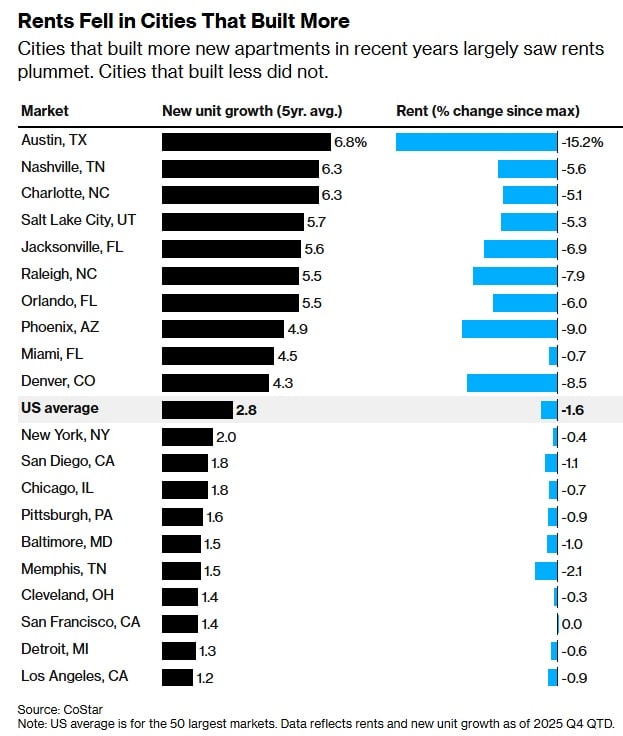
New construction has already decelerated in Austin due to falling prices, which compresses already-near-zero margin on real estate development.So yes, it really is "just build more housing." The problem is: why would you build more housing as prices fall?
by estearum
3/19/2026 at 4:10:28 AM
I'm confused by this objection, if you draw a stereotypical supply and demand curve, you can see how prices settle to an equilibrium point. Of course reality has more complications, but I think your objection is 95% answered by a supply and demand curve. You keep building houses when it is profitable. You stop when it is not. This naturally keeps everything in balance.by pinkmuffinere
3/19/2026 at 11:12:59 AM
Free markets for housing are likely to settle into an "optimum" where some percentage of people cannot afford housing at all, because while construction/rental of housing for them would net a return, it's not worth the opportunity cost. Plus you should not wait for the market to respond to a lack of housing: people will be homeless in the meantime. Supply/demand is mostly reactive, because building for anticipated future demand years down the line is very risky, so most investors don't like that.Markets don't optimize for "everyone gets some", yet that's precisely what you need for housing. You'll always need the government to come in at some point to provide for those left behind by the free market.
by chmod775
3/19/2026 at 4:39:16 PM
The thing about arguments like this is they're usually used in service of blocking housing. As in we shouldn't do what Austin did because it won't fully solve the problem. We should instead stick with the status quo, which gets much worse than Austin.by graeme
3/19/2026 at 12:17:26 PM
Isn’t the initial response to a lack of housing that people consume less housing than they would like, rather than homelessness, eg families with children sharing rooms more than they might like, adults living with roommates, or just people having to live further away from where they would like to be (or moving out of a city altogether)?I don’t dispute that there are levels of affordability that are bad enough that they start to lead to various forms of homelessness, but it doesn’t seem to me like a fundamental rule that, if some people can’t afford to live alone in a large amount of housing, they also can’t afford to live with roommates sharing a smaller amount of housing, and that the right level of housing prices should also price some people out of those arrangements (ie it demands a pretty high level of inequality if you assume that the market allows typical people to afford to live alone and that sharing can typically reduce per-person rents by half or more)
by dan-robertson
3/19/2026 at 1:52:06 PM
It’s all fun and games games until you’re municipality starts banning adult co-living situations.You underestimate how intrusive these people will be to protect the value of the single largest asset most of them will ever own
by polothesecond
3/19/2026 at 2:58:11 PM
Individual landlords also dislike those and may not allow it, because the ability of the household to make rent now depends on all adults in that household. 3-4 broke adults who may only loosely know each other and with their own individual plans are a lot less stable than, for example, married couples. It's basically 3x the risk and hassle. Chances are you'd have to evict them after just a couple months.They'd rather just leave the apartment empty and hope to find a better tenant.
by chmod775
3/19/2026 at 4:36:44 PM
> municipality starts banning adult co-living situationsIs that not typically happening only for more egregious situations? E.g. the ban is on more than 3 or 4 unrelated adults living together. There are plausible reasons why that should be regulated, it is not clearly a conspiracy by homeowners to prop up the value of their own homes.
by rootusrootus
3/19/2026 at 3:34:54 PM
> Free markets for housing are likely to settle into an "optimum" where some percentage of people cannot afford housing at all, because while construction/rental of housing for them would net a return, it's not worth the opportunity costYou provide no basis for the idea that the returns on housing have to drop below the point at which its financially viable to build before housing becomes affordable. You just say "because" then restate your premise.
> Markets don't optimize for "everyone gets some", yet that's precisely what you need for housing.
Just because markets don't optimize for it, doesn't mean it doesn't achieve it.
> You'll always need the government to come in at some point to provide for those left behind by the free market.
Disagree.
by BobbyJo
3/20/2026 at 4:18:43 PM
"Not worth the opportunity cost" is not the same as "not financially viable". It means that there are lower risk/higher return investment opportunities than creating that housing. More simply stated "Why would I want to turn my $100 into $110 +/- 20% if I could turn them into $130 +/- 20% instead?"by chmod775
3/19/2026 at 11:36:04 PM
Is that necessarily true or just incidentally true in certain metros given the regulatory restrictions we have now?Our food is supplied via markets and yet with just subsidies almost nobody starves across western countries.
by Hammershaft
3/19/2026 at 8:20:34 PM
The trick is to acknowledge the market as the main mechanism at play, and have the sense to work around the margins. When the tinkerers get too enthusiastic, they tend to do more harm than good.by marcusverus
3/19/2026 at 8:52:22 AM
I have struggled to understand why houses don't get built and land sits idle for years. I can only assume that it's significantly more complicated. I'm not trying to excuse the complications. I guess if the house prices are forecast to go up, you build some houses, but not all that you can because the longer you wait, the higher the profit will be on the ones you start later. If house prices are going down, even if it's profitable when you start, you're not likely to build houses because you might be left holding houses that will sell at a lower margin. If there was a tax on unused land, that might skew things towards building more even if prices are declining, but I'm sure there are lots of views on that.by taffronaut
3/19/2026 at 10:06:09 AM
Why would you build on a plot of land when the plot of land itself is already appreciating in value with you doing nothing to itBuilding is risky and costly
Having an asset that appreciates on its own regardless of what you do with it is not
by jaapz
3/19/2026 at 2:35:03 PM
In Texas, at least, the lack of income tax is made up for in property taxes. Just owning that plot with nothing on it is still going to be a sizable liability.by salawat
3/19/2026 at 10:45:29 AM
Holding costs of land are far from $0 in any major metropolitan area. Sitting on it involves its own form of risk.Vacant land that's desirable is often held back from development due to zoning or infrastructure issues.
by bpt3
3/19/2026 at 11:13:40 AM
> Vacant land that's desirable is often held back from development due to zoning or infrastructure issues.Nah, it's mostly speculation. Zoning/infrastructure issues get baked into the price. If you cannot build anything on a plot of land, its price falls.
by estearum
3/19/2026 at 11:23:16 AM
Only at point of buying. If you buy some land and the mayor suddenly implements rent control then the value goes down.by philipallstar
3/19/2026 at 5:35:13 PM
Until someone gets the zoning board to wave a magic wand and change the allowable uses of the property, and then it's a lot more valuable.This happens all the time, and is a major reason why people will sit on land for extended periods of time.
by bpt3
3/19/2026 at 11:17:17 AM
Sitting on it is a predictable cost, while building means a costly chaos which may or may not turn out the wished profitability. So when you are used to "old profits" you maybe rather wait on the predicted do-nothing-cost, and hope for the tide to turn again in your direction.by soco
3/19/2026 at 12:45:05 PM
Guys you have no idea about these things and what you are talking about. source: I am a city plot owner.No land owner will suddenly become a developer to build an apartment block.
A plot owner can sell land to a developer or form a joint venture with developer putting in their land as starting capital (much more risky) most people either keep land as gold or sell it when they need money.
I hope it is clearer now.
The very idea that everyone who owns land should build an apartment block is laughable, it is very complicated endeavour best not to get into it if you know nothing about it. Hell building a single family house is complex, let alone five story building.
So you either keep it if you don’t need money or you sell it if you want to buy something else or need to have liquidity. And you don’t even sell it to buy other investment vehicle because land is already better than gold.
My plot increased 3 times in price in 10 years. Try to beat that with SP500. It’s virtually immune to inflation no matter how the broader economy fares it will always shield from inflation because you cannot make more land hah.
Even in utopia of automation and post scarcity society good location land will be truly lucrative and unimaginably expensive if not outright prohibited to own by private individuals. The question is what will be a “good location” in 30 years.
by juleiie
3/19/2026 at 2:06:54 PM
> My plot increased 3 times in price in 10 years. Try to beat that with SP500. It’s virtually immune to inflation no matter how the broader economy fares it will always shield from inflation because you cannot make more land hah.The GFC says hi :-)
by oblio
3/19/2026 at 1:54:37 PM
> Even in utopia of automation and post scarcity society good location land will be truly lucrative and unimaginably expensive if not outright prohibited to own by private individuals.Indeed, there’s a reason you see silicon valley execs going all in all acquiring land to build fortresses. At the end of the day, regardless of the cold march of technological progress, land remains the root of all real power.
by polothesecond
3/19/2026 at 2:11:22 PM
> No land owner will suddenly become a developer to build an apartment block.No one is suggesting this.
> A plot owner can sell land to a developer or form a joint venture with developer putting in their land as starting capital (much more risky) most people either keep land as gold or sell it when they need money.
Most people don't own vacant lots, but some who do hold onto it as an investment. It's a pretty poor one on average over time, just like gold (which is a good analogy).
> The very idea that everyone who owns land should build an apartment block is laughable, it is very complicated endeavour best not to get into it if you know nothing about it. Hell building a single family house is complex, let alone five story building.
Again, no one is suggesting this. The assumption is that a developer would buy a lot to build on, because that's what happens in practice.
> So you either keep it if you don’t need money or you sell it if you want to buy something else or need to have liquidity. And you don’t even sell it to buy other investment vehicle because land is already better than gold.
Land and gold are not better than the stock market over time.
> My plot increased 3 times in price in 10 years. Try to beat that with SP500. It’s virtually immune to inflation no matter how the broader economy fares it will always shield from inflation because you cannot make more land hah.
The S&P 500 beats real estate over time. Congratulations on getting lucky with your plot of land. Land is a good inflation hedge, assuming you are in a growing area. Ask rust belt land owners how things worked out for them.
> Even in utopia of automation and post scarcity society good location land will be truly lucrative and unimaginably expensive if not outright prohibited to own by private individuals. The question is what will be a “good location” in 30 years.
Thanks for highlighting one of the many issues with communism, but we will never reach a post-scarcity society for many reasons, including this one.
by bpt3
3/19/2026 at 3:07:35 PM
You have no idea what you are talking about…by juleiie
3/19/2026 at 4:02:28 PM
If you think you do know what you are talking about, do you think you could back it up with a source?by ApolloFortyNine
3/19/2026 at 5:31:53 PM
What on earth are you talking about?You know what increased more than 3x in the last 10 years? The S&P 500 index (it went from $203.87 at the start of 2016 to $681.92 at the start of 2026). And your plot of land is a massive outlier to the upside in the US overall during that time.
Historically, undeveloped land basically tracks inflation. Obviously, there are specific plots of land that dramatically exceed that, and there are specific plots of land that don't keep up with inflation.
That's the only thing you got right: raw land is an inflation hedge.
by bpt3
3/19/2026 at 8:22:17 AM
Some would say that housing is a right (while acknowledging the need for housing construction and its workers and supplies to be paid for) and that it should be funded somehow, even if the free marker profit becomes negative during certain periods. Like any market manipulation, the question then would be how to intervene to keep housing construction going when construction isn't profitable, while not fomenting corruption in the industry.by unethical_ban
3/19/2026 at 8:52:39 AM
Housing where? Is housing for me in Malibu a human right? There's plenty of places to live in Texas for basically nothing.I'm honestly trying to take this seriously, but I really can't square the problem of location and utility. On of the reasons why West Virginia has such a low homeless rate is just that mobile homes and manufactured housing is pretty much legal in many areas around the state. One of the reasons why California is so expensive is that those types of inexpensive housing options are effectively illegal statewide.
by scoofy
3/19/2026 at 5:40:45 PM
Yeah seriously... when I was dirt poor and hurting, I moved to Shreveport and was able to get by on minimum wage. There's plenty of places in the Deep South where one may live a decent life for moderate wages. Not everyone gets to live the life of Riley.by FuriouslyAdrift
3/19/2026 at 9:22:16 AM
> There's plenty of places to live in Texas for basically nothing.What are the employment options there? If I move to a cheap house somewhere where there are no jobs for me, I just moved somewhere where I cant afford.
by watwut
3/19/2026 at 9:36:47 AM
>If I move to a cheap house somewhereAgain, I'm not trying to be difficult here, but "where" is "somewhere." There are jobs in Austin, San Antonio, Kerrville, Marfa, and El Paso. They might not all be for me, but they exist in all these places. Where you live and what your commute is, again, is not exactly something that's particularly trivial to define. At what point should I start looking in San Antonio rather than Austin?
These are hard questions. This is what I mean when I ask whether I have a right to housing in Malibu? At what point should I be expected to just move to East LA?
At the end of the day, housing in Austin is relatively inexpensive. There are real options below $300K. Living in SF, it's pretty astounding that that's even possible within the city limits, much less at reasonable commuting distances.
I certainly think incentivizing subsidized low income housing is worthwhile, and I think even incentivizing builders to just target the low income price points is also worthwhile. I just think that focusing on subsidizing the lowest income folks, rather than letting markets actually work for most people has been shown to trivially fail in CA where I live at actually accomplishing anything. A lot of "ugly" 5-over-1's have been built in Austin, and it's working to keep the place affordable for working class people. I'm absolutely fine with that.
by scoofy
3/19/2026 at 5:07:04 PM
> At the end of the day, housing in Austin is relatively inexpensive. There are real options below $300K.This is so insanely out of touch. Most people will never be able to afford a house over $200k, even in Austin. I live here, you apparently live in California. As a resident, let me tell you that Austin is not affordable, and definitely not "inexpensive". Housing here is relatively inexpensive compared to the most expensive metros in the world, it's not relatively inexpensive compared to the US housing market, or more relevantly, the Texas housing market. This isn't the Bay Area, it's the middle of Texas.
> A lot of "ugly" 5-over-1's have been built in Austin, and it's working to keep the place affordable for working class people.
Austin isn't affordable for working class people and it hasn't been for a long time, so no, those new constructions aren't keeping it affordable, they've just stopped the insane rent increases that were coming every year for more than a decade. A living wage in Austin for a single person is $100,000, for a family it's $200,000, and that is well above the median household income of ~$90,000. Working class people are well below the median and aren't making $90,000 per year. These numbers are from an article in our local newspaper from this week. [0]
[0] https://www.statesman.com/news/local/article/austin-cost-of-...
by miyoji
3/19/2026 at 6:55:21 PM
I literally grew up in Austin. I understand the Austin housing market. I understand is not cheap. That doesn’t mean it’s not affordable.According to your article:
> Based on those costs, MIT estimates the living wage for a family of four in the Austin metro area is $112,866 a year, or $49,322 for an individual.
That’s well below median household income.
> The organization created a “Household Survival Budget,” which includes housing, child care, food, transportation, health care, technology, taxes and miscellaneous expenses. According to the group’s estimates, the living wage for a family of four in Travis County is $102,096 with two kids in child care and $85,356 with no kids in child care. For a single adult, the survival budget is $39,924.
Again. When we are talking about the housing crisis in the Bay Area, we are talking about small condos costing $1M. Just forget having anything be closer to median income affordable for a family of four. In Austin that’s still possible. It’s not Milwaukee, but it’s a functioning housing market.
by scoofy
3/19/2026 at 2:18:38 PM
> Texas led the nation in job creation in 2025, adding more nonfarm jobs than any other state and setting multiple employment recordshttps://www.wfaa.com/article/money/business/everything-bigge...
As someone who has lived here for a long while, it seems like there are lots of jobs in a lot of industries here. We're not all oil riggers and cowboys.
by vel0city
3/19/2026 at 9:23:41 AM
You can always work full remote. Or maybe you're an elderly retiree.by zozbot234
3/19/2026 at 12:44:27 PM
Elderly retirees seldom move. They’ve long paid off their mortgage and we keep property taxes extremely low so they are pretty much immune to the cost of housing. Once you put down roots in a community it’s hard to leave.by TimPC
3/19/2026 at 7:58:18 PM
They also usually don't want to leave their established doctors. This is actually one of the reasons why we need mixed-housing options within neighborhoods so that elderly people can downsize into more manageable one and two bedroom apartments, condos, or duplexes etc without having to leave the neighborhood. Downsize into housing stock without stairs, without a large yard to upkeep, downsize into something smaller that would be more affordable to adapt for someone aging in place.by angmarsbane
3/19/2026 at 8:39:12 AM
... but your own housing isn't any form of basic human right, its a luxury all around the world and always has been. Now I completely understand folks who come out of uni and see the salaries (sans faangs and generally devs and few other lucky positions), the prices and the emotions of missing out come easily.But it isn't a right, just because you would like it. Same as I don't have a right to a car at price I would like, just because I live, by my choice, in rural environment close to nature. I desperately need one though for work commute, shopping, taking kids to school etc so thats as non-optional as accommodation to existence of my family. I can either suck up car's actual prices, move whole family so I don't need it or do similar choices in life to tackle that.
But car ain't a right. Same as your own accommodation, of course not a modest small apartment but a house, ideally close to work, amenities, schools, and costing peanuts. Literally what everyone else wants. Or am I incorrect in your expectations? Because if yes, its easy to accept cheap remote small old properties, those aren't expensive for above-average earners at all, anywhere.
by kakacik
3/19/2026 at 11:24:23 AM
> its a luxury all around the worldChina has a 96% homeownership rate.
Kazakhstan 98%
Laos, Romania, and Albania 95%
Slovakia 93%
Russia 92%
by RobotToaster
3/19/2026 at 10:27:10 AM
Positive rights and negative rights. Societies can and often do guarantee rights that place an obligation on society and others to fulfill. In the US, we have a right to emergency medical care regardless of ability to pay. We have a right to a fair trial and representation. In NYC, the city is obligated to provide shelter for the homeless. Some thing that should be more universal. Not all questions can be answered by me right now.by unethical_ban
3/19/2026 at 9:24:21 AM
The Universal Declaration of Human Rights, Article 25.1:> Everyone has the right to a standard of living adequate for the health and well-being of himself and of his family, including food, clothing, housing and medical care and necessary social services, and the right to security in the event of unemployment, sickness, disability, widowhood, old age or other lack of livelihood in circumstances beyond his control.
by bo0tzz
3/19/2026 at 10:51:32 AM
So if I declare a right to immortality, then no one dies?It's almost like those words are the product of useless bureaucrats, rather than an actual right.
by bpt3
3/19/2026 at 11:00:15 AM
That is a disingenuous counterexample.by unethical_ban
3/19/2026 at 2:37:22 PM
It's really not.What happens if everyone takes this declaration at face value and decides to be unemployed? Who pays for all the services that every person is entitled to?
by bpt3
3/19/2026 at 7:09:29 AM
If a minority has most of the wealth then the equilibrium supply may include a lot of supply of second homes, very large homes on large plots for the rich, properties sold at a premium based on how much they can extract from renters, and even investment properties occupied by nobody whilst still having insufficient small basic homes and dense housing.Capital that could be invested in better serving the bottom half has to compete not only with the use of those resources to further enrich the rich but other investment opportunities.
by michaelmrose
3/19/2026 at 7:25:00 AM
There is more than enough land for everyone, and rich people aren't really competing for the kind of housing that poor people are competing for, e.g. smaller plots with smaller homes. The demand of the rich does not eliminate demand of the poor, so the market produces different kinds of housing for different clientele.Think about it this way: assume you supply all the housing to all the rich people. Then there still remains untapped demand of others that can be fulfilled by further production of homes for those specific people.
This story fails when land becomes restricted, which is exactly what zoning laws cause. Zoning is a big harm to the poor.
by sophrosyne42
3/19/2026 at 10:32:04 AM
> rich people aren't really competing for the kind of housing that poor people are competing for, e.g. smaller plots with smaller homes.This disregards basic geometry. Sure, in some rare situations you only have one small plot of land surrounded by existing construction or natural boundaries. But, in the majority of cases, you have one large plot of land, and you can either construct one big house on it, 5 smaller houses, 10 small houses, or 200 apartments in a block. The rich are absolutely competing for this lot with the poor.
And as inequality goes up, the rich can even start contemplating buying up surrounding properties, tearing down construction, and transforming a small plot into a much larger one.
by tsimionescu
3/19/2026 at 8:04:26 AM
But zoning is required to maintain order. Nobody wants anybody to live in favelas.As with everything the regulator needs to strike a balance to make the market work.
by baq
3/19/2026 at 8:27:45 AM
Given the choice between being homeless and living in favelas, millions in Brazil have chosen to live in favelas.The reality of zoning laws in Western countries is to provide a target for regulatory capture by the NIMBY crowd. With the result that we're systemically underbuilding housing, then wonder why we wound up with homelessness.
by btilly
3/19/2026 at 10:31:33 AM
Favelas are a local optimum which systemically is very difficult to get out of and is a sign that the regulator is powerless. It's a great example of a market failure.by baq
3/19/2026 at 8:27:45 AM
Rich and poor alike are competing for scarce land near where people actually live and work.by michaelmrose
3/19/2026 at 8:18:13 AM
There's a couple of "ifs" there and the scenario seems implausible. If I look at the prime real estate in a city it tends to be a lot of skyscrapers rather than very large homes (with occasional exceptions like say a Buckingham Palace). But it looks like the economic equilibrium is lots of cheaper apartments rather than large homes for rich people.> ... and even investment properties occupied by nobody ...
Not much of an investment. Something is wrong if that is happening, probably manifesting as a lack of supply. Otherwise what is the point of an "asset" that doesn't generate income, degrades over time and could easily be rented out at a profit rather than sitting unused?
Whatever scenario there is where it makes sense to have an empty property, assuming a sane policy backdrop, it'd always be better for the owner do what they were going to do anyway but also rent it out.
by roenxi
3/19/2026 at 8:30:18 AM
People don't want to rent those homes out because once you're doing so it's difficult to evict a long-term tenant. You just lose out a lot on flexibility - even if you try and manage that risk by leasing out housing e.g. on a yearly basis, landlord-tenant law often overrides that since there are strong ethical reasons for not evicting someone who has since come to treat that rental space as their home.Short term rentals are better on that score: no one sensible forms a long-term expectation that they're going to live in an Airbnb that they've rented for a few days. (If you think short-term rentals are "bad" for the long-term market or have negative side-effects on the neighborhood, then tax them to manage that tradeoff. But banning them altogether is unconscionable and just leads to houses sitting empty and unused.)
by zozbot234
3/19/2026 at 11:30:43 AM
There are some places in the UK (mostly new developments in London) that have a significant number of deliberately empty investment properties despite the law here making it easy to evict tenants. They are not being used for short term rentals either.Although the easiest route (no-fault eviction) is being abolished soon, wanting to sell a property remains a valid reason to evict.
Some people just buy property as a speculative investment.
I do not think it is the main cause of shortages in London - that is people buying holiday homes, which are often large and centrally located. London provides a lot (restaurants, nightclubs, gambling, prostitution, financial services...) that attracts people with a lot of money to spend from all over the world.
by graemep
3/19/2026 at 11:46:41 AM
> despite the law here making it easy to evict tenants"Easy" is relative. "Evicting" an airbnb'er once the term is up will always be orders of magnitude easier than kicking out a long-term tenant who regards that as their actual home. There's not even anything necessarily wrong with this! The easiest way to address the issue is literally to slash any remaining red-tape that's making things difficult for those who would want to AirBnb these properties out, while managing the resulting side-effects (including the plausible effect on the long-term rentals market) by levying a special fee if necessary.
As a bonus, easy AirBnb rental provides an alternative for some who might otherwise want a permanent holiday home.
by zozbot234
3/19/2026 at 5:11:29 PM
If we don't have an excess of housing why should we allow ANYONE even one single property to serve as an unlicensed hotel. If we tax un-lived in property extremely punitively nobody will hold them at all and it should soon be sold or rented out.by michaelmrose
3/19/2026 at 5:18:35 PM
I'm fine with taxing both long-term vacant properties and AirBnb at fairly high rates, since both have negative effects on the surrounding neighborhood - the latter to a markedly less extent than the former, of course.by zozbot234
3/19/2026 at 5:08:33 PM
The purpose of housing is not to provide an investment vehicle nor should we optimize for this. Airbnb should just regulated out of existence in most urban markets because we are chronically low on housing and the city doesn't need short term rentals at all.by michaelmrose
3/19/2026 at 5:13:13 PM
The purpose of most real estate is to provide shelter for people, not to sit empty and unused. That's exactly what AirBnb allows to those who are only willing to rent short term (because it's their vacation home and they want to be able to use it).by zozbot234
3/19/2026 at 6:02:35 PM
You are referring to properties held by the already rich (only the rich can afford 'vacation homes').If they can't afford a 'vacation home' without short term rentals then it should be sold and provide housing year-round and build equity for a new homeowner.
by FuriouslyAdrift
3/19/2026 at 9:07:49 PM
Housing someone provides a fundamentally different kind of value than offering a second home or short-term stay. A home meets an essential social need, while vacation homes and similar uses provide far less public benefit. On that scale, the social value of housing a person is vastly greater than the value of adding another short-term rental bed.That does not mean hotels would stop being built, because developers and hotel operators are optimizing for a different kind of value. But it is more than enough reason to oppose turning even a single home into a de facto short-term hotel.
The reality is not simply that people are monetizing unused space. The ability to rent homes short term encourages people to buy more second homes than they otherwise would, because the income offsets the cost. It also encourages investment in housing that would otherwise remain in the long-term market, since owners know unused time can be monetized. Some buyers purchase properties specifically to operate them as Airbnbs, and many landlords convert homes that once served monthly or yearly tenants into short-term rentals because they can charge more, adjust rates freely, and often earn more overall.
by michaelmrose
3/19/2026 at 7:24:20 AM
If you want second homes to be used productively, just allow folks to list them on AirBnb for planned short-term rental. Long-term rentals are a total non-starter politically for second homes, since you obviously can't ethically throw out someone who regards that rental space as their home. But short-term is actually fine.As for larger homes, people should be allowed to live in there as larger, extended family groups - a common pattern in non-Anglo cultures. Ban "single family" restrictions since they amount to unconscionable discrimination against such reasonable living arrangements.
by zozbot234
3/19/2026 at 4:33:48 AM
What do you do when that equilibrium point is hopelessly above what the average person can afford?by idiotsecant
3/19/2026 at 6:48:05 AM
Not sure I buy the premise. Austin has a household $133k median income with a $435k median home price. It’s very affordable.But, to make Austin more affordable still, you make it less expensive to build so that it’s profitable to build. Typical regulations that do this are: - Lower minimum sizing requirements - open zoning - raise height limits - make sure you don’t have unwarranted restricted fire codes (some places have elevator stairwell requirements that are insane) - make permitting easier or not required at all for some cases - no min parking requirements
Pretty sure as good as Austin is, they could easily reduce the costs by up to 30% (there are parts of the country with 50% the cost per sq ft for new construction).
by mchusma
3/19/2026 at 5:26:58 AM
That means there’s an invisible hand keeping prices up, or basically that the market is not free enough. That’s caused most of the time due to excessive regulation.Another reason is high demand in locations where offer is limited due to physical limitations. There’s always demand to live in Broadway, and offer can never catch up due to its physical limitations.
by tirant
3/19/2026 at 5:57:29 AM
> That means there’s an invisible hand keeping prices up, or basically that the market is not free enough.Nowhere in the economic theory there is a proposition stating that prices should fall below affordable levels, given enough competition.
by laserlight
3/19/2026 at 7:16:17 AM
We are not talking about economic theory. We are talking about house prices. Time after time it has been seen that free-enough market can lower the prices to affordable levels.by Sankozi
3/19/2026 at 7:30:14 AM
Fair, but the thread has evolved into a discussion on the theory. We are definitely in the territory of theory when the invisible hand is mentioned.by laserlight
3/19/2026 at 8:59:08 AM
I took "invisible hand" as a joke. The one with pattern : either (fairies/magic/invisible hand) or (sensible argument/observation here).by Sankozi
3/19/2026 at 7:29:31 AM
The relative abundance of land compared to other factors of production is, in fact, such a proposition. But when land is restricted through zoning laws this stops holding true. In other words, we must eliminate restrictions on production for the benefit of all people, but particularly the poorest.by sophrosyne42
3/19/2026 at 6:05:08 PM
I mean I would love to bulldoze that strip of forest next to Beverly Hills and put in a hog farm. It would provide tons of jobs.by FuriouslyAdrift
3/19/2026 at 6:50:58 AM
We don't need economic theory for that it's just common sense. Humanity has been erecting structures to live in for approximately our entire existence. The modern economy is mechanized. How could a wood frame structure or a small high rise possibly be unaffordable if the market is functional?Stop and think for a second. Someone in good health with a willingness to DIY and a sufficiently flexible schedule can literally build their own house from the ground up. It's a substantial time investment but not actually as much as you might think. Housing isn't very resource intensive compared to the rest of the modern economy.
The only possibilities I can imagine to explain unaffordable housing are broken regulations, critical levels of resource exhaustion, natural or man made disaster, and gross economic dysfunction.
by fc417fc802
3/19/2026 at 7:13:51 AM
It's regulations. But before you call them broken, some of it is safety. Safety standards keep rising with technology and the economy as people can afford more. Same with cars. There's also zoning restrictions in some places designed to prevent slums by requiring large residences. I guess that's happening here too.by foxglacier
3/19/2026 at 10:27:49 AM
Also living standards, ancients houses are dead simple and today could probably be built with usd 5k-10k in a couple months. But most people wont accept a home with no electrity, no lights, no AC, no indoor plumming, etc.by cylemons
3/20/2026 at 6:03:17 PM
Yes that too. We're a bunch of spoiled brats complaining how much we have to work but it's only because lifestyle creep keeps pace with wealth.by foxglacier
3/19/2026 at 7:11:50 AM
The average person would need a MASSIVE investment in time to learn all the skills required in addition to investment in tools. Furthermore people won't lend joe random the funds required in the same fashion as they would for an actual finished house OR constructing a house via a contractor.by michaelmrose
3/19/2026 at 6:56:56 AM
The invisible Hand may be monetary policy. The median household may simply no longer be able to afford the median home due to the continued wealth distribution shift brought on by interest rate targeting.by lumost
3/19/2026 at 8:34:27 AM
> That means there’s an invisible hand keeping prices upConstruction labor is quite expensive and so are the raw materials (and going up). Means there is a hard lower bound on cost and unfortunately it's not that cheap even if they built at zero profit (which nobody will).
by jjav
3/19/2026 at 5:39:37 AM
> That means there’s an invisible hand keeping prices up, or basically that the market is not free enough. That’s caused most of the time due to excessive regulation.No. Why do you guys fall so easily for the "regulation" cliche?
The answer is far easier: unwillingness to invest.
Why are there investment funds willing to burn through tens of millions in stupid stuff like NFTs or pets.com, but investing $10m on a 5 story apartment building that can get you a solid RoI of 20% is frowned upon?
by locknitpicker
3/19/2026 at 6:24:52 AM
Why the investment funds have to build the houses? Houses has been built/funded from zero by the future owners since forever, either individually or through cooperatives. That way, "investors" don't need a positive ROI, and they happily lose money overall if they get a home.I know some people that are currently "willing to invest" in buying a ship container or two and transform it into a house to get costs down. The problem? Regulations don't allow them to put the container in their own property.
by otherme123
3/19/2026 at 7:13:23 AM
Using a shipping container is almost always a stupid plan compared to just putting up some wood. As much as I want to make zoning more flexible, I'm not in a rush to change that particular regulation.by Dylan16807
3/20/2026 at 8:10:13 AM
Sounds arrogant to block someone else plan to have a home, just because you don't like it. And then claim regulations are not the problem, but lack of willing to invest.If you think containers are a bad idea, don't buy one.
by otherme123
3/19/2026 at 6:52:44 AM
The invisible hand is zoning. There's plenty of investment available but you literally aren't allowed to build what would be useful in most cases.Sure you're free to go out into the middle of nowhere and build all sorts of wild stuff but there's no market for that because that isn't actually what anyone wants. You can't blame the investors when what people actually want to pay for has effectively been outlawed.
by fc417fc802
3/19/2026 at 6:10:14 AM
The good ol' invisible hand;Literally an appeal to ignorance.
"What else could it be?"
by Sl1mb0
3/19/2026 at 7:26:59 AM
OP used the term incorrectly. The term was used by Smith to refer to the fact that in the market, order occurs by the alignment of incentives of different people without any central planner.by sophrosyne42
3/19/2026 at 5:51:38 AM
This is theoretical MBA101 speech:In reality, those ideas do not apply to the housing market, esp. as there is no real competition; and because the demand is absolutely inelastic (if we are already applying in MBA-wording universe)
Also, that this is true you can see if you compare to housing markets which "are more free than the Australian"
by KellyCriterion
3/19/2026 at 6:24:29 AM
The regulation is single family zoning. Zoning makes it impossible to stack high rise apartment buildings in the areas that people want to live in.by jjmarr
3/19/2026 at 11:25:39 AM
People want to live in those areas because of the lower density. Remove that and they become much less desirable.by bpt3
3/19/2026 at 7:20:02 AM
Of course demand is elastic.Do you think, people will migrate to a city with an unaffordable housing (unaffordable for them)?
Unless you are living in North Korea, the competition is also there.
by Sankozi
3/19/2026 at 10:52:25 AM
No, it is inelastic:- inelastic means the demand is more or less independet of the price; you can't "just stop renting & living" if prices are going up, your options to bypass are highly limited -> therefore its called >inelastic<
by KellyCriterion
3/19/2026 at 11:56:10 AM
You can "just stop renting" and move somewhere else.Housing demand is less elastic than, let's say, potato demand, but it's not "absolutely inelastic" as you have said.
by Sankozi
3/19/2026 at 12:20:29 PM
Good transit and road infrastructure also both make demand more elastic because the choice of where you can live without changing jobs expands.by AlexandrB
3/19/2026 at 3:00:01 PM
In MBA101-bobos world this is true in theroy, in practice its not. (let me guess: You do not have children, yet, right?)Thats always the biggest difference:
In theory, there is no difference between practive and theory - but in practice, there is ;-)
by KellyCriterion
3/19/2026 at 4:43:00 AM
there are many things you can do, but essentially you want to make it profitable for builders to make houses at a lower price point, or give the average person more money. Some approaches (not all of which I'm endorsing):- reduce restrictions around planning / construction / etc (because it takes time and expertise to comply, both of which cost money)
- find a way to bring in cheaper labor, or make it possible for construction companies to hire the same labor at a lower price. Maybe a subsidy, maybe reduced taxes, maybe relaxed labor laws
- add a subsidy for homes
- make your citizens more wealthy, so the price is no longer above their means
- outsource construction to a place that can build it more cheaply (eg, prefab homes)
by pinkmuffinere
3/19/2026 at 5:42:35 AM
> - find a way to bring in cheaper labor, or make it possible for construction companies to hire the same labor at a lower price. Maybe a subsidy, maybe reduced taxes, maybe relaxed labor lawsIt's far easier than that: just have your regional/local government finance urban renewal projects that increase occupation density. You can even tie the project to the expansion of a public transportation system.
by locknitpicker
3/19/2026 at 4:39:11 AM
Won't the market fill the gap? For example, in Indonesia, "standard size" houses are mostly out of reach for new buyers (young generations), so they build houses farther away and/or smaller.by wiradikusuma
3/19/2026 at 5:40:37 AM
Remove parking minimums and work to address inequality? If that the case in Austin though?by CalRobert
3/19/2026 at 1:41:09 PM
it isn'tby dnautics
3/19/2026 at 7:42:07 AM
Where does this happen, in presence of a reasonably free market?I can only think of extremely land-limited places like Monaco and Gibraltar. Where the answer is "not everybody should live in Gibraltar".
But the US has a lot of land. So much land that it can afford wasting it on endless sprawl of single family homes, which is the least efficient way of providing housing. Most Asian megacities would not be able to exist if they had as strict zoning principles as the US has.
Maybe you should also think about barriers such as "bans on boarding houses". This is what messes with poor people the most. A room in a house full of rowdy individuals sucks, but it is still a room. Possibly you may spend just a year there, then find something better. A tent in an encampment of rowdy individuals is strictly worse on all accounts except cost, and bouncing back from that is harder.
by inglor_cz
3/19/2026 at 4:53:53 AM
Sure, so long as the balance involves not housing people which is pretty sick and twistedby throwaway27448
3/19/2026 at 5:04:12 AM
I never claimed the balance will occur at a point that I like. This is just math, it’s not a political stance. If you want more homes, go build homes.by pinkmuffinere
3/19/2026 at 10:44:25 AM
Then your point is meaningless. I (GP) was also pointing out the same equilibrium mechanic. The specific point I was making is that all evidence points to the equilibrium (in the US and elsewhere) being at a point that does not make housing easily attainable, and so becomes a political liability."Go build homes [beyond equilibrium]" is not a solution
by estearum
3/19/2026 at 5:00:23 AM
I don’t understand your sentence. What’s the subject of the verb “housing.”by rayiner
3/19/2026 at 7:19:39 AM
I think the subject is perhaps an implied "you", "us", or "society". Here's how I read it:Sure, so long as involves (you / us / society) not housing people which is pretty sick and twisted
by pinkmuffinere
3/19/2026 at 5:15:59 AM
The subject is “people”. Parent is suggesting that the equilibrium point of housing supply and demand naturally leaves some people unhoused.by mwilliaams
3/19/2026 at 5:33:33 AM
Which isn’t quite accurate as for example people prefer to move out of their parent’s homes while young adults but aren’t necessarily homeless if they don’t.Basic housing is a necessity, but people also huge homes and 2nd homes etc. So housing policy should therefore be more complicated than simply subsidizing anything you can call housing. Capping the home mortgage tax deduction at ~median home prices for example is probably a better use of government funds.
by Retric
3/19/2026 at 5:32:18 AM
That is the object of the sentence. He is asking who the subject is, in other words the thing or person that is doing the housing of the people. Is it the government? Is it you? I'm currently responsible for housing myself, which is annoying so I would prefer someone else take on this responsibility.by ekkeke
3/19/2026 at 9:11:33 AM
Why would you produce more bread, milk, eggs as prices fall? You would of course wait for the next-pig cycle - when the starving masses pay any price to you.The answer- essentials can never be a non-government interferring market. This can be by creating artifical oversupply by buying up oversupply for foreign aid or bio fuels(food production). In the case of housing, this is by having the goverment continually construct housing.
by 21asdffdsa12
3/19/2026 at 12:06:00 PM
The government intervention in the markets for agricultural products is because farmers are often an important political base, not to keep prices low for consumers. Without the intervention, prices would fall and supply would have to fall too, which would be good for consumers and bad for producers.by dan-robertson
3/19/2026 at 2:25:04 PM
I'd argue that government intervenes in agriculture for supply-chain safety first and foremost.Governments are concerned with this because no meat (or rice) on supermarket shelves during a supply-shock of any kind leads to rapid unplanned regimechange very consistently.
So basically every western government throws a few billions a year at local farmers so they stay (and this is not a US phenomenon, EU does the exact same thing). This is also less necessary for countries where labor is cheap.
This is arguably good for most consumers because essential calories being more affordable "on average" is not good enough, you'd typically rather pay (partially indirectly) a higher average to guarantee availability and avoid starving.
by myrmidon
3/19/2026 at 2:17:05 PM
And the biggest reason is, learning from history, the instability of food prices destabilizes nations.There have been many “bread riots.”
by harrall
3/19/2026 at 3:43:24 PM
Bread is much cheaper today (at least relative to incomes) than in the days of bread riots.by dan-robertson
3/20/2026 at 8:29:11 AM
https://en.wikipedia.org/wiki/Arab_Spring#Causesby 21asdffdsa12
3/19/2026 at 6:06:26 PM
Wheat is HEAVILY subsidized.by FuriouslyAdrift
3/19/2026 at 11:14:01 AM
One of the main housing issues is government interference. People want to do things to get money from other people, including building houses for them to buy.by philipallstar
3/19/2026 at 12:29:30 PM
You're probably being downvoted because you're just assuming everybody knows what you mean. For somebody who doesn't it's going to be a nonsensical statement. The issue is that the government mandated banks enable easier access to loans for housing, as a means of resolving prior housing issues.But what happens when you suddenly start giving a bunch of people the ability to go arbitrarily far into debt to buy something that they perceive as priceless (because housing, and most any other 'thing' tends to endlessly appreciate in value in an inflationary economic system)? Obviously prices skyrocket. The exact same thing happened with education for the exact same reason.
by somenameforme
3/19/2026 at 10:41:47 AM
Sure, which is a different intervention than what's being discussed here.by estearum
3/19/2026 at 2:23:48 AM
Because home builders don't make money by buying and selling houses, they make money by building them and selling them.by terminalshort
3/19/2026 at 2:30:48 AM
This 1000x. Folks don’t get that the primary market != secondary market. Same as pre-IPO stock holder != IPO time buyer.by mrcode007
3/19/2026 at 2:31:45 AM
And... how is this relevant?I'm not sure what you're trying to imply here. You should spell it out explicitly.
by estearum
3/19/2026 at 2:40:56 AM
The difference is between buying and asset and producing an asset. Even if RAM costs are falling, it can still be profitable to produce more RAM, as long as the costs are far enough below the eventual sales price.It's entirely different if you're buying the housing already built; there's no productive activity, you're just a rentier and do not benefit at all from falling housing prices.
The differences in interests between an asset holder and a productive builder are night and day.
by epistasis
3/19/2026 at 2:44:44 AM
> it can still be profitable to produce more RAM, as long as the costs are far enough below the eventual sales price.Right... my point is that the costs are not far below the eventual sales price. That's why construction is slowing down.
And as mentioned several other times, it's actually not as simple as cost > sale price. It's margin > margin of alternative investments of similar scale and risk profile.
by estearum
3/19/2026 at 3:09:58 AM
Dr Horton is the largest builder in the US. In q3 2025 they had a 21.8% gross margin.by gnopgnip
3/19/2026 at 3:24:52 AM
As someone who is not versed in real estate, I don't see why your comment and parent couldn't both be true. Is Dr Horton building homes in Austin? Are the margins in Austin pulling down their average margin? That could explain high profit while dissuading new construction in Austin. *I don't know the answers to either of these questions, but of you do, that could provide some "proof" for either side of the argument, depending on what the answers are.by eks391
3/19/2026 at 2:35:13 PM
> Is Dr Horton building homes in Austin?Yes, a ton.
https://www.drhorton.com/texas/austin
> That could explain high profit while dissuading new construction in Austin.
Given they're still building a ton in Austin, there doesn't seem to be a dissuasion for building there. I do not have any idea about their average margin in the Austin market versus other markets though, but if that was a major decider on whether to build or not the answer is they're still choosing to build.
by vel0city
3/19/2026 at 2:41:03 PM
You can look at new housing starts to see there is indeed a dissuasion to building there. That's literally the very first observation in this thread: construction rates are already falling significantly.by estearum
3/19/2026 at 3:15:26 PM
Dropping a bit from being one of the highest rates in the country still puts it at one of the highest rates in the country.Looking at this data:
https://constructioncoverage.com/research/cities-investing-m...
If housing starts in Austin drop 15% for 2026, as some places are estimating, that puts Austin from 32,294 to 27,453 new homes added. It changes its national rank in this dataset from #6 to...#6.
by vel0city
3/19/2026 at 3:20:22 PM
… why would the relative ranking matter?Your claim is that falling prices aren’t leading to less development.
That is both logically and empirically false.
The observation is simply that supply chases demand. As demand is satisfied, prices go down and supply creation slows down or even stops. It’s befuddling that you’re acting like this doesn’t apply here.
by estearum
3/19/2026 at 3:25:46 PM
> why would the relative ranking matter?Trying to compare competitiveness of various markets on where builders are going to invest their money building?
> It's margin > margin of alternative investments of similar scale and risk profile.
Homebuilders want to build homes. They'll build where its profitable for them to build. Lots of markets are facing downturns in new construction, but home builders are still choosing markets like Austin more than tons of other markets.
> Your claim is that falling prices aren’t leading to less development.
I never said such a thing, although I do think you're potentially thinking in too black and white on it. In fact, I think it was quite clear I was talking about comparing the Austin homebuilding market to other markets with my statement "Austin market versus other markets though".
> As demand is satisfied, prices go down and supply creation slows down or even stops
I think we're still far from demand actually being satiated in the Austin area. Its still the 6th most growing metro in the US, even with housing construction dropping an estimated 15% for 2026.
If builders were really heavily dissuaded from building in Austin, if margins were really that terrible compared to the rest of the country, why would it be the 6th largest spot of housing growth in the US? Shouldn't all those builders decide to invest elsewhere?
I agree, margins are probably less than they were or were projected to be compared to just a few years ago. And I agree that's probably one of the biggest drivers of new construction cooling a bit. But the questions I was answering were:
Is Dr Horton building homes in Austin?
Are the margins in Austin pulling down their average margin?
The answer to the first is obvious and easy. The answer to the second is more complicated, but if it was truly dragging down their average margin in any significant way wouldn't they have just stopped and invested in building in the higher margin areas?
by vel0city
3/19/2026 at 3:55:02 AM
Their gross margin is a lagging metric on houses they built 2/3 quarters ago, and applied for development permits ~4 quarters ago.US homebuilder gross margins have been declining since 2023.
by smcin
3/19/2026 at 2:50:53 AM
It was not clear that it was your point at all! Yes of course, gotta get your return on capital invested or the money goes elsewhere, probably into a REIT that invests in the existing assets and drives up prices even further. Because the demand for housing goes somewhere: either existing owners profit or the people building and alleviating the shortage profit.Every single municipality in the US I'm familiar with has done everything they can to make it expensive to build and try to remove any profit margin from building. Which leads to capital moving towards piggybacking on the rentierism of the average homeowner, the people who control the policies that make it unaffordable to build.
by epistasis
3/19/2026 at 3:01:00 AM
How do you interpret "which compresses already-near-zero margin on real estate development" if not "the costs are already near the sale price?"by estearum
3/19/2026 at 4:03:53 AM
Not all new houses sell. Some become shadow inventory, some take 5+ years to sell. If you drive around new developments you can measure the fraction.IIRC, Mountain House (near Tracy, CA) in the 2008-2010 crash was an example of a large new development that did not initially sell and was in serious danger of going zombie, and not having the new schools that had been promised to people moving in.
by smcin
3/19/2026 at 3:05:20 AM
There is a difference but not in the way you think. Producing an asset is just buying other assets and labor. The difference with buying an asset is that a part of the assets you bought for production is illiquid for a term of the production. Generally you can only sell unfinished construction at a huge discount during most of the stages. So producing an asset is as same as buying an asset but with a lockout period, when you cannot sell.by pandaman
3/19/2026 at 3:22:54 AM
But building cost > sale value is possible.Or land ends up better value left as suburban house than developing up.
Or they build where sale cost - build cost is maximized. I.e. different city.
Governments need to build more housing. Make it bland so snobs can price discrimnate themselves to buy builders' homes. Why thrifts by the government home for value for money (and quality).
by nsnzjznzbx
3/19/2026 at 3:52:15 AM
You think the government knows better how to identify land that is profitable than private builders? Why? Or is this one of those opinions based on "is OK for the state to pay for it because there's infinite money for my pet project"?by vasco
3/19/2026 at 4:30:24 AM
Because I grew up in the UK and there is a fuckton of government housing from 60s and 70s. It is ugly but it is housing people.Government doesn't need to make a profit due to taxation.
by nsnzjznzbx
3/19/2026 at 5:02:22 AM
Hello https://cep.lse.ac.uk/_new/publications/abstract.asp?index=1...UK public housing is widely known for being shit. Unsafe, puts all the poor people together in a block. There's bunch of crime, and your kids will be likely to stay stuck there or go to jail due to bad influences.
Social housing should be sprinkled around it has been found. So nice example of what I was saying.
by vasco
3/19/2026 at 9:39:52 AM
I would rather have more housing than less though. Government can build it at scale without worrying about profit.And privately built appartment blocks are awful. One cracked in Sydney had to be evacuated. Concrete cancer and water ingress issues. It is concrete enshittification.
by nsnzjznzbx
3/19/2026 at 2:00:20 PM
The question is not if, but who and how.by vasco
3/19/2026 at 4:57:56 AM
[flagged]by ghufran_syed
3/19/2026 at 8:41:54 AM
Please don't introduce an isolated tragedy to engage in ideological battle.Comments should get more thoughtful and substantive, not less, as a topic gets more divisive.
by tomhow
3/19/2026 at 5:54:36 AM
> like the fine example of Grenfell towerThe Grenfell tower fire was caused by a renovation intended to improve thermal insulation.
The renovation project used an external thermal insulation system that failed to meet both the manufacturer's recommendation and building regulation requirements. The particular system was actually banned in the UK while it was installed.
Tell me why you believe this has anything to do with public housing.
by locknitpicker
3/19/2026 at 4:02:44 AM
Because government has a unique pricing advantage, they get additional value from the houses they build in the form of all the positive externalities and property tax revenue. So projects that wouldn't be profitable for private builders might still be worth it to the government. So it should be both.They're just gonna pay builders a sum anyway so it's not like they need to shoulder the full upfront cost anyway.
by Spivak
3/19/2026 at 4:05:50 AM
Do you have example of another area the government has higher profit margins than private industry? I can't. And if I was going to think a government would build housing, it would be in places that are cheap and I could mass house a bunch of people, not in hip expensive cities which is what people want when they talk about this.But surely soviet style huge blocks of tiny t0 apartments all stuck together is a dream...
by vasco
3/19/2026 at 4:16:10 AM
> Do you have example of another area the government has higher profit margins than private industry?Public transit. Capturing enough money from fares is difficult, maybe impossible, but it's quite profitable if you can capture the value generated by the enabled economic activity and raised property values.
The same really goes for most infrastructure. There's a reason the government operates nearly all the roads. Also the fire departments and police stations
by wongarsu
3/19/2026 at 4:51:16 AM
Likely the same for public schools and maybe universities. Having educated folks in your city increases productivity and revenues and incomes.by raybb
3/19/2026 at 4:54:15 AM
Yes and that reason is not because they are better at doing it profitably it's because they are commons that are wildly unprofitable to do well. If you let private industry build roads you'd have nice roads in cities and dirt in the rest of the country.In this case what people want is the reverse. They want the government to build in Austin.
The government should be involved when market forces won't solve an issue, ie no market will make it profitable to send an ambulance to a town 3h away in the mountains. You don't need affordable housing in the center of Austin just because it's trendy though.
by vasco
3/19/2026 at 10:38:13 AM
Isn't the US example: Medicare/Medicaid? It has far less costs (i.e. more of the money spend ends up with patient care) and has a reasonably good reputation?by hnaccount_rng
3/19/2026 at 4:24:20 AM
https://en.wikipedia.org/wiki/Government_Pension_Fund_of_Nor...by neom
3/19/2026 at 5:04:06 AM
This is a government literally putting their money in private companies instead of using it themselves (for idk schools or infrastructure for their people instead of giving it to nvidia and tesla). It's the most literal illustration of "private" beats "public" investment. Not sure what point you tried to make.by vasco
3/19/2026 at 2:40:18 AM
It's not necessarily prices falling here but the profitability of [demand] at [price]. Like if prices fall 10% but demand rises 20%, you would want to build more housing.This is the beauty of the free market because it guarantees three things:
[1] Real estate is generally a good investment and will hold value or appreciate in the long term, because supply will adjust to demand shocks to rescue values
[2] If people want to live somewhere, houses will be built for them to live there
[3] Real estate developers and construction are solid, safe businesses with great unit economics because building may decrease prices, but may still increase demand
It's when you constrain and restrict a market that players have to adjust and then you get crazy scenarios
by cuuupid
3/19/2026 at 2:42:06 AM
> Like if prices fall 10% but demand rises 20%Not as a developer you wouldn't...
You already have razor thin margins. Prices going down 10% means you cannot get financing for your project.
Holding real estate is generally a good investment. Developing real estate actually is not.
> Real estate developers and construction are solid, safe businesses with great unit economics
No they are not lol
by estearum
3/19/2026 at 3:23:47 AM
If you live in a magical fairy world where supply and demand are fixed, sure. In the real world, prices going down 10% leads to a surge in demand, and so you can fill more of your units. This leads to either equal or increased revenue, for the same construction (flat cost), which actually yields higher margins. This is why developers are usually concerned with occupancy rates, and prices are more a concern for homeowners.There are only really 3 scenarios where prices are low and demand is low:
[1] There is a dramatic surplus of supply, in which case if a developer is trying to build they've not done research and probably should not get financing
[2] There is some other factor (usually high crime) in which case again, developer should do their research, and the market is operating fine
[3] You are developing super early and operating within incentives offered by the city, usually tax abatements, which drive down the carrying cost and make it a better investment.
Also important to note that in scenario [3] a smart developer will slowly release inventory to restrict supply to meet demand, and as demand grows, release more inventory at the newly raised price, continuing to do so as long as the tax abatements advantage the strategy. This is common in successfully developed areas e.g. Jersey City, and is fine as long as broad scale collusion doesn't occur
by cuuupid
3/19/2026 at 2:47:19 AM
Can you define razor thin? Grocery stores have very small margins, as little as 1%.Homebuilders make at least an order of magnitude more on a very expensive item.
by bpt3
3/19/2026 at 3:47:06 AM
> Grocery stores have very small margins, as little as 1%.Looking at the Kroger 2024 Annual report shows that they have 22.3% gross margin . they pay dividends, had a stock buy back, etc so its entirely possible that they had a very low margin but gross margin seems to be similar to a home builder.
Sales $ 147,123
Merchandise costs $113,720
Rent, Depreciation, Amortization $655
Gross profit $32,748
for a gross margin of 32.7/147 = 22%
by eigen
3/19/2026 at 5:07:25 AM
The net margin of around 1.5% seems more relevant: the gross margin is just the revenue minus the cost of good sold plus cost of transportation. The net margin is the money you have left after paying things like Rent, employee wages, electricity, taxes, interest on debt.by ghufran_syed
3/19/2026 at 2:56:27 AM
Grocery stores don't require millions to billions of dollars of capital to execute each new transaction.So it's not the margin itself but actually the spread between the margin and what investors could get by investing in alternatives. Real estate investment opportunities are often measured by their advantage (measured in fractions of a percentage, .2% advantage being considered solid) over 10 Year Treasuries or S&P 500 returns.
Real estate developers do often actually lose money, but the more salient boundary condition is whether they can get financing for a project, where they have to clear a bar well above the "just make >$0" bar.
by estearum
3/19/2026 at 10:41:15 AM
> Grocery stores don't require millions to billions of dollars of capital to execute each new transaction.Neither do homebuilders, because homes don't cost millions to billions to build (high end custom homes can cost millions, but that's not what we're talking about here).
> So it's not the margin itself but actually the spread between the margin and what investors could get by investing in alternatives. Real estate investment opportunities are often measured by their advantage (measured in fractions of a percentage, .2% advantage being considered solid) over 10 Year Treasuries or S&P 500 returns.
Okay? So they have an advantage over alternatives, which means higher profits. And a .2% advantage is not considered solid, or meaningful in any way without a lot of missing context.
> Real estate developers do often actually lose money, but the more salient boundary condition is whether they can get financing for a project, where they have to clear a bar well above the "just make >$0" bar.
Many companies often lose money, due to incompetence or bad luck. The industry as a whole has very healthy margins.
by bpt3
3/19/2026 at 10:52:39 AM
Even a small (~10 home) development, of which we need hundreds of thousands, will require millions in financing. And as the development gets smaller and requires less financing, the economics get a bit worse due to ~fixed cost of land acquisition, development, and infrastructure/utilities.> Many companies often lose money, due to incompetence or bad luck
One of those signs of incompetence or bad luck is building a bunch of new supply into a market with falling prices, in which case you will find yourself not among those with healthy margins ;)
by estearum
3/19/2026 at 2:49:48 AM
> [1] Real estate is generally a good investment and will hold value or appreciate in the long term, because supply will adjust to demand shocks to rescue valuesReal estate is NOT supposed to be a good "investment" and only became so because the government started propping it up with bank bankstops, zoning, NIMBY, redlining, etc. If your pricing is working correctly, real-estate should be close to zero-sum.
Austin, in particular, had several nasty bust cycles where real estate prices tanked after overbuilding which is precisely what kept the cost of living under control. Alas, that is a thing of the past after 2008 when everybody realized that the federal government will backstop the banks "Real estate number must always go up! Brrrrr!"
by bsder
3/19/2026 at 3:39:32 AM
For nearly every homebuyer, a home is the largest purchase they will ever make and the bulk of their net worth. It needs to be a good long term investment that at least reasonably paces with inflation, otherwise you are losing money by buying a home and everyone has to rent and then you have feudalism with extra steps.The good news is this is totally fine with keeping cost of living under control and overbuilding, because prices will go back up over time. Most people aren't going to own their home until the 30 year mark so it really is a much, much longer term investment than anything like overbuilding or other factors can reasonably affect.
The problem is really that people started seeing 2x-10x returns on homes and started treating that like the norm. That is not a 'good investment' that is a 'money printer,' and in most cases the government does not want to safeguard that behavior, but it's hard not to when those same people panic like crazy if their home only goes up 2% in value in a year or, god forbid, decreases in value for a year.
There is really no good solution to that mentality, if there really was one then Wall Street would have uncovered it ages ago to get more people into long term ETFs.
by cuuupid
3/19/2026 at 4:46:50 AM
> a home is the largest purchase they will ever make and the bulk of their net worthThat's bad and a central part of the problem.
I accept that my car is depreciating in value every year I own it, and but I need a car so I buy one. I don't need it to be a good long term investment, despite it being a major purchase.
The entire mindset of treating a family's home as being an investment class rival to bonds and equities is a relatively new phenomenon, and one that's clearly been detrimental to many.
by marcuskane2
3/19/2026 at 8:51:14 AM
> > a home is the largest purchase they will ever make and the bulk of their net worth> That's bad and a central part of the problem.
Why? Or to ask in a different way, how could it not be?
For nearly all regular working people, there is nothing they will ever buy that costs more in labor and materials than a home. So of course it will be the most expensive purchase most people ever make. How could it not be?
by jjav
3/19/2026 at 4:30:39 PM
A home costs 10-20x more than a car, you are being incredibly disingenuous by boiling them both down to “major purchase.”by cuuupid
3/20/2026 at 8:37:20 AM
> It needs to be a good long term investmentNo, it needs to be roughly zero sum but only over very long timescales. Anything else is a disaster.
If housing is a "good investment", it attracts rampant speculation and concentration of ownership to the capital class. You need regular wipeouts to force the speculators out of the market (doubly so if they are buying on leverage).
If housing is a "bad investment", people abandon the real estate and you get blight which becomes a self-perpetuating cycle downward.
Things need to be kept balanced in housing so that people can use it to be a place to live. We are currently in the middle of seeing the dysfunction that happens when being "shelter" is overshadowed by being an "investment".
by bsder
3/19/2026 at 2:52:13 AM
It seems to me that the market will select for urban sprawl though which is a negative for society but has the highest margin. E.g. Houston suburbs, miles and miles of cheap to fab single family homes that turn it into a suburban hell scape where you have to drive everywhere.I don't think the free market is giving the promises you say it is - supply isn't elastic for real estate if nobody's building because there's no margins. Demand can be anywhere really.
I like to look to Tokyo for an example. Small lots, extremely predictable regulations (that are still strict enough to ensure a safe living situation), fast approvals, mean it's much faster and easier to throw up an 8-10 story apartment than say downtown Austin, and so even today they keep doing it despite land in Tokyo being very expensive. And, no sprawl.
by komali2
3/19/2026 at 4:24:30 AM
They can throw up 8-10 story apartments in Tokyo despite land being very expensive because they tear them down and rebuild them after 20-30 years. Also, Tokyo outside of a few areas isn't that tall, it is definitely dense, but 3-4 story tall building dense (those homes are also torn down and built anew ever 20-30 years, so construction buzzes in Tokyo).It would be better if you considered new actual living capacity in Tokyo rather than just new constructions.
by seanmcdirmid
3/19/2026 at 2:08:20 PM
I believe the market in the US selects for urban sprawl because it's usually subsidized by the dense urban core. Suburban areas often don't generate enough tax revenue to support their own infrastructure and services.by bandofthehawk
3/19/2026 at 3:39:00 AM
Why are you accrediting Houston to the free market rather than Tokyo?by austhrow743
3/19/2026 at 3:56:51 AM
Houston doesn't have zoning laws, Tokyo does.Generally speaking, freer markets seem to lead to worse outcomes overall.
by komali2
3/19/2026 at 4:20:47 AM
Have you seen Tokyo?by taormina
3/19/2026 at 4:44:09 AM
I've lived in Tokyo and Houston. Tokyo is infinitely more livable and the housing is still relatively affordable. In Houston even if you can get a new place it'll be clapboard garbage that's a one and a half hour drive from work.by komali2
3/19/2026 at 5:22:05 AM
Average home price in Tokyo is 1.5x that of Houston. Average wage in Houston is 1.5x that of Tokyo. So the data doesn't support your post unless you really really love sushi and arcades.by hunterpayne
3/19/2026 at 3:18:52 AM
There is the possibility that the government builds housing, since the government doesn't have to care about direct profits and can include the overall economic effects of affordable housing in its calculations. We don't expect much direct profits from roads either, but we keep building more and more of them.by adrianN
3/19/2026 at 5:02:27 AM
That only makes sense if there is a positive externality from housing. Is there?by rayiner
3/19/2026 at 1:55:13 PM
Yeah, there's no positive benefit to making sure people have housing. That's why every day when I walk home from work, I have to think really hard about if I'm going to go home today, or just hang out under the overpass and panhandle.by malfist
3/19/2026 at 5:16:56 AM
Of course, many.To be sure, are you asking if society does better when its people are homed vs. homeless? Because that seems like a question with an obviously-yes answer.
by ImPostingOnHN
3/19/2026 at 12:36:54 PM
The concept of externality has a specific definition and you’re not addressing housing in those terms.by rayiner
3/19/2026 at 12:45:40 PM
I'm not sure "externality" means what you think it means.Society being better off in many ways (more productive society, happier society, less crime-ridden society) is an example of multiple positive externalities resulting from its people being homed vs. homeless.
by ImPostingOnHN
3/19/2026 at 7:41:26 AM
Why shouldn't housing, like any other goods, be as cheap as possible for as high quality as possible?by donkeybeer
3/19/2026 at 12:35:36 PM
Do you think that’s what government produced goods gets you? If so, shouldn’t the government make everything?by rayiner
3/19/2026 at 1:04:45 PM
I was saying in general, privately or government built housing, not that government in particular should be making housing. I meant that housing market seems to be highly anticapitalist in many ways valuing the opposite of what a good should be.by donkeybeer
3/19/2026 at 9:19:56 AM
Because "cheap" government housing has never been "high quality" in the history of the world. Those two properties are antithetical.Humans don't have a ton of preferences for the electricity they consume or the water they drink, just that it exists. It's a commodity, so a good task for government. Housing is not an undifferentiated commodity and is subject to extreme variances in preference. Markets do differentiation and preference matching infinitely better.
Hence why Government housing always takes the form of a utilitarian blight on the community with giant towers of tiny apartments with tiny windows...doesn't matter if its communist Russia or the richest capitalist city on earth (NYC), all government housing results in the same outcome.
Assuming someone will chime in with some "halo" government housing project in the nordics that represents like 0.01% of the government stock there but socialists will use as propaganda. However, it's important to remember these are not cherry picked examples, they are median examples:
[1] NYC government housing: https://www.brickunderground.com/sites/default/files/styles/...
[2] Russian government housing: https://i.redd.it/twz37r739xse1.jpeg

by pembrook
3/19/2026 at 11:03:05 AM
Pretty sure France and Singapore both have quite successful and high quality public housing projects.by estearum
3/19/2026 at 11:48:43 AM
France has similar issues as the US housing projects from the 70s (creating ghettos), these are not places that people choose to live. And yes, all governments put up halo projects that you see in the press that do not represent the average, please link me to them claiming I'm wrong, and I will say yes, this halo project designed by a famous architecture firm does look nice! Now show me the median late-1970s constructed French public apartment.Singapore is different because they eliminated the "cheap" part. Singaporean HDB flats are expensive, have extremely long wait times (you're stuck for life when one comes up), while still being super tiny. Fertility rates are 0.87 there (replacement rate is 2.1). The domestic population is literally disappearing itself. I'm sure highly regulated tiny housing stock and development policy has no influence on family size though...
by pembrook
3/19/2026 at 1:07:14 PM
The floor space and the proximity to neighbors are perfectly valid reasons to not prefer apartments. Calling them a "blight" is bs, unless you had in mind as your ideal something like historic parts of London because rows of identical mansions in a suburb looks to me no different than rows of vertically stacked apartment blocks. They are both clean, geometric and "industrial" looks.by donkeybeer
3/19/2026 at 10:12:20 PM
> Because "cheap" government housing has never been "high quality" in the history of the world. Those two properties are antithetical.I've lived in military on-base housing. It can be just fine ... or sometimes not.
by dctoedt
3/19/2026 at 1:42:22 PM
The government housing in communist countries didn't actually have tiny windows, compared to the housing stock available at the time.by def_true_false
3/19/2026 at 9:34:48 AM
Not just government made housing but any housing. Housing market needs don't seem to have as much wide fragmentation as eg most of the Western world seems quite happy with suburb style housing and most asia seems content with apartment though aspiring to owning houses.I am saying just like any other capitalist endeavour, where things that barely existed or were quite expensive many years ago eventually reached a point where both the price became so low and quality so good that it became a mindlesss thing eg sawblades. And housing for whatever reason has been an extremely anticapitalist market. Even if we take the exact same houses people want today, their execution seems far from optimized. Think of something like precutting all the timber and sheets at a factory and doing some light adjustment and fitting on site, developing new materials that are cheaper or easier to work with tools, etc there are countless angles of attack.
In optics for example, it was mostly this rather bespoke work by a few artisans and people back then might have said this needs a fine touch that can't be done on mass scale. And then Carl Zeiss emerged. I feel housing is in the pre Carl Zeiss era.
EDIT: Neither example looks bad to me. The russian looks denser but both look clean and well organized. It doesn't at all look like blight to me, any more than a grid of houses in a suburb does. It's clean and geometric just like rows of houses in suburbs. If you like one but have a problem with another, I think you are trying to get offended deliberately.
by donkeybeer
3/19/2026 at 6:39:40 AM
Because they don’t care about profits, they always end up overpaying and taking way longer time than necessary.And who pays for that? The whole society: Either the government raises taxes, gets more in debt, or they print more money driving inflation up.
The most basic commodity, food, is a great example. The moment the government has ever step into controlling production of food, we’ve only seen subpar performance and starving people as a consequence. Ultimately killing millions (USRR, China, Korea…)
by tirant
3/19/2026 at 8:55:07 AM
> The moment the government has ever step into controlling production of food, we’ve only seen subpar performance and starving people as a consequence.You might be surprised to hear how heavily government directed and subsidized food production is in the USA.
by jjav
3/19/2026 at 10:08:23 AM
This is nonsense. Agricultural subsidies are the largest item in the EU budget. Nobody is starving in Europeby circlefavshape
3/19/2026 at 3:22:48 AM
That is a good idea that requires careful attention to make sure it has near-perfect execution. Because we do that, and they are called 'the projects'.by sgc
3/19/2026 at 3:28:11 AM
I'm under the impression that more supply=lower rents, even if execution is not perfect, but I'm not an economist.by adrianN
3/19/2026 at 3:46:05 AM
Sure if that's all you care about, it will do that. At the price of making people's lives miserable due to substandard housing if it's done wrong. I said it's a good idea, let's just make sure we do it right.by sgc
3/19/2026 at 4:15:04 AM
> At the price of making people's lives miserable due to substandard housing if it's done wrong.I'm curious to see how Austin will do in the near future by that same metric. More people can afford a place that will let them pay rent, although now at least some of those people will be living in someone else's basement or garage. These may not be very nice places to live, but they may be all some people can afford.
They've also removed the regulation requiring a second way out of a burning 5 story building. Austin faces an increasing number of red flag warnings and has the 5th highest wildfire risk in the US. It remains to be seen what removing that second exit route will cost in the charred corpses of families.
Austin is also cutting corners on permitting which is great news if that was all needless red tape that can be rushed or skipped without cost, but if new apartments built today are (or soon become) deathtraps due to lax code enforcement that could be a major problem down the road.
Austin has already lowered rents which is great, but hopefully it was also done right and it doesn't result in more people being forced into substandard housing or increased deaths. As long as it doesn't, other cities should look into trying some of the same things Austin has done.
by autoexec
3/19/2026 at 5:07:31 PM
They've also removed the regulation requiring a second way out of a burning 5 story building.This has been well studied. Requiring two stairways significantly increases costs, constrains layouts, and is not actually safer: https://www.pew.org/-/media/assets/2025/05/single-stair_repo...
by orangecat
3/19/2026 at 10:35:24 PM
The Center for Building in North America has been aggressively pushing for these single stairwell reforms all over the country. Stephen Smith, writer of that report, is the founder of that group as well as the founder of Quantierra a real estate tech company.The real estate industry is in huge support of this particular reform, and they stand to massively profit from it, but the people who are strongly against it include The International Association of Fire Fighters, the National Association of State Fire Marshals, The International Association of Fire Chiefs, and The National Fallen Firefighters Foundation. These are the people who are most informed about the dangers and risks involved and in what safety measures are required to save lives and fight building fires effectively.
The report itself does make some very good arguments like how much safer modern construction has become, and also some rather weak ones (for example it ignores the poor quality of data on fire and smoke related fatalities in the US, as well as important differences between the US and Europe) and I'm not even saying that single stairwell buildings can't ever be made safely, but if safety really wasn't a problem we wouldn't see a lack of support from firefighters who are the actual experts in this space. Until they are convinced of the safety of these reforms real estate developers are going to have a hard time convincing me.
Here are a couple of their objections:
https://www.iaff.org/wp-content/uploads/2024/06/JointStateme...
https://cityclerk.lacity.org/onlinedocs/2025/25-0247_pc_IAFF...
by autoexec
3/19/2026 at 5:45:10 AM
Is substandard housing worse than no housing?by CalRobert
3/19/2026 at 3:39:13 AM
Not really? "The projects" are a consequence of a very specific approach to government housing construction.There's an alternative approach which mirrors the public healthcare concept of "public option". Instead of restricting government housing to means tested individuals or specific low income populations, you develop a public competitor to drive prices down and to eat costs in regions where housing is needed but the economics just don't make sense yet.
i.e. the US Postal Service model. It works extraordinarily well as long as you don't repeatedly capture and handicap the org/agency (like has been done to the USPS). And even with the USPS despite being severely handicapped it still provides immense value by driving prices down while maintaining the essential service of last mile delivery.
A similar approach could be envisioned for a public construction agency.
by OneDeuxTriSeiGo
3/19/2026 at 4:20:23 AM
Any program created by the US government can be captured and handicapped, like has been done to the USPS.Also, the Postmaster General was on Capitol Hill today saying how this time next year the service won’t be able to afford delivering to all addresses in the US.
by 7speter
3/19/2026 at 11:23:47 PM
> Any program created by the US government can be captured and handicapped, like has been done to the USPS.Agreed but even despite that they generally are a net positive.
> Also, the Postmaster General was on Capitol Hill today saying how this time next year the service won’t be able to afford delivering to all addresses in the US.
The same postmaster general who is a longstanding board member at FedEx.
And the US Post was still an extremely effective agency for well over 150 years, only truly beginning to become shackled when Nixon transformed it into the USPS in the 70s, and even then it retained most of its efficacy until the 2000s and 2010s when it truly began to fall onto its last legs.
But also despite being shackled the way it currently is, it's not exactly nontrivial to reform it provided there was any political momentum towards doing so. So it may get its legs back in the days following this administration.
by OneDeuxTriSeiGo
3/19/2026 at 4:37:59 AM
There are multiple city and state housing facilities in my area that are perfectly fine. They are not huge or luxurious but they're safe, clean, and well maintained.When the options ar homelessness or subsidized housing, subsidized housing is absolutely the best option, which is backed up by decades of data.
by idiotsecant
3/19/2026 at 5:07:49 AM
"When the options ar homelessness or subsidized housing, subsidized housing is absolutely the best option, which is backed up by decades of data."Not quite. That's only true if you are housing people who ended up homeless due to bankruptcy or similar reasons (lost jobs, medical issues, etc). If you have people who are homeless due to sever addiction, you just end up with more OD deaths. You have similar issues with people with sever mental illness.
The homeless are not a monolith and different parts of the population need different solution unless you really really don't give a f*ck about them.
by hunterpayne
3/19/2026 at 3:47:32 AM
I’ve seen some housing projects around my city that are actually quite nice. They didn’t end up being shabby because they were built poorly. They were shabby because they were reserved for the very poor and, consequently, became extreme concentrations of poverty and crime. This makes people unwilling to invest in maintenance and continued improvement of their homes.If the government just went on a building binge of housing to be sold at market rate, or even set an upper bound before qualifying to buy them at a middle class income, it’d work out fine. That’s basically how Singapore does it only they couple it with somewhat aggressive policies to encourage people to downsize their living situations once they’re empty nesting to free up family dwellings for people with families. We probably wouldn’t need to do that second part since we’re not a claustrophobic island, and could just count on natural turnover.
by naravara
3/19/2026 at 2:23:06 AM
It doesn't matter whether prices are going up or down, it matters if the price is more than the cost to build.by creato
3/19/2026 at 2:28:29 AM
No, not really.It matters whether the margin is higher than other investment opportunities of similar scale and risk profile.
Already, the answer is very often no. In Austin, the answer will increasingly be no. That means people will not finance new construction, so if demand continues to grow it will outstrip supply and prices will go back up until the margin on new construction exceeds that of alternative investment opportunities of similar scale and risk profile.
by estearum
3/19/2026 at 3:06:26 AM
I would expect the development of Austin to continue until market equilibrium and then pause. Decreasing margin does not mean equilibrium. Obviously austin is not at equilibrium because we still have price data on developer activity and that would be near zero if developers couldn’t make returns given risk etc.I guess I don’t see where we disagree?
by pclowes
3/19/2026 at 11:02:12 AM
I mean... that is pretty much what we're seeing:Austin new housing starts (approx per month):
2019: 1416
2020: 1504
2021: 1495
2022: 2083
2023: 1415
2024: 916
2025: 900
2026: 481
The problem here is that the market obviously does not have perfect information, limited mechanisms to coordinate, and significant lead time. It seems pretty much baked in at this point that many of the projects currently underway will complete into a negative market and (assuming Austin remains somewhat desirable) a whole lot of developers will be wiped out. This will stop development until prices rise again, probably back to a level where housing is quite expensive again relative to local wages.
by estearum
3/19/2026 at 2:56:15 AM
Yes really, that deeper understanding is exactly what is meant when somebody says "the cost to build is lower than the price." If we're going to be pedantic, you're ignoring the huge amounts of uncertainty on costs that are inherent to any project, the amount of risk versus the expected profit.And indeed that amount of uncertainty: will I be allowed to build eventually? How long will I have to pay interests on assets before I'm allowed to build? Can I actually build what's specified in code or will discretionary processes arbitrarily change what I'm allowed to do, 18 months into the project?
by epistasis
3/19/2026 at 3:00:24 AM
> Yes really, that deeper understanding is exactly what is meant when somebody says "the cost to build is lower than the price.It demonstrably is not what people understand it to mean to "the cost to build is lower than the price." The cost to build can be well below the sale price and development still be a totally uninvestable activity.
by estearum
3/19/2026 at 2:54:18 AM
Your explanation of fluctuations in supply and demand are not very revelatory. Everything being in flux at all times is kind of an elementary fact of life.by lotsofpulp
3/19/2026 at 2:57:25 AM
It's clearly not elementary if people here believe that you can just keep building until prices collapse, and people will still keep building.The question is whether the market achieves equilibrium at a point where 1) developers can get financing to build profitably, and 2) units can be sold at a broadly attainable price to the local market.
The answer appears to be no because the cost of inputs is so high. No one here is talking about directly reducing the cost of inputs. They believe that instead developers will just continue to build units that they sell at a loss, or at least investors will continue to invest in construction that returns less than the S&P 500 or 10 Year Treasuries (they won't).
by estearum
3/19/2026 at 4:38:05 AM
As long as the cost to build housing is less than the revenue from selling it, why wouldn't you?It's not like homebuilders in Austin flee for North Carolina when the margins shift slightly.
by rconti
3/19/2026 at 2:37:56 AM
it doesn't matter if prices are falling or rising, it only matters how the ROI of building compares to other investment opportunitieswe can also make it cheaper to build. easing taxes on imported materials, bringing in more skilled labor, expediting permits, and even direct subsidies like tax breaks
by spongebobstoes
3/19/2026 at 2:39:38 AM
> it doesn't matter if prices are falling or rising, it only matters how the ROI of building compares to other investment opportunitiesCorrect, which it basically doesn't in Austin, which is why construction is decelerating.
> we can also make it cheaper to build
Yep, this is the only structural solution. The "just add supply" runs into the problem of price equilibriums. The reality is the input costs of building housing basically guarantees that housing is hard-to-attain for any local market. We need to address the cost of inputs. Temporary reductions in price are temporary and the market will self-correct back to restrict supply (as we're seeing in Austin) until prices go back up to being hard-to-attain.
by estearum
3/19/2026 at 3:30:55 AM
The problem is it can't drive prices below what the free market would dictate?Talk about praising with faint damns.
by pfdietz
3/19/2026 at 11:04:58 AM
No, the problem is that the free market in advanced economies appears to dictate a price point for housing that is unattainable for broad swaths of society.Classic case of Baumol's disease, which is not solved by "well duh we just gotta build more." People will not "just build" enough to solve the problem because they won't "just build" beyond equilibrium (for long).
by estearum
3/19/2026 at 2:06:04 PM
No, the problem is the government has artificially restricted housing supply and this has driven up prices. It's not a market failure, it's a government failure.by pfdietz
3/19/2026 at 3:06:04 PM
I think it's not helpful to talk of "government failure" as long as democratic principles are upheld.You could call it "voter failure" instead. But I'd argue that many of those voters are just acting in their own best interest, because they already own a home and more construction/housing supply does not help them at all.
Some part you might be able to blame on the system, because I'm pretty confident that owners of at least one home are politically overrepresented literally everywhere (just look at home ownership percentages of politicians compared to citizens).
I personally think a lot of this is just the natural consequence of an aging population, where young-people-concerns are basically "underrepresented" by design.
by myrmidon
3/19/2026 at 6:04:01 PM
Of course it's helpful, unless one has the ridiculous idea that democracies can't make mistakes.Yes, voters are acting in their own interests, or at least what they perceive to be their interests at the time. This can lead to bad outcomes. It's why we have things like the Bill of Rights, which restricts what even a majority can impose.
The idea that voters are always right would also seem to eliminate the possibility of arguing for change. Voters are responsible for current policy therefore it must be right, so how could change be good?
by pfdietz
3/20/2026 at 2:33:54 PM
> The idea that voters are always right would also seem to eliminate the possibility of arguing for change. Voters are responsible for current policy therefore it must be right, so how could change be good?I'd argue the exact opposite. If voters are wrong, and cause bad outcomes, why would you blame "the government", when it's clearly voters being stupid? And I'm not arguing for "no change"-- the fix is to vote better next time. I think it is only fair to directly blame "the government" in a democracy if it either acts against its voters, or is otherwise incompetent, hypocritical or corrupt.
I'd argue that the largest "problems" government causes with housing are institutionalized NIMBYism and more generally policies to prop up housing values.
This happens (mostly) because (many) voters want it.
To fix this, we need more votes from people that suffer most (i.e. young voters, which notoriously don't) and more awareness/priority/empathy from all voters (ideally even the ones not directly affected).
I strongly dislike blanket blaming "the government" for issues like this, because I feel it kinda disenfranchises people.
I'd argue that any policy problem that wouldn't be solved via re-election is never really a "government problem", it's a "people problem" (voters being stupid) or an "incentives" problem ("vote cost" being compensated indirectly by political donations, media attention or similar).
by myrmidon
3/19/2026 at 3:58:46 AM
This is an empirical claim. It looks like new monthly permits are down from ~4k a month in 2021-2022 to ~3k a month. They're still up significantly from before 2020. The building boom has slowed but it's still elevated. Not particularly close to zeroing out.The data is here: https://fred.stlouisfed.org/series/AUST448BPPRIVSA.
by SocialGradients
3/19/2026 at 4:03:04 AM
Not to mention, Austin could just make it cheaper to build to offset lower sell prices. Gruber et al estimate permits are 50% of an LA home's price. Fix permitting and rent goes down 50% by your assumptions that developers build until margins are 0.Assume austin is only half as bad as LA, a 25% rent decrease would be incredible
Gruber's paper: https://evansoltas.com/papers/Permitting_SoltasGruber2026.pd...
by SocialGradients
3/19/2026 at 11:10:18 AM
> Gruber et al estimate permits are 50% of an LA home's priceThat is not what Gruber shows. The 50% figure is that there's a permit adds a 50% premium on the value of raw land. In other words, the permit cost is "only" 33% of the cost of the permitted raw land. That's significant and a big problem, but very very far from "50% of on LA home's price."
But yeah structurally the solution is indeed to reduce the cost of production. Which if your 50% figure was correct, would be huge. But it's not correct.
by estearum
3/19/2026 at 11:51:10 AM
Building codes also push prices higher. In the EU, the recent regulations force developers to build luxury buildings as a baseline, at a high cost.Not all buildings require elevators, intelligent thermostats, triple-panel windows or electric car plugs. Especially when you are experiencing a housing crisis.
by Saline9515
3/19/2026 at 8:23:37 PM
Why would you build more cars as prices fall?What do you think homebuilders do? Just close up shop when the market dips?
The answer is there are companies in the business of building homes. If there is profit to be made, they will keep building. Most of the issues we have today are caused by extreme and dysfunctional regulatory regimes that destroy the return on investment by extending the process out. More time sitting on the property before building = lower investment return, and other investments end up making more sense.
by foobiekr
3/19/2026 at 8:34:36 PM
> What do you think homebuilders do? Just close up shop when the market dips?Uhh yes. Downward price pressure is a business-destroying event in real estate development. The amount of risk developers take on with each project is pretty incredible actually.
> Why would you build more cars as prices fall?
For one, there are advantages to scale. That is hardly true (and in many cases the opposite is true -- diseconomies of scale) in real estate development.
> The answer is there are companies in the business of building homes. If there is profit to be made,
No. The question is whether there is more profit to be made from building homes than from investing e.g. in the S&P500 or US 10yr Treasuries. Otherwise investors don't finance new home construction. We are already in an environment where real estate financing is simply not a great option compared to other ways to invest money, and so construction will slow as prices go down (which is, as stated, already happening in ATX).
by estearum
3/19/2026 at 9:30:30 AM
Of its still profitable to do so, considering opportunity costs for the capital, firms will continue to build. However, it's so expensive to build that these project wind up not becoming bankable very quickly. I think that's the underlying issue that needs to be addressed.by wnc3141
3/19/2026 at 10:54:09 AM
Correct -- this is what I'm pointing to.The problem is the cost of inputs. Classic Baumol's disease. We cannot escape Baumol's disease by just saying "hurrr durr just gotta get people to finance projects into a market with falling prices!"
by estearum
3/19/2026 at 6:16:51 AM
> already-near-zero margin on real estate development
by throwaway2037
3/19/2026 at 1:27:00 PM
https://www.nahb.org/news-and-economics/press-releases/2025/...8.7% net profit during a period of explosive appreciation across the nation.
Normal net profit is about 7%.
S&P 500 has been returning more than twice that annually over the past 10 years.
That is how real estate financing decisions get made.
by estearum
3/19/2026 at 6:49:29 AM
The prices may be falling, but if you can still make more profit (per unit time) building in Austin than elsewhere (due to less red tape or more local builders or whatever), building will occur.by modriano
3/19/2026 at 10:24:30 PM
No, it's absolutely possible that building as a whole is not a good use of capital. There is not some fixed quantity of people-who-must-build and dollars-that-must-be-spent-building.If the incentive disappears, the people and dollars disappear. And they have to clear a much higher bar than merely being profitable. Because it's a capex heavy industry, development must compete against other ways to invest capital (like S&P 500 or the US 10-Year).
by estearum
3/19/2026 at 10:12:15 AM
Thats how supply demand works right? Its a stable equilibrium. When supply is low, prices rises to entice supply, supply increases to match demand, prices fall, the rate of increase of supply falls as well until supply approaches to meet demand. It prevents oversupply. If supply slips below demand again prices will rise to pull it back upTheres no problem here. Thats how the system should work
by samrus
3/19/2026 at 10:48:38 AM
To some degree yes. However, the problem I'm pointing to is that the equilibrium in several developed economies (esp US) seems to be at a level that makes housing unattainable for a huge number of people.I.e. Probably due to Baumol's disease, there is no price at which it is both 1) profitable to invest in constructing new housing and 2) makes housing broadly attainable to people.
This is a problem. There are a lot of goods (like a platinum-bodied iPhone) that cannot achieve both (1) and (2). However, unlike all of these other goods, housing is a necessity with an extremely high floor on demand.
by estearum
3/19/2026 at 12:45:08 PM
How can real estate have zero margin when housing rises exponentially in price?No other good behaves like this. A midsize sedan didn't increase in price (in real term) over time, while new cars improved.
New houses don't really improve that much over time, yet are getting more more and more expensive.
Why is that?
by torginus
3/19/2026 at 1:20:24 PM
> How can real estate have zero margin when housing rises exponentially in price?Well let's think about it...
It would suggest that costs are going up, correct?
What are the main costs? Land: Goes up alongside housing prices. Labor: Also goes up alongside housing prices.
Unlike cars, there are very few economies of scale in real estate development. In fact, due to the dynamic above, there are actually diseconomies of scale in housing development. The more you develop an area, the more expensive it gets to continue development.
We normally don't scale goods that have diseconomies of scale because, like we see in housing, they become unaffordable and cease to exist. Unfortunately, housing is a necessity, and so we must build it against increasingly disfavorable economics.
Same is true of healthcare and education. Other goods/services that have diseconomies of scale simply don't scale. That is not an option for housing, education, and healthcare.
by estearum
3/19/2026 at 4:31:19 AM
> already-near-zero margin on real estate developmentWhy is the margin so low when the prices are so high? Is it because the value of housing is already priced into the value of land?
> The problem is: why would you build more housing as prices fall?
Why would you want to? When you stop being able to sell more houses, that's the sign that you've built enough.
by lmm
3/19/2026 at 11:06:01 AM
Yes, the prices of inputs are very high and rising. Mainly land and labor, but materials aren't cheap either. Housing is also one of the few thing we need at massive scale but which has diseconomies of scale. The more you develop an area, the more expensive it gets to develop it further.by estearum
3/19/2026 at 9:28:16 AM
This is how markets balance. When there is under supply prices go up and incentivize production. When there is oversupply production goes down. Prices converge on a small premium to the price of production.by crystaln
3/19/2026 at 1:23:18 PM
Correct, and the argument being made here is that the convergence point on "small premium to price of production" actually sits at "unattainable for an increasing proportion of Americans."Similar to how the convergence point on price for a platinum-bodied iPhone converges at "unattainable for enough people to support its production" and it therefore doesn't exist.
The difference being, obviously, that society can hum along just fine without platinum-bodied iPhones and it cannot hum along without housing.
by estearum
3/19/2026 at 7:15:42 AM
Supply increases until the market reaches saturation. The question is why build more housing if the current supply is sufficient?by sophrosyne42
3/19/2026 at 10:25:42 PM
Saturation == until it's not longer a comparatively strong use of capital, not "until a significant portion of people are comfortably housed."by estearum
3/19/2026 at 4:53:07 AM
Why let private developers build at all? The market provides perverse incentive to not house everyone.by throwaway27448
3/19/2026 at 5:09:12 AM
To create artificial scarcity on a free market, it should be either a direct monopoly, or a giant cartel that includes every single developer and has mechanisms of punishing the outliers.by RuslanL
3/19/2026 at 5:48:29 AM
How so?by CalRobert
3/19/2026 at 9:40:57 AM
That sounds like they could use some deregulation to keep margins healthy.by PowerElectronix
3/19/2026 at 11:50:44 AM
To house people. Shelter is a basic need.by pbhjpbhj
3/19/2026 at 2:18:25 PM
lower prices != unprofitable, it might, it may also mean lower, similar, higher margins / ROIby balderdash
3/19/2026 at 4:42:22 AM
Huh? In Silicon Valley the objection is usually: even if we build more housing, prices won't fall.So which way is it now?
by eru
3/19/2026 at 11:10:43 AM
I don't know what those people say, why are you asking me?by estearum
3/19/2026 at 12:59:56 PM
>The problem is: why would you build more housing as prices fall?So human beings with thoughts and feelings can live indoors. It's not hard.
by thinkingtoilet
3/19/2026 at 9:55:38 AM
The point is that housing would be cheaper, not that it would become dirt cheap.There are some inherent costs to new housing. Work of professionals involved, cost of materials, compliance with all technical regulations, some profit for the developer, connection to infrastructure. Let us mark this unavoidable cost by C. It is a component of the current prices.
Then there is the component N, which is deadweight cost caused by zoning and non-technical regulations. I am not saying that it should be 0, but it is in our interest that it is kept in check, maybe 20 per cent of C. As of now, in some places, it well may be 120 per cent of C, even though it is really hard to calculate.
This component of the final price directly enriches no one, it is pure friction caused by special interests of various parties that don't want to see any new housing either near them, or anywhere (landlord cartels that hate competition - indirect enrichment).
Even C is now a formidable figure. Modern homes are basically industrial robots, they are much more complicated from the inside than they were 100 years ago. But there isn't really a reason why they should be horribly expensive.
If as a regular office person you can buy a home for, say, 5x your annual income, it is not unaffordable. That is well, just normal. Not completely everyone is expected to own their home.
The problem is that nowadays, the multiplier in many places isn't 5x, but 10x or 12x. That is just way too much. And given that C cannot be easily massively reduced (unless some sort of massive robotization of construction work happens), you really need to attack N.
by inglor_cz
3/19/2026 at 5:27:28 AM
> The problem is: why would you build more housing as prices fall?Profitability is not black-and-white. Real estate investments can still be profitable if prices fall.
There are different types of real estate markets too. Working class homes in suburbs are not the same market as upper middle class apartments in an urban center.
A very interesting type of investment is high-density housing in catchment areas of new public transportation hubs. Those tend to be so profitable that they can even finance the investment in the public transportation service.
All you need is willingness to invest.
by locknitpicker
3/19/2026 at 2:27:22 AM
In my state, or in my capital city, you say this, but the real estate developers are generally the top 1% in town. If they're running on razor-thin margins, I'm not seeing it - I am seeing them on my Facebook (being friends with the wife of the mayor) doing things like taking their kids on vacation to the French Riviera, Switzerland, Tokyo, the Maldives... well, alongside the City's Planning Committee commisioners and their families...by FireBeyond
3/19/2026 at 3:04:19 AM
Highly restrictive development rules, often sold as ways to stick it to those very rich developers, are precisely what make them so rich. Only those with huge amounts of capital to spend can make it through the gauntlet of the rules and have big enough asset portfolios to stay in the game. They can bank land for decades, speculating on the best time to take their profits, all while others live through shortages of housing and do not have access to that land.Those very processes that make it hard to develop keep out the scrappy up-start competition, the contractors that could be building houses all over if they had enough lawyers/planners/specialists to help them get through the system.
Look, for example, at LA, which has super super restrictive rules on what can be developed where, and has huge amounts of discretion at the political level, so that NIMBYs can block what they want. The only people who can build housing are developers who bribe the politicians (there was a somewhat recent arrest in LA on this, involving literal bags of cash, by the FBI).
Having simple, straightforward rules that are completely objective is the only way to try to flatten out the playing field. However such rules get shot down by NIMBYs precisely because they don't want the shady developers profiting off apartments! It's all highly ironic.
by epistasis
3/19/2026 at 2:29:31 AM
Well you see, we clearly need to armor the parts of the planes that have bullet holes in them upon return!by estearum
3/19/2026 at 2:39:39 AM
I get what you mean, but I doubt corruption is good for building good housingby maest
3/19/2026 at 5:29:57 AM
Corruption isn't prevented by regulations; its enabled by regulations. That's the flaw in your thinking. If a market's only players are really rich, there are 2 possible reasons for that: 1) the market is really good and more players should be entering or 2) the market is highly regulated which prevents more players. Guess which happens a lot more than the other in RE development?PS Most of the people who build houses aren't very rich, just the CEO/big boss who owns the entire company is. The other 99.9% of people are middle class/blue collar.
by hunterpayne
3/19/2026 at 5:33:39 AM
> just the CEO/big boss who owns the entire company is. The other 99.9% of people are middle class/blue collarYup. I did some IT integration work for a man who owned a local construction company and was very effectively vertically integrating it. In addition to their other work he'd buy land, personally, his company would build at cost prices, and his office staff first informally and then more formally became property managers.
by FireBeyond
3/19/2026 at 2:25:51 AM
Construction costs don't scale linearly with rent prices, it's a different market altogether that depends on regulation/worker supply/material costs/equipment/etc.As long as construction costs remain below the value of the units all-in, there's profit motive for developers to build.
by pembrook
3/19/2026 at 2:30:50 AM
> As long as construction costs remain below the value of the units all-in, there's profit motive for developers to build.Not true
Real estate development is extremely capital intensive and therefore it's a question of all-in cost of capital compared to other investment opportunities.
by estearum
3/19/2026 at 3:32:34 AM
The opportunity cost has already factored that in. Unless you think cost calculations are arbitrarily forgetting to include certain costs for no reason?by 9rx
3/19/2026 at 11:11:17 AM
Well for sure in the actual financial models yes, but it's demonstrably true that most HN commenters here do not know this is how to think about the question of returns.And FWIW "opportunity cost" doesn't really show up as "a cost" in the traditional sense.
by estearum
3/19/2026 at 1:54:20 PM
> And FWIW "opportunity cost" doesn't really show up as "a cost" in the traditional sense.I cannot think of any forward-looking situation where opportunity cost doesn't show up. What case are you thinking of? The discussion, of course, is about a forward-looking situation.
In hindsight often one becomes more interested in seeing if the opportunity cost was paid. A common way to calculate that is to forget about cost and only look at expenses. More specifically, income minus expenses. The result of that calculation gives the opportunity realized. This may be what you are thinking of, but the opportunity cost is still there, it's just that the way of looking at it has changed.
by 9rx
3/19/2026 at 2:40:48 AM
Maybe other real estate savvy people can help me understand this plus two other things I'm confused about in the housing crisis:1. Houses are unaffordable for many Americans. To get houses to prices where they'd be affordable again would require a housing prices drop that would likely be, market-wide, significantly low enough to put a ton of people underwater on their mortgages. What is society/the government meant to do about that? Is it an insurmountable floor on how low we can get housing prices? That floor feels very close if so.
2. We've been promising the last five generations (or more) of Americans that a house is an Investment, capital I, an excellent place to keep your money. How do we overcome the political pressure to turn a house into a depreciating investment for the length of time required to get housing to be affordable again? What kind of politician would put their neck on the line to piss off every boomer and 75% of gen X and 30% of millennials, or whatever the house ownership distribution is?
by komali2
3/19/2026 at 2:46:31 AM
There's a big difference between land prices and the building prices. When costs rise 5% per year for a house that's untouched, that's almost entirely the land price going up.You can make housing cheaper by putting more houses on the same amount of land. In high cost areas, the price of land dominates the cost of housing.
Political pressure to change the investment nature of housing can come from various directions, for example establishing a land value tax, which eliminates the financial incentive to speculate on rising land prices by keeping people out of your area, redistributes all those unearned land rents to the population equally, as is only fair, and also results in a lot of people selling land to be redeveloped taht are otherwise hoarding it when the rest of society would be using it a lot better. Of course, in societies with high levels of land ownership, the voting public usually tries to vote away such extremely fair taxes.
Politically, we must stop prioritizing the views of homeowners at the local level. They already got their reward, massive unearned capital gains on their residence, there's no need to give them priority on land use over the general needs of society.
by epistasis
3/19/2026 at 2:51:34 AM
> Politically, we must stop prioritizing the views of homeowners at the local level. They already got their reward, massive unearned capital gains on their residence, there's no need to give them priority on land use over the general needs of society.They are the majority of people in most areas, so it does make sense that they would be given priority in some ways.
The rest of your post is unsubstantiated vitriol, which isn't exactly convincing.
by bpt3
3/19/2026 at 3:10:43 AM
You quoted my vitriol to the homeowners, the rest is not vitriol, it's basic land economics.> They are the majority of people in most areas, so it does make sense that they would be given priority in some ways.
In some ways sure. But in the ways that they are? Absolutely not, it's basic unfairness. The entire tax system is tilted in favor of home owners. We don't need to do that, we could make it more equal so that people with less wealth are not penalized.
by epistasis
3/19/2026 at 10:29:32 AM
It's not "basic land economics", it's your personal opinion about how things should be and whether you think current policies are fair.The tax code does favor home ownership, because people want to support it. Less people will be able to afford their own home without that support, which seems to be the opposite of what you want.
by bpt3
3/19/2026 at 3:47:23 AM
#1 is the symptom, #2 is the problem.High levels of home ownership combined with "local control" and "democracy" enables the "haves" who already own homes to weaponize government to keep supply low and home values high. Zoning restrictions, building codes, taxes, and other government tools are brought to bear to support this. The "have nots" don't have a chance.
Austin seems to be a counter-example when they "instituted an array of policy reforms" in 2015 that showed great results. Sadly the key may be appealing to the greed of existing homeowners. Changing zoning to allow tall apartment buildings where single family dwellings once stood lets existing home owners make even more money by selling than they'd make by continuing to restrict supply. While it's sad if that's the only path to success, we'll have to take small successes where we can find them.
by zugi
3/19/2026 at 8:27:04 AM
I'd also rethink these questions under the assumption that incomes rise over time as the dollar reduces in purchasing power. The original premise was that due to inflation the cost you paid for a home would reduce your economic burden for housing. The slow and steady rise of inflation along with income would guarantee your loan to income ratio would improve.The last few years have distorted this promise and I think some people have taken a more extreme view of the time window in the name of increased short-term profits.
All said the price you pay today being less of a burden over time was never meant to be a short-term profit motive in the discussion of homes as a economic safe haven.
by kxrm
3/19/2026 at 11:40:57 AM
[dead]by taintlord
3/19/2026 at 6:52:55 AM
That gets automatically decided by the market. That's the beauty of markets. They automatically solve the local knowledge problem. It takes a government to create a lack of housing.by energy123
3/19/2026 at 11:44:36 AM
[dead]by taintlord
3/19/2026 at 2:17:14 AM
This comment is phrased as if the article is confirming these points when it either doesn't mention them or even directly refutes them. First there is no mention of either crime or rent control in the article. But more importantly, it states that "A key piece of Austin’s strategy has been to encourage the construction of affordable housing." So why are you concluding that affordable housing isn't needed?by slg
3/19/2026 at 2:28:19 AM
The comment is phrased in the greater context of the public discussion about housing, in general. Not the specific information of the article.You know, like how a discussion about war might reference the various recent wars that everyone knows about; it's not limited to just the content of the article.
by jychang
3/19/2026 at 2:35:31 AM
But it didn't reference anything, it stated political opinions like they were confirmed facts, provided zero evidence to support those assertions, and completely ignored the ways in which the article provides counterevidence.by slg
3/19/2026 at 4:06:56 AM
They aren't saying affordable housing isn't needed. Just that the method for making housing affordable shouldn't be trying to make the current housing supply cheaper.And from this is where you get "rent-control is a terrible idea". Essentially: trying to artificially drive down housing prices in any way is generally inadvisable if you can just build more housing.
Sure that's technically an opinion, but it's one based in facts, and it certainly doesn't have "zero evidence".
https://www.brookings.edu/articles/what-does-economic-eviden...
by manlymuppet
3/19/2026 at 4:59:39 AM
That's a pretty generous interpretation that requires you to believe rent control and building housing are diametrically opposed to each other.by Capricorn2481
3/19/2026 at 5:44:42 AM
rent control dramatically decreases the incentives to build and in many cases makes it impossible (read uneconomic) to do soby hunterpayne
3/19/2026 at 2:25:01 AM
Affordable housing is the only type of housing that will ever be built. Builders aren't so stupid as to build products that their customers can't buy. Government intervention is not needed.by terminalshort
3/19/2026 at 2:53:44 PM
Just up the street from me, a local builder is trying a tactic I have not seen before (in our area, at least). They are building out a new neighborhood, but it is quite diverse -- one end is dominated by duplexes in the 500K range and some smaller single family homes. The other end has larger, nicer homes priced at 2M or a little over. All in the span of a quarter mile or so.They think it will work. I will be interested to see how it plays out.
by rootusrootus
3/19/2026 at 2:34:36 AM
I'm not sure if you're intentionally changing the definition of "affordable housing" in an attempt to make the desire for it seem silly or if you genuinely don't know how the term is typically used. But what you're describing is generally referred to as "market-rate housing" and not "affordable housing".by slg
3/19/2026 at 2:43:34 AM
Affordable housing = housing that regular people can affordThe only silly thing here is that "low income housing" got rebranded as "affordable housing" and absolutely everything else got rebranded as "luxury homes" for political reasons.
"Market-rate housing" is even sillier given that it is literally the opposite of what "affordable housing" policies dictate
by cuuupid
3/19/2026 at 3:00:40 AM
I'm not going to debate what the definitions should be, I'll just say I don't think it is productive to join an existing conversation using terms with different definitions than everyone else uses. Defining all housing as inherently "affordable" makes the term meaningless and even if you disagree with the motivations behind the desire for "affordable housing", at least the term has meaning in the way it's typically used.by slg
3/19/2026 at 3:11:28 AM
You are quite literally debating what the definition should be, because this is _not_ the existing definition of affordable housing, it is legally what OP is saying. "Affordable housing" is just when the household spends <= 30% of gross income on housing related costs. This is the definition used by the HUD and the same definition applied in policymaking.What >you< are referring to and what it is conflated with by progressive policymakers is "low income housing" which imposes an AMI based restriction on the resident's income. This in turn means that 30% of their income is much lower and restricts the sticker price of the home.
In recent years, most 'affordable housing' policy has been advanced by progressives, who use that term for marketing purposes, whereas the actual policy primarily relates to 'low income housing' or even 'very low income housing.' This does not mean 'affordable housing' = 'low income housing', it just means the term 'affordable housing' is used in the title and the actual measures advanced are related to AMI and 'low income housing.'
by cuuupid
3/19/2026 at 3:21:15 AM
Those definitions aren't in conflict. The "progressive" definition is just the applied version of the "HUD" definition scaled to local income levels.by slg
3/19/2026 at 3:28:20 AM
There is no "progressive" definition, income level is not at all part of the definition. Per the universal legal definition of 'affordable housing,' if a home costs $1B but is occupied by Elon Musk, it would still be affordable because it is less than 30% of his gross income.When you are dealing with income levels it is universally called 'low income housing,' and the HUD definition is already scaled to local income levels, the 'A' in AMI stands for 'Area.'
You are conflating marketing ('we need more affordable housing!') with policy ('low income housing')
by cuuupid
3/19/2026 at 3:56:09 AM
> There is no "progressive" definitionYou seemed to disagree with that in your prior post, but I’m glad we can now agree that there is no point debating this then.
by slg
3/19/2026 at 4:27:43 PM
It's amazing how much of leftist discourse is just them pretending not to understand things, thus making discourse impossibleby cuuupid
3/19/2026 at 4:55:15 AM
It is productive to decline to use propaganda terms. If, every time someone says they support affirmative action they are asked if they support having higher standards for Asian applicants to medical school than for white applicants that’s good because forcing people to defend their support of racist policies reduces support for them. By the same token pointing out that affordable housing doesn’t mean housing people can afford, it means politician allocated housing paid for by the general taxpayer, reduces support. Reducing support for bad things is good.by barry-cotter
3/19/2026 at 5:49:19 AM
Its also helpful to know that there is a specific (US) program called "affordable housing" that subsidizes rents for low income people. The economic effect of that program is to increase rents (but not home prices). This especially hits the working poor who make just a bit too much to have subsidized rents.by hunterpayne
3/19/2026 at 4:27:14 PM
This is not a program, it is a term used by the HUD and very explicitly does not relate to income levels. That is the point I keep making, when the modern (<5y) left keeps touting “affordable housing” they are misusing the term simply because they don’t want to say “low income housing” even though everybody acknowledges they are actually referring to “low income housing.”It is very important to distinguish the two because “affordable housing” is a marketing term that could reasonably convince someone that the policy is meant to help 80% of people including themselves, when in actuality it is low income housing which is restricted to <20% of the area population and even fewer voters.
by cuuupid
3/19/2026 at 5:42:27 AM
I like this reasoning. If there exists a person or organization that can afford to buy a thing then it is an affordable thing. Now this might sound like a tautology but that’s only because it isby jrflowers
3/19/2026 at 2:29:13 AM
And yet, gentrification.by ms_menardi
3/19/2026 at 2:32:04 AM
God forbid bad parts of town ever get good.by triceratops
3/19/2026 at 2:42:52 AM
That's not what gentrification is. Relevant to this article, I lived through the gentrification of large parts of Austin in the early 00s.What happened was that good housing full of artists and musicians and other self-employed creatives began gentrifying, driving up property values, which drove up property taxes, which became unaffordable to the existing residents (who had owned their homes for a long time). Many (actually, most) of these artists had to sell and leave.
They often left for other cities. But hey at least the good houses everyone liked all got torn down to be replaced by McMansions for the influx of techbros.
Austin still has that slogan, "Keep Austin Weird." It failed. Austin isn't weird anymore. The University of Texas still is responsible for a lot of great stuff about Austin, but huge chunks of the city are just boring these days. There's certainly much less interesting culture happening. It's been airbnbified.
by KPGv2
3/19/2026 at 2:54:20 AM
My interpretation of your comment:The existing residents (artists) made money by selling their appreciated houses. Those who could afford to remain were now in areas with less crime and poverty.
The new residents spent a ton of money to live in a place they themselves culturally diminished.
We should re-evaluate the winners and losers here.
by triceratops
3/19/2026 at 4:37:57 AM
Let's talk about the East Side.https://www.austinmonthly.com/in-photos-what-gentrification-...
I don't think many home owners got a price for their land that allowed them to buy a similar house elsewhere.
The world is far from an ideal model where what you get is what you deserve.
Note the history of the East Side power plant, which depressed property prices. Ditto, I-35 construction plans. The article says the plant will become a park now. After the new developers locked in purchases.
by FarmerPotato
3/19/2026 at 10:38:17 AM
You see this business model everywhere. They buy up all the land around an industrial site, small airport, race track, pig farm that smells bad, etc, etc. Then they and their Karens lobby for rule changes that force that use out or make it non-competitive in the broader market. Then they develop the land.Nothing will fix it until some case goes up to the supreme court and results in some sort of "they were there first the .gov can piss off" doctrine.
by cucumber3732842
3/19/2026 at 2:51:15 AM
My heart breaks for those poor people whose houses became worth multiple times what they paid for them. A true tragedy. I would be devastated if my house became so valuable that the property taxes were more than I could afford.by terminalshort
3/19/2026 at 2:44:44 PM
Even if we don't enact Prop-13-like things to keep property taxes reasonable I'm sure we could get a compromise where your property tax remains stable as long as you deed the appreciation over baseline to the city/county.Win/win, right?
by bombcar
3/19/2026 at 2:50:10 AM
> good housing full of artists and musicians and other self-employed creativesIt looks like - it might not be what you mean, but it looks like - you're saying 'good housing' is housing that has "artists and musicians and other self-employed creatives", as opposed to poor working people.
by mmooss
3/19/2026 at 3:59:23 AM
Many artists and self-employed creatives are themselves poor working people - making art is work (and so is marketing it to potential customers), and most artists are not lucky or successful enough to become wealthy doing it.But yes, I think there is a sense in which people who are driven to create have some kind of ineffable, cultural capital that people without this drive do not have. So a neighborhood that is full of artists is more interesting, and therefore more valuable to spend time in, than one that isn't.
by JuniperMesos
3/19/2026 at 4:42:03 AM
See the photo in the above East Side article. In the old neighborhood, people talked to the photographer because the front yards didn't have privacy fences.by FarmerPotato
3/19/2026 at 4:33:52 AM
[flagged]by 7speter
3/19/2026 at 12:03:51 PM
Your comment violates site guidelines. "Assume good faith" https://news.ycombinator.com/newsguidelines.htmlWhat did you hope to do by saying this?
by triceratops
3/19/2026 at 1:17:28 PM
There’s nothing good faith to be interpreted from a pithy comment that denies real suffering experienced by real people. If OP wanted to be interpreted in good faith they should’ve written more substance to their comment.by datsci_est_2015
3/19/2026 at 12:47:07 PM
What is a better faith interpretation of downplaying gentrification like this? Like what do we talk about when we talk about gentrification if not this? Gp is not even, like, denying the concept, and literally saying that it is good (in a sarcastic way).It's not "better faith" to construct an entire alternative world for the user's comment to remove it from the actually existing implications of their point. I am not sure what that it is, but it certainly isn't a healthy exchange of ideas.
"I think we should burn down all the forests"; "Oh geeze that sounds like a terrible idea.."; "um it's actually pretty bad faith for you to assume they were talking about forests on Earth and not some bad evil forests that could hypothetically exist somewhere else..." taps the guidelines sign
by beepbooptheory
3/19/2026 at 1:45:08 PM
I refuse the premise that "gentrification" is purely negative. There are benefits and downsides. https://news.ycombinator.com/item?id=47434356The downsides of not building new housing at all are even worse than "gentrification" and they fall even heavier on the poor. https://news.ycombinator.com/item?id=47434470
by triceratops
3/19/2026 at 2:39:39 PM
I don't want to throw the dictionary at yeah but gentrification is the word we generally use to talk about a downside to maybe a more general effort in urban development. This is really really weird hill to die on.. Just pick another word, I don't think you'd lose the nuance you are trying to inject here. As it stands its just needlessly provocative, a Twitter-hot-take vibe that is generally frowned upon around here.Also (imo) don't link to yourself like this! Especially when its to just another short comment in the same thread! Why do that??
by beepbooptheory
3/19/2026 at 3:18:51 PM
> don't link to yourself like this... Why do that??I've been told off (by dang, no less) before for copy-pasting comments. There's no winning it seems.
by triceratops
3/19/2026 at 5:50:59 AM
Can you guess what the #1 source of wealth increase in the AA community has been over the last 20 years? That's right, grandma's house...guess where she lived.by hunterpayne
3/19/2026 at 2:43:25 PM
This is a huge important part - if gentrification of an AA community occurs in an area where the homes are owned by the residents, it's a great wealth-growing event; generational even.If the gentrification of an AA community occurs where the residents rent then they capture none of it and are forced out.
by bombcar
3/19/2026 at 3:29:21 PM
Let's assume communities are rated on a scale of 1 to 10. A "gentrified community" goes from being a 3 to being an 8. Renters are forced to move because they can't afford 8/10-rated-community rents, while existing owners profit handsomely. On this we all agree.Where do the new residents of this now-8/10 community come from? Probably a place that was less than 8/10 - maybe it was 7. So now there's less demand for all the 7s and their rents decrease, allowing residents living in 6s to move there. And so on.
Assuming housing construction in the region has kept up with the population, even the renters who were forced out of the previously 3/10 community will likely find new housing in a 4/10 neighborhood at the same price. Their relationships from the old place were probably disrupted by the move (bad) but they also got better housing for the same money (good).
The key in this is housing construction must be allowed to increase with population.
by triceratops
3/19/2026 at 4:38:24 PM
Exactly - when things are happening "naturally" for some value of "not artificially constrained" you find that people move over time and what were the luxury dwellings of 20/30/50 years ago are the new "starter homes" of today.When supply is artificially constrained, the old homes get torn down and replaced with luxurious ones - without increasing dwelling spaces available.
by bombcar
3/19/2026 at 2:48:29 AM
Good for whom? If it's good for the residents, that's great. If it's bad for the residents, who get driven out, but good for some developers and outside rich people - that's what gentrification is.by mmooss
3/19/2026 at 2:59:11 AM
Unless all of the housing is owned by non-residents prior to gentrification, some residents always benefit from their neighborhood going upscale. Either through increased home values, allowing them to sell and improve their lives. Or because it's now a more pleasant area to live in.Even renters in gentrifying areas may profit if housing construction outpaces population growth. Yes, they may have to move, but also the places they move to on their current budget may be nicer - because the people who can afford better have moved too.
by triceratops
3/19/2026 at 3:12:17 AM
> increased home values, allowing them to sell and improve their livesThat also raises property taxes, making the neighborhood unaffordable and driving them out.
> it's now a more pleasant area to live in.
For new wealthy residents. People who have spent lifetimes there don't want everything to change and have their communities destroyed.
> Yes, they may have to move, but also the places they move to on their current budget may be nicer - because the people who can afford better have moved too.
These are theoretical and very general averages. The actual individuals often do not benefit. Being forced to move is not a mere inconvenience to your theory.
by mmooss
3/19/2026 at 3:17:27 AM
The alternative: new housing doesn't get built. Existing housing - including the "bad" neighborhood that isn't redeveloped for fear of "gentrification" - gets bid up to the moon. People who can't afford rent end up moving anyway and commuting from very far away, if they're lucky. Or they end up on the streets, if they aren't so lucky.That isn't theoretical. I just described the SF Bay Area.
by triceratops
3/19/2026 at 4:37:02 AM
When people in NYC are driven out of their neighborhoods because of gentrification, they generally move down south. There isn’t some magical part of town that they can afford with their “current budget”by 7speter
3/19/2026 at 3:33:27 PM
> There isn’t some magical part of town that they can afford with their “current budget”Literally impossible unless:
1. People are living in multiple houses
2. New construction hasn't kept up with population growth
We're commenting on an article that says the exact same thing.
by triceratops
3/19/2026 at 4:17:41 PM
> Literally impossibleEconomic theory says some things are theoretically impossible, no literally, but economic theory wouldn't say that here:
The local housing market is much more complex than supply and demand, with larger economic factors (e.g., interest rates), very imperfect information (affecting everyone from buyers, to sellers, real estate agents, lenders, etc.), coordination by landlords (e.g., RealPage), non-economic factors such as prejudice (or just a co-op board!), government actions, larger trends, temporary inefficiencies, etc.
Economic theory is useful, but it does not predict or circumscribe the immediate reality of individuals. Life is much more complicated than that.
by mmooss
3/19/2026 at 4:54:52 PM
We're seeing in TFA that this economic theory worked on Austin rents.by triceratops
3/20/2026 at 4:47:58 AM
First, I didn't say there is no supply effect; I said it's far from impossible for the effect to make a difference.Second, many factors are involved in a complex market; you and I don't know how much effect the supply had in this case. That you are interested in that input isn't evidence of its effect.
by mmooss
3/19/2026 at 2:51:38 AM
In this case affordable housing nets out as a way to overcome policy barriers to market rate housing. So it actually makes the market freer.Many other implementations of affordable housing further raise the barrier and thus even if any is built it doesn’t help widespread housing affordability issues.
Rent control is just another flavor of housing affordability policy that often (always?) backfires.
Crime, social peace, and economic opportunity are very linked. A lot of house prices in urban areas are wildly distributed and often the increase cost is to buy distance and safety (often just a couple blocks) from high crime areas.
by pclowes
3/19/2026 at 3:16:23 AM
>In this case affordable housing nets out as a way to overcome policy barriers to market rate housing. So it actually makes the market freer.>Many other implementations of affordable housing further raise the barrier and thus even if any is built it doesn’t help widespread housing affordability issues.
Can you be specific with what you mean here? Because this reads like a no true Scotsman argument that it doesn't count as "affordable housing" if it works. The article discusses the programs encouraging income-restricted units which seems like a classic affordable housing program. What specifically do you think is different in this case?
by slg
3/19/2026 at 3:44:32 AM
Affordable housing in a vacuum disincentivizes development and results in worse affordability.Affordable housing used as an incentive or way to overcome other barriers to housing (density limits, height limits, zoning etc) that makes the market more “free” net is will produce more development.
You don’t need it for development but it can be used effectively depending on other policies. As with all things it depends on what policy makers are optimizing for. These are all tradeoffs. But affordable by itself all else equal limits developer upside and incentives less development meaning less supply and higher prices.
by pclowes
3/19/2026 at 4:36:23 AM
>Affordable housing used as an incentive or way to overcome other barriers to housing (density limits, height limits, zoning etc)I'm not sure what type of affordable housing program doesn't meet this definition. They are almost always tied to incentives for developers, including sometimes in the form of a removal of other housing restrictions. Or are you specifically objecting to financial assistance on the renter/buyer side? Because I assumed the “it” in “it doesn’t need to be “affordable”” was referencing the new development.
by slg
3/19/2026 at 4:57:51 AM
See San Francisco. Also generally anywhere else where prices are rising and developers can’t develop and yet there are a lot of affordable housing policies. CA as a whole has mismanaged this so badly they have a net migration outflow.Also removing other housing restrictions that ostensibly were put in there by constituents is a valid reason for constituents to oppose AH. They get called NIMBYs for this but if the local populace wanted more high density development then the density limits wouldnt be there to be excepted by AH
by pclowes
3/19/2026 at 5:27:11 AM
>Also generally anywhere else where prices are rising and developers can’t develop and yet there are a lot of affordable housing policies.Like I said, the “it” in “it doesn’t need to be “affordable”” seemed like it was referencing the previous “Build more housing”, so situations in which nothing is built are different. If your original intent was that not all housing policy should be about affordable housing, then we agree. But I do think it's an important part of the solution.
by slg
3/19/2026 at 5:38:39 AM
> if the local populace wanted more high density development then the density limits wouldnt be there to be excepted by AHIf people didn't want housing there, it wouldn't be built. If they didn't want the exemptions to be codified, then they wouldn't be.
The only way your statement makes sense is if you restrict "local" to a sufficiently small subset of the people (a town? A block? One single address?), but in that case, a greater number of people within a greater definition of "local" seem to disagree.
If the state gifts a locality power to impose zoning restrictions, then the state can usually alter (or withdraw) that gift when it stops being beneficial to the people of the state, even if a small subset of those people living in that one locality don't like it.
by ImPostingOnHN
3/19/2026 at 4:29:57 AM
Vienna built housing itself, with this housing it was possible to have cheap rents and keep rents from private investors down. https://en.wikipedia.org/wiki/Housing_in_Viennaby wolfi1
3/19/2026 at 4:36:11 AM
Unless you want to build more sprawl-oriented social housing, you'd still need, in most American cities, to reform zoning codes and building codes (single stair and elevator reform) to get Vienna style social housing.It's a "yes, and" problem though, mostly. Let the market build what it can, and if you want to pursue social housing, do that too - just don't let the perfect be the enemy of the good and delay the reforms while you try and put together all the social housing pieces.
by davidw
3/19/2026 at 8:41:29 AM
No, you need a government agency which will build social housing.Not once has the private sector ever been "encouraged" to build social housing with deregulation. The only reason it keeps getting touted as The Solution in the media is because deregulation would boost their profits.
The bottleneck is land, anyway. If you dont tax that enough or take it with eminent domain then you'll end up like San Francisco with absurdly low density housing and criminally high rents.
by pydry
3/19/2026 at 2:25:49 PM
The problem in San Francisco is NIMBYism, where supposed 'socialists' try and stop purely below market rate housing because it's the wrong shape or size or something.by davidw
3/20/2026 at 10:22:37 AM
Of course. they have enormous mortgages and anything which drags down the absurd value of their home is an ominous threat.Blaming "fake socialists" or "nimbyism" doesnt change the fact that they are entirely rational actors in an economic system that is rigged to make the wealthy wealthier (e.g. with prop 13).
In fact, it's a clever rhetorical device to conceal the root cause and displace criticism towards the main culprits and, well, you fell for it.
by pydry
3/20/2026 at 4:46:03 PM
NIMBYs exist throughout the US, even in states without Prop 13 or similar things.Some of them are even renters.
No one is trying to conceal the problems with unfair tax systems - indeed, the people who spend time advocating for housing are probably your most likely allies in trying to fix it.
by davidw
3/19/2026 at 4:33:02 AM
It’s worth noting that a major confounding factor is that, unlike most cities with a housing crisis, Vienna is well below its population peak and so does not need to build nearly as much housingby bobthepanda
3/19/2026 at 9:29:59 AM
Technically yes, but lol no. Population is about the same as at its peak and density (person/m2) was about four times that of today. https://de.wikipedia.org/wiki/Schlafg%C3%A4nger https://www.demokratiezentrum.org/wp-content/uploads/2022/10...by Paradigma11
3/19/2026 at 8:22:59 AM
During that peak Vienna’s housing situation was infamously bad though. You’d have single rooms shared by multiple families and beds being used by multiple people on a timetable.by ginko
3/19/2026 at 4:11:27 AM
Rent control is one of the best ideas, and it may be a civilizational, foundational idea.Property ownership is at the very core of entrenched power, and the foundation of rent-seeking and wealth asymmetry.
If you look at even the Monarchs of long past - it wasn't their 'titles' that made them powerful - it was the economic rent that came along with the land ownership.
Even in more open market economies, property is still is basically long term economics lording over short term economics of wage earning workers.
Being able to kick someone out of their home almost arbitrary basically puts working class people at the 'total whims of the market' and it's one of the most disruptive concepts imaginable.
If we take the view that 'housing is about housing first - only about investment to the extent it does not disrupt housing' - then a different perspective takes shape.
Many Canadian provinces have 'basic rent controls' and it does not generally prevent new housing development.
If anything, providing 'housing stability' is probably the best way to create base prosperity, so those people can go out and spend on all the other things.
There might need to be some degree of leeway here and there for certain kinds of density challenges, but that can be had with rent control
There is almost unlimited land in North America to build on - if in one spot it's a bit difficult - build elsewhere.
If people want to have 'density' then incorporate an area and 'build density' in that area.
Also it does need to be 'affordable' but that can work with regulations.
Edit: our housing problems are about screwed up management, it's actually not even an ideological problem underneath. Like 'rent control' the way it is framed scares some people, but its literally province wide in Ontario, Quebec and it's a 'non issue' for new unit hinderance. Even the nimbyism stuff can be worked around: if people don't want high-rises next to them, it's their right, but there's a lot less opposition to 'mild density' especially if it fits in local cultural and aesthetic context. We can have our cake and it eat on housing. I think we invent ideological lenses because it's easier to frame 'narratives' than it is just weird policies, special circumstances, hiccups, different municipal things going on all at once.
by bluegatty
3/19/2026 at 4:19:53 AM
It would be far more efficient to simply tax away all rent collected from land instead of grossly warping markets and creating terrible incentives for all involved.The reason is that you can’t produce more land. Fixed supply will also warp economic markets and create terrible incentives (land speculation).
If you want the best solution, you implement a land value tax. If you want the 2nd best solution, tax property (Land + Building value). If you want the worst solution, implement rent control.
by hahahacorn
3/19/2026 at 4:47:22 AM
Rent control is not 'warping markets' - it's the notion that 'homes are markets' that is 'warped' - that's the basis of the problem.The workaround is to build more dwellings, and rc generally is not an inhibitor there.
Funny enough 'wealth taxes' may actually be the worst of tax of all - aka a double negative - like a double negative.
What we want to do is make it so that 'rich people get rich' not from rent-seeking but from real value creation.
by bluegatty
3/19/2026 at 8:06:56 PM
> Rent control is not 'warping markets' - it's the notion that 'homes are markets' that is 'warped' - that's the basis of the problem.something can be essential + morally important + still governed by supply/demand constraints, this is such a silly statement to make. If there was no market, there would be no efficient allocation of resources. You need to make homes abundant to have the most economically (and thus, morally) efficient outcome.
> What we want to do is make it so that 'rich people get rich' not from rent-seeking but from real value creation.
Agreed! Tax the full rental value of land (rent seeking) and do not tax the value of the productive value creation that happens on it (building, capital, labor).
by hahahacorn
3/19/2026 at 8:36:56 PM
It's a bit disturbing and dystopian that one counldn't think of any other way to 'distribute things efficiently' than markets ... but worse, that even contemplating that there could be 'other ways' would be 'silly'.This is the genteel version of "BUT THAT'S COMMUNIST!!" in response to any kind of policy that isn't rooted in a really narrow purview of markets.
Also - it's also a misrepresentation to consider that 'rent control' is somehow not quite a 'market based' solution, or, that considering 'homes' to be a civic function first, and economic issue second, somehow means they'd completely outside market functions.
"have the most economically (and thus, morally) efficient outcome." <- Adam Smith himself would completely disagree.
The argument I'm making here is directly against this warped sense of what value is.
Markets are just a system of rules that allocate only through the narrow purview of those rules.
We only get 'efficiency' as defined by those rules.
There are many examples, but at easy one, is that we grow our GDP substantially by getting older and sicker, and 'having more work to do' to take care of our system gone awry, or, that wars can be very profitable due to the armaments and subsequent reconstruction efforts.
Both of those by the are rooted in a similar notion - that we don't actually measure 'consumer surplus' - which is the value or 'profit' obtained by the individual, we only ever 'producer surplus'.
If we started to put 'consume surplus' as part of the GDP (impossible, because value is in the eye of the beholder, but maybe plausibly, it could be done) - then we'd see the 'consumer GDP' drop off a cliff as we got old and sick, so much that it would not make up for the increased consumer side GDP benefit of 'medical economy'.
That's just to start.
You could look at national security and justice, and how if we had to pay our soldiers for the risks they take - it would never work.
The more challenging one is to start recognizing the markets are mostly a function of power arbitrage, and not value creation.
We like to think that 'the man who builds his home, and does work for others, creates value, while the man who does nothing all day does not' - yes - that's the easiest way to see it, and it's not wrong. But most of the economy does not work that way, it works on power. Traditionally, it's rooted in real estate, now, it's also rooted in resource access and I would say finance. (And of course as always, political access and monopoly rights).
We should make 'housing' the primary focus, and use 'markets' as a 'tool' to enable social outcomes, not the other way around.
So the 'baseline things' - like basic housing, civil infrastructure, security, food security - those we have to have to be grounded in non-market terms using 'markets as tools' - and then the rest of everything, well, people can have fun, do as they please etc..
Critically - more people should to read Adam Smith, to see where he was coming from. The 'godfather' of economics was the first person to grasp it's limitations.
by bluegatty
3/19/2026 at 9:49:39 PM
Oh boy, that's a lot of poetic waxing.> It's a bit disturbing and dystopian that one counldn't think of any other way to 'distribute things efficiently' than markets ... but worse, that even contemplating that there could be 'other ways' would be 'silly'.
It's not disturbing, nor dystopian. And I didn't say there isn't any other way of distributing things efficiently, but there is no way of distributing _more_ efficiently.
Ultimately, you understand the beauty of markets, or you don't. Under the right conditions (fair markets, open information, competition, no monopoly), the invisible hand of the market distributes more efficiently and fairly than any individual or team ever could, without requiring the labor of an expert to be spent doing something that the invisible hand of the market could, leaving them to use their highly valuable skillset in some other way to actually benefit mankind.
My argument is specifically predicated on the fact that a housing market is well positioned to benefit, and doesn't because of poor policy decisions, like rent control, overly restrictive zoning, poorly designed tax schemes, etc. - which you assumed it isn't and then broadly and generally said I don't understand market limitations, agreed with me in a super roundabout way, and made sure to include some irrelevant nonsense about power arbitrage instead of value creation wrt housing. You lack focus and brevity. Truth comes from understanding things simply, not complicating the domain until you can apply any lens you want to view it in any way you choose.
by hahahacorn
3/19/2026 at 7:37:33 AM
RC of course is inhibitor. It lowers value of the house, which lowers builder's profit, which lowers number of new investments.by Sankozi
3/19/2026 at 3:43:18 PM
Unless builders aren't building for profit.Create an entity with a mandate to build and the funds to make it solvent. Basic and dignified shelter that enables all the other economic activity does not need to be a profit center.
by underlipton
3/19/2026 at 9:13:44 PM
This is possible but requires lots of money and oversight. I have never heard about scheme like that that replaced private investors. But as a way to offset some RC problems it could probably work.by Sankozi
3/19/2026 at 5:08:59 AM
Who builds them? Private party. What’s their incentive? Making money.by culopatin
3/19/2026 at 6:32:22 AM
It's not the 'building' that's the problem - it never wars.It's property ownership this is the core problem.
It's a zero sum game, of no value creation and mostly just economic rent extraction.
It's the 'property problem' not the 'thing on it'.
We have no problem getting people to 'make stuff and sell it'.
by bluegatty
3/19/2026 at 8:02:08 PM
Property is not zero sum. You can build nicer things and improve land and me doing so doesn't hurt you.Land IS zero sum. Land I own is land you do not own, and does not serve you, and I should not profit from the value of the LAND, only the value of the property I build / maintain / manage.
by hahahacorn
3/19/2026 at 6:52:47 PM
If homes can be bought and sold, then there is a market. Is your are taking about a society without money, that is a different discussion entirely.Anyways, there are many studies showing that rent control is bad in the long term for housing affordability.
by nsvd2
3/19/2026 at 6:07:50 AM
> it's the notion that 'homes are markets' that is 'warped'A market in this case isn't a literal street market with vendors hawking their goods. The word "market" describes the relationship between people who have more than they need selling to people who need and would prefer to exchange their money (or vouchers etc.) to acquire it.
Housing can't not be a market anymore than food or labor could not be a market. It's like saying it's warped that water evaporates and becomes clouds and turns into precipitation. It's a word that describes one of the natural systems of how the world works.
Even in communist societies where the State owns all the land and all the housing and decides how to distribute it, you still have a State-owned-and-directed market between citizens who need housing and a State that has excess housing and provides it to citizens.
by solatic
3/19/2026 at 7:39:57 AM
Almost nobody is using the word market as you are in your comment.by Sankozi
3/19/2026 at 9:23:40 AM
Rent control doesnt change the underlying fundamentals but it inhibits the ability of the ownership class from exploiting the working class based upon those fundamentals.It will also provide immediate relief for struggling citizens, whereas a LVT or taxing property will take time to actually drive construction which will push down rents.
It's something local governments often have the authority to implement, unlike LVT.
A little mentioned fact: the highest rate of house building in new york (FAR FAR higher than today) coincided with by far the STRICTEST rent controls. Something to ponder next time somebody tells you that rent controls just stops homes from being built.
by pydry
3/19/2026 at 4:18:39 AM
> Rent control is one of the best ideasIt's funny how this question might have the greatest divergence in answer distribution between people who do and don't know what they're talking about
Other candidates are "is debt good" and "is property tax better or worse than income tax"
by wyager
3/19/2026 at 4:24:49 AM
I think it's a matter of perspective maybe more than 'knowing what they are talking about'.Like - seeing property as 'investment and ownership' vs 'places where people live' is sometimes pretty big gap. Especially when we've been grounded in 'mortgages and wealth creation' for regular middle class people.
Rent control and the underlying civilization power dynamics are kind of a subtle thing, I think most folks are going to just answer in terms of 'what is good for them'.
by bluegatty
3/19/2026 at 5:41:12 AM
Rent control drives up rents, not down. Since rent control was enacted in SF, rents have increased by 15x in 45 years. That's 24% a year annualized over 45 years. Its similar for other places that enacted it.Rarely in human history has a specific policy failed more spectacularly. Yet you still hear supposedly educated people advocate for it every year.
by hunterpayne
3/19/2026 at 7:04:10 AM
> Rent control drives up rents, not down. Since rent control was enacted in SF, rents have increased by 15x in 45 years.A couple of things:
You're aware of the Californian property tax control? If you aren't, go read up on the 197X Proposition 13, as well as the ways even vaguely-savvy landowners can get around the "tax is reassessed when the property changes hands" rule. IMO, it's only fair that tenants get the same sort of price-increase-protection that landlords get. If the landlords get rid of Prop 13 and anything even remotely like it for the next fifty years, I'll be first in line to clamor for the removal of what passes for rent control in the few cities that have it.
Unless you -as a developer- especially request otherwise, SF's rent control only applies to buildings that were in existence back in 197X, when the ordinance was enacted. New units are not covered by rent control. It does not apply to any commercial buildings... just residential rentals. It also only controls the rate of rent increase until the unit is vacated. Once it's vacated, the landlord is free to charge whatever rent they wish.
Your story gets confounded by the fact that -for a variety of reasons- it's nearly impossible to build any new residential buildings in SF. When demand is met with a nearly zero increase in the supply, the cost of the thing being demanded tends to go up.
Rents are generally quite high in California, not just in SF. From [0]
                        2000    1990    1980    1970    1960    1950    1940
  United States         $602    $447    $243    $108     $71     $42     $27
  California            $747    $620    $283    $126     $79     $42     $27
  Washington            $663    $445    $254    $113     $71     $43     $22
Though, it is more interesting to look at the numbers when adjusted to 2000's dollar. [2] I wonder if your "15x" figure is inflation-adjusted...
                        2000    1990    1980    1970    1960    1950    1940
  United States         $602    $571    $481    $415    $350    $257    $284
  California            $747    $792    $560    $484    $389    $256    $286
  Washington            $663    $569    $503    $434    $350    $263    $226
[1] Costa-Hawkings prevents cities from even considering the adoption of the policy to level the playing field with Prop 13-subsidized landlords.
[2] <https://www2.census.gov/programs-surveys/decennial/tables/ti...>
by simoncion
3/19/2026 at 4:22:30 AM
Rent control is the wrong solution to the right problem (ie affordable housing).It creates all sorts of problems that wouldn't exist otherwise. For example, if you've been in a rent control house or apartment for 10+ years and are paying significantly less, what happens if you want to move? Or just need a bigger place? It's a huge impeediment to mobility and flexibility.
Also, you have an adversarial relationship with your landlord. They want you to leave so they can raise the rent. They'll skimp on maintenance, turn off the heat (even when it's illegal) and generally make your life miserable until you leave.
The solution to these problems is social housing, meaning the government becomes a significant supplier of affordable, quality housing. The very wealthy and the real estate industry don't want this however because it will decrease profits.
> Property ownership is at the very core of entrenched power,
In the literature, there is a distinction made between private property and personal property. I'm fine with people owning their own home if they want. That's personal property. Private property is when we allow people and corporations to hoard housing. I'm all for making it financiall punitive to own more than one house.
by jmyeet
3/19/2026 at 4:34:16 AM
The problems that rent control creates are far smaller than the problems that exist without it.To start - your 'very first example' is not even really 'a problem'.
'Without rent control' - you get kicked out of your abode every few years if your salary doesn't keep up with housing inflation. With rent control, you have the option of 'having a home; you decide when you want to leave (for the most part).
The answer to the 'second example', 'adversarial tenant/landlord' is that the theory doesn't line up with reality for the most part. Again - in most rent controlled areas this kind of stuff does not happen, especially if it's entrenched in the culture. It works well in a ton of housing markets like Quebec, Germany.
The primary concern about rent control limiting expansion ... just does not exist. It doesn't really impede new builds.
by bluegatty
3/19/2026 at 6:15:37 AM
> 'adversarial tenant/landlord' is that the theory doesn't line up with realitySo disconnected from reality that it beggars belief.
Anytime you put two or more adult people into a relationship together and at least one person feels like they do not have the option to leave if things get bad (e.g. landlord feels like the tenant is wrecking the property but has no right to evict, tenant feels like landlord is not taking care of maintenance but feels pressured to stay due to artificially low rent), the result is toxic suffering.
by solatic
3/19/2026 at 9:41:29 AM
Why is right to evict tied to rent control? Seems irrelevant"Pressure to stay" can certainly be alleviated, rent control all properties. Half measures do not necessarily solve half the problem.
by fyredge
3/19/2026 at 12:57:40 PM
Rent control is literally the removal of the right to evict a tenant who refuses the otherwise-uncontrolled rent increase you request. The inability to evict them for refusing the rent increase is what de-facto keeps the rent from increasing beyond its controlled limit.by solatic
3/20/2026 at 3:17:39 PM
Oh, I get that, but what's stopping the landlord from evicting someone who damages their property? Or if the landlord no longer wants to rent and wants to live in it themselves?by fyredge
3/19/2026 at 4:17:23 PM
>'Without rent control' - you get kicked out of your abode every few years if your salary doesn't keep up with housing inflation. With rent control, you have the option of 'having a home; you decide when you want to leave (for the most part).But your renting, you don't own your home, why are you entitled to live there forever paying a below market rate? Maintenance has costs too, eventually if you live there long enough the property owner can even be losing money on your share of the building upkeep (paid by other people's higher rents). And yes the government _should_ let you increase rent in that instance, but then you're relying on your local government, which can dramatically change decade to decade as the political landscape changes.
The quickest Google revealed rents have gone up 71% since 2019 in Quebec [1], so I'm not sure if it's the poster child for rent control. I will say that at least makes them seam reasonable to accepting increases.
[1] https://www.cbc.ca/news/canada/montreal/quebec-rent-registry...
by ApolloFortyNine
3/19/2026 at 5:00:04 AM
> To start - your 'very first example' is not even really 'a problem'.Yes, it is. Anywhere with significant and strong rent control results in a large number of people who simply cannot move. Look, rent control is better than no rent control but it address the symptom not the problem. The real problem is that rents shouldn't significantly outpace inflation. In a better world, you should be able to easily move because you're not locked in to a below-market rent that you don't want to lose. And rents get more expensive because a whole bunch of people make sure that housing is an appreciating asset. It should be a depreciating asset.
> The answer to the 'second example', 'adversarial tenant/landlord' is that the theory doesn't line up with reality for the most part. Again - in most rent controlled areas this kind of stuff does not happen
You will not find in any American city, especially one with rent control, where tenants do not absolutely hate their landlords as the general rule. What are you smoking?
by jmyeet
3/20/2026 at 5:24:49 AM
"Anywhere with significant and strong rent control results in a large number of people who simply cannot move."Having the choice when to move if the far, far more ideal scenario - there is not even a discussion.
This is not Apples to Oranges, it's Apple to Bag of Apples.
Rent Control gives people the option to stay, yes, with the realization that it may be more costly to move later.
So 'no rent control' is a horrible situation, with rent control it's a workable situation.
"l not find in any American city, especially one with rent control, where tenants do not absolutely hate their landlords as the general rule. What are you smoking?"
That is a function of garbage culture and total social break down - not rent control.
I live in an area where everything is rent controlled in entire region - and we dont have that.
This is tantamount to the "We need guns everywhere to stay safe!" argument so many people make because they can't wrap their heads around a community of people that just don't act crazy and violent.
by bluegatty
3/19/2026 at 7:39:55 AM
> 'Without rent control' - you get kicked out of your abode every few years if your salary doesn't keep up with housing inflation.Nope, you don't. You just do your best to foresee that outcome in advance before renting and pick a house you can afford. And if rents start to move against you, you plan to move out well in advance of getting "kicked out" by unaffordable prices. But that's actually easier than the status quo since no rent control means (1) lower rents overall for the same quality housing! and (2) everyone gets a home for the right price, there is no hidden privilege or lottery aspect to it. Of course it should be paired with higher property taxes or LVT so the rent itself isn't just value-capture by landlords, but that's politically doable. Just a matter of not picking the wrong political fight.
by zozbot234
3/19/2026 at 5:35:49 AM
> our housing problems are about screwed up management, it's actually not even an ideological problem underneathBroadly, our housing problems are bureaucratic in origin and I think bureaucracy is indeed an ideology.
by slopinthebag
3/19/2026 at 10:58:28 AM
There is a massive difference between rental prices and home ownership. There is a further difference apartment rentals and single family rentals.Rented apartments are a commodity with features. Owned houses are fixed assets with different economic rules.
by austin-cheney
3/19/2026 at 2:21:50 PM
Yet Austin didn't just "build more housing" in a vacuum, they also changed how and where you can buildby KolibriFly
3/19/2026 at 1:46:43 PM
Build more housing and scale schools, police, and fire linearly per unit.by xbar
3/19/2026 at 3:18:37 PM
truly incredible, instead of subsidizing demand you build more houses and just like that they're more affordable, somebody should write some economic theories on this.by jpfromlondon
3/19/2026 at 5:52:26 AM
>If you build housing, but allow crime to riseBuilding enough housing that rents go down is the same thing as lowering crime so not much of an issue there.
by protocolture
3/19/2026 at 7:54:26 PM
The Law of Supply & Demand. As immutable as F=ma.by WalterBright
3/19/2026 at 11:56:19 AM
We love solutions to housing that sound good but won’t work, like rent control and subsidizing demand. Building more is unpopular because it would actually work.The same goes for homelessness. Feel good sound good solutions are popular. Housing the homeless is not.
BTW I have this weird crazy hypothesis that there might be a connection between homelessness and insufficient housing supply. Like, people not in a home, and not enough homes. I know it’s a stretch.
Sometimes I feel like there are other problems like this that we don’t really want to solve but want to pretend to solve.
by api
3/19/2026 at 2:03:45 AM
Multiple things can be done at once. The policies you laid out are not mutually exclusive, and have different utility for different communities. But yes, fundamentally more housing is needed for growing populations. Conversions and rezoning are also important parts of the urban equation to “build more housing”, not just exurban McMansion developments.by datsci_est_2015
3/19/2026 at 9:42:33 AM
You may be implying it but you also need to make sure this new housing goes into the long term rental market, instead of being secondary residences or airbnbs. I've seen it happen first hand in my home town. That may not be a problem for Austin though.by simgt
3/19/2026 at 1:21:51 PM
Austin is not even that good at "keeping law and order" (marginally better than say SF). It's really just "build more housing".by dnautics
3/19/2026 at 3:37:21 PM
I don't know how much I buy this. Washington, DC added about 60,000 units between 2015 and now, so a little less proportionally to Austin (with 1 million residents vs 650k). Metro area, 160k more in DC, with a population of 3 million (vs 2.5 million in Austin). Even if DC's unit add is slower than Austin's, you'd expect median rent changes to be within the ballpark, right? Maybe only a slight increase instead of the small decrease Austin saw?No. Rent doubled.
I don't know if Austin or DC is an outlier, but considering how many states sued property managers and their rental management software providers over price-fixing, I'm leaning toward Austin. In the rest of the country, building more doesn't lower rents. Lowering rents lowers rents. And you have to force landlords to do so.
by underlipton
3/19/2026 at 6:29:54 PM
Accounting for inflation, rents barely moved from 2022-2024 in D.C.: https://ipropertymanagement.com/research/average-rent-by-yea...I suspect most of the rent increase is due to inflation (sticker price). Nonetheless rents are still rising, which means 60k units were not enough to outweigh demand.
by ej88
3/19/2026 at 7:19:32 PM
I'm sure 3 years noted for their high inflation rates are indicative of the preceding 7 years which were not. /sby underlipton
3/19/2026 at 10:42:45 PM
either way, it's clear they didn't build enoughby ej88
3/19/2026 at 10:15:14 AM
> Build more housing. Keep law and order.At least the latter has been equated with fascism in recent years. That's why it's become such a problem.
by philipallstar
3/19/2026 at 4:27:49 AM
> Yes rent control is a terrible idea.When you aren't building more housing, for whatever reason, rent control is the only thing that prevents domestic 'immigrants' into your city from making all the residents homeless.
Since cities can't stop migration into them, it's the only tool they have to protect their existing residents.
---
PS. If you believe in trial-by-combat for housing, why not a similar approach to border control? It's the same concept, open it all up and let the market decide whether your existence is worth it.
There are billions of honest, hard-working, capable people who will happily pay more than you for where you live, do your work for less pay than you're willing to accept, and would love to live... Wherever you currently feel entitled to live.
What gives you any right to deny the market from improving the welfare of your landlord and employer?
by vkou
3/19/2026 at 5:51:47 AM
The problem is, rent control scares away developers and traps tenants in apartments that they've grown out of.Also why should cities prioritize protecting residents based on how long they've lived there? Everyone counts the same.
by TurdF3rguson
3/19/2026 at 6:20:18 AM
> Also why should cities prioritize protecting residents based on how long they've lived there? Everyone counts the same.That's a great question. Why do countries prioritize existing citizens over all people who want to move into them? We are, after all, all the same. Two legs, two arms, just under a dozen fingers, most of us aren't destructive shitheads.
If we just let in anyone who wants to emigrate, you wouldn't be trapped in an apartment, or home, or city or life you were born into. You would always have the chance to 'upgrade' to one that's worse!
by vkou
3/19/2026 at 7:40:05 AM
You're not emigrating anywhere, lol. Should I be treated like trash when I move from Bronx to Queens? How about SoHo to Tribeca? All US citizens have the same rights and every vote counts the same as every other vote.by TurdF3rguson
3/19/2026 at 8:07:51 AM
Should Juan be treated like trash if he wants to move from Mexico City or Honduras to Queens?Why should you deny him that mobility? Is he any worse a person than you are? Why does he have to jump through hoops and quotas and queues and all sorts of degrading, dehumanizing bullshit before he can do so?
Why?
---
If your answer is 'because that's the law and because we can make him jump through all those hoops', that's the answer to why cities choose to protect people who are existing residents at the expense of people who aren't. Because it's the law and because they can, if you don't like it, tough, you are free to go somewhere else.
by vkou
3/19/2026 at 8:21:35 AM
I guess I need to hear more about your seniority rules. If I leave in a city all my life and leave for a month, do I have to start over when I move back?by TurdF3rguson
3/19/2026 at 9:30:31 AM
Not sure what your point is. My point is that the rules around rent exist to protect current residents of a city. Just like rules about immigration exist to protect current residents of a country.If you think one of them is immoral and unfair, but the other isn't, you're the one who needs to square that cognitive dissonance - not me.
It sounds like you generally think economics should trump the welfare of existing residents. That's certainly a view, but a logical consequence of it is wide-open borders.
by vkou
3/19/2026 at 9:43:17 AM
> you're the one who needs to square that cognitive dissonance - not me.No, you are. You have imaginary rules about who should be protected in a city (based on seniority??) that nobody else is aware of and are certainly not following. It goes by things like age and net worth, and basically nobody gives a shit how long you've lived somewhere.
by TurdF3rguson
3/19/2026 at 12:57:10 PM
There's no "No" for you. You might be right and vkou's rent control is a bad solution, but he is certainly right and the laws as is are hypocritical.by lostmsu
3/19/2026 at 9:47:03 AM
> You have imaginary rules about who should be protected in a city (based on seniority??)Rent control is not imaginary (Any more than any other rules are), and yes, that is exactly how it functions, for the purpose that I have described.
It advantages senior occupants (Who are grandfathered into controlled rates), at the expense of junior ones, or ones who don't live there yet (Who are presented with inflated rates, for obvious economic reasons).
by vkou
3/20/2026 at 12:01:45 AM
There is no duty of cities to protect residents from "domestic migration". This exists entirely in your head.by TurdF3rguson
3/20/2026 at 1:51:58 AM
There's no duty of cities to do anything, yet they choose to do quite a bit. Some of them choose to have rent control.by vkou
3/19/2026 at 4:26:34 AM
Well, build more housing and ensure the more housing is being bought by people who live in it or (if you don't find enough of those) by people who will rent it to them. Many problems occur when capital buys living space as an investment that needs to go up in value, since now there is an incentive to keep some scarcity.by atoav
3/19/2026 at 6:41:35 AM
in america, more density and more people always means more crimeby b0rtb0rt
3/19/2026 at 4:16:30 AM
So pretty much everything you've said here is wrong.Build more housing? In a place like Austin, you can just keep building out, basically. To a point. Eventually cities doing this reach a limit. Houston and Atlanta are pretty much at or beyond that limit.
And it's not that building low-density SFH housing is the most economic. It's simply the most subsidized. Every road, every parking space, every sewer pipe, every water pipe, every utility pole, every school, every hospital, every police station, every fire station... they all add factor in to the true cost of housing and the more spread out things are, the more expensive those things become. Taken to extremes, look at the billions Houston spends now to add just one more lane (because this one will totally solve traffic) on, say, the Katy Freeway or the ring roads.
Yes it does need to be affordable. NYC is the posterchild for this. Nothing that's getting built on billionaire's row will ever trickle down to being affordable housing. They build ultra-luxury housing because it's the most profitable and it does absolutely nothing for anyone else because these units are just ways for non-residents (mostly) to park wealth and not pay their fair share of taxes.
Rent control is the wrong solution for the right problem and it's typically American. By that I mean it forces the solution onto private landlords who are going to do everything possible to get out of those obligations and deliver subpar but compliant housing. And they'll demand tax breaks for it. When in fact the solution is for the government to supply a large chunk of the housing market ie social housing. But there's a pervasive and wrong idea that we can only solve problems in the private sector and that's nothing more than a wealth transfer from the government to the already-wealthy.
"Just build more housing". Yeah, and then you get Houston. Cities need to be planned. Cities require infrastructure. And one of the most important thing cities need is public transit infrastructure, something sadly lacking in virtually every American city.
The core to so many of these problems is that we need to stop treating housing as a speculative asset. Owning two or more houses should be incredibly difficult and expensive and should be taxed punitively. By this I mean the capital gains on non-primary residences should be 80% and property taxes should be significantly higher.
by jmyeet
3/19/2026 at 5:14:56 AM
I dont understand your solution, houses are expensive because there are too few of them in desirable places (otherwise we have plenty). The govt becoming a command economy wrt to housing does not fix the supply. If the govt is just supposed to handle all the supply and demand aspects of housing well I have good news, there is a lot of very cheap housing in former Soviet Republics just not desirable housing.Also taxing homeowners harder doesnt really solve the problem. CA has insane taxes, SF especially has a giant budget. They just waste it. I dont believe that once the govt raises taxes they will suddenly become efficient and competent.
The idea that the more spread things out the more expensive they are is sound theory. However in practice, per capita taxes in a city are often higher than the rural or suburban regions. One water main should serve more people in a city and its cost amortized across the population should be cheaper.
In practice, cities tend to have tons of programs that drive taxes up. They are free to do that, not necessarily bad, but also not efficient from a tax payer perspective.
by pclowes
3/19/2026 at 5:55:14 AM
There's no reason for houses to be as expensive as they are. They are expensive because we've created incentives to make them more expensive. This is because we treat houses as investments, allow people to hoard housing, build the wrong tyhpe of housing (because it's more profitable), allow non-residents to use housing to park wealth, etc. So voters vote in politicians who put up barriers to build more housing and to defeat any kind of public transit infrastructure even though it would absolutely benefit people who still want to drive (by removing people from the roads who don't). Why? Because taxes.Housing should be for residents of that city to provide a utility: shelter. Not as an investment vehicle.
It simply doesn't have to be this way. The poster child for this is Vienna [1][2].
Increasing house prices are an illusion of wealth creation. Let's say you buy a house for $200k but over the years it goes up to $800k. But every house costs $800k so you still have only 1 housing unit's worth of wealth. You've simply increased the barrier for younger people to buy houses.
Put another way: increasing house prices are simply stealing from the next generation and that money is really going to the already-wealthy and, to a lesser extent, the old. Just look at the median age of homebuyers in the US, currently 59 [3].
[1]: https://www.youtube.com/watch?v=41VJudBdYXY
[2]: https://www.theguardian.com/lifeandstyle/2024/jan/10/the-soc...
[3]: https://www.apolloacademy.com/median-age-of-all-us-homebuyer...
by jmyeet
3/19/2026 at 4:53:01 AM
You seem to know Houston; alas yes Austin was formerly surrounded by open spaces.But let's not miss the point of the article. This is a right-ward shift of the supply curve. It means that the economics of building the next unit got cheaper. That's the point.
I've seen a lot of neighborhoods across the USA, and Austin making way for higher-density housing on urban corridors (Lamar) is like, duh, this is more live-able. There are new towers along rail and bus route, townhomes packed in, and behind the tree line it's now possible for some single-family lots to become duplexes or fourplexes. And rather than McMansion ugly, the new Austin residents are dressing those up to look pretty darn cool.
There is a lot more to be done to remove supply-side barriers in every city.
by FarmerPotato
3/19/2026 at 6:53:31 PM
Houston has a very high density of delicious food. The traffic is horrible but if there was a big investment into public transit, I think it would be a very nice place to live.- an austinite.
by verall
3/19/2026 at 4:56:46 PM
So build more dense housing. It's that easy. Neuter the NIMBYs. Let people build.by 4fterd4rk
3/19/2026 at 4:28:37 AM
It's possible to build more housing and have rent control. Rent control is the only thing allowing working class families to live a dignified life in the USA's most desirable cities. Land value tax and social housing are simply not politically feasible – rent control is.by fogzen
3/19/2026 at 6:13:47 AM
That is simply not true in any way. Have you ever lived somewhere with rent control? Working class families who have members working jobs in rent controlled areas commute in from often over an hour outside of the city. There are only 3 types of people who live in those cities: those in public housing, upper middle class and wealthy. Their plumbers live in Tracy.by hunterpayne
3/19/2026 at 2:17:17 AM
You have to restrict investors buying up that newly built housing too.Homes for people. Not investors.
by tharmas
3/19/2026 at 2:33:40 AM
No not really. You just have to restrict the same investor from buying all the housing in an area, and prevent investors from colluding on rents.by triceratops
3/19/2026 at 9:41:25 AM
Sounds easier to just outlaw investor from owning houses they don't live in themselves. Seems we can't really stop collusion, only real way to win there is to not make that possible in the first place.by embedding-shape
3/19/2026 at 12:01:16 PM
Then everyone is forced to buy a house to live in, no matter what their situation or desires are.Of course we can stop collusion. What are you even talking about?
by triceratops
3/19/2026 at 12:07:36 PM
> Then everyone is forced to buy a house to live in, no matter what their situation or desires are.Great! Now we're talking real solutions that can actually help people :)
> Of course we can stop collusion. What are you even talking about?
Besides laws and regulation (which already exists and clearly isn't enough), what is your suggested solution for stopping collusion?
Price fixing is/was already illegal in the US (if I understand the Sherman Act correctly), yet the largest landlords in the US was found to engage in price-fixing and artificially raising rents. https://www.propublica.org/article/justice-department-sues-l...
by embedding-shape
3/19/2026 at 1:43:03 PM
That's not helpful at all. There are many, many situations where you don't want to own. https://news.ycombinator.com/item?id=47434393 You're telling all these people "f** you"by triceratops
3/19/2026 at 1:49:32 PM
I currently don't own, and I can't either, because I don't want to be stuck in one place for too long. If the prices where lower, where I could reliably buy, live for some years then sell again, without a huge amount of hassle, and not costing at least one million to buy some shitty apartment, then that'd be preferably.And besides just having "real estate investors" slurping up all housing, people could own one house then rent out parts of it, or a collection of people could own their apartment building together, there are many other ways to make housing work that doesn't involve huge companies owning large parts of the market. A little bit of nuance goes a long way.
by embedding-shape
3/19/2026 at 2:07:58 PM
> people could own one house then rent out parts of itIt's already a thing, called house hacking. Tough luck if you're a couple that wants a complete unit instead of a room in someone else's house.
> a collection of people could own their apartment building together
That's called a co-op or a condo (the difference is a bit fuzzy to me). This still involves ownership and upkeep of an asset, which many people prefer not to do.
> huge companies owning large parts of the market
Make it publicly-owned, for all I care. Or let it be individual landlords. Or forbid a single company from owning more than 5% of the stock in a city. As long as it's market rate and abundant and competitive, it literally does not matter. More houses = cheaper housing.
> yet the largest landlords in the US was found to engage in price-fixing and artificially raising rents
Your own link shows that we know this happened because there was a Justice Department investigation about the practice. How can you say enforcement isn't happening.
by triceratops
3/19/2026 at 3:11:11 AM
Investors add to demand for housing. This will help drive up prices. And no, builders will not necessarily increase supply if they can realise increased margin of profit due to increased demand. We see that with RAM manufacturers. RAM suppliers constrain supply to boost margins. Same with house builders. The difference is people can go without RAM but everyone needs a place to live.by tharmas
3/19/2026 at 3:22:01 AM
> Investors add to demand for housingAnd here I thought people who want to live in houses add to demand for housing.
Investors buy houses that people want to live in. If people don't want to live someplace, you won't see any investors there either.
by triceratops
3/19/2026 at 4:33:04 AM
1 house is built. Alice wants to own it to live in it. Bob wants to own it to rent it to Alice. 2 people want to own the house.by greyface-
3/19/2026 at 4:47:54 AM
> 2 people want to own the house.and so how do you decide who gets it?
1) morally. Alice deserves it because her intention is more pure.
2) financially. Bob gets it, because he can pay more for it than alice.
Which choice above you make as a policy direction is a reflection of your world view. I'm voting for 2), but i can understand the POV of 1), even tho i disagree with it.
by chii
3/19/2026 at 6:35:04 AM
You are entirely missing the point. The correct answer is to build 2 houses. The problem with these policies is that they artificially restrict demand. If they didn't do that, nobody would have a problem with them.by hunterpayne
3/19/2026 at 7:16:13 AM
> The correct answer is to build 2 housesthe utopian answer is to build two houses. But we don't live in utopia.
The constraints faced today is real (paper or physical). You can't wish it away, and you can't say it's "easier" to just build two houses.
by chii
3/19/2026 at 12:07:08 PM
So build 2 houses.by triceratops
3/19/2026 at 3:55:50 AM
> And here I thought people who want to live in houses add to demand for housing.Desire is a necessary component in demand, but it also requires willingness at a given price point. If houses are selling for $1,000,000 and you only have $500,000 to spend, then no matter how much you dream every night about having a home, you are not a contributor to demand.
by 9rx
3/19/2026 at 3:59:11 AM
Counterpoint: houses sell for $1,000,000 because there are more people with $500,000 (and every other number less than $1,000,000) who want those houses than there are houses.by triceratops
3/19/2026 at 4:10:13 AM
How is that a counterpoint? It says the same thing with different words.by 9rx
3/19/2026 at 7:32:40 AM
You said the person with 500k is not contributing to demand, they said the person with 500k is contributing to demand.by Dylan16807
3/19/2026 at 1:05:25 PM
Said comment doesn't mention demand. However, it is true that supply and demand normally find equilibrium, which is the concept the comment was trying to describe. Which is the same concept I described. In simple terms, if you have 10 houses for sale (supply), then in a normally functioning market there will only be 10 people with the desire and willingness to buy them (demand). Many more may have the desire to own a home, but factors like price see their willingness disappear.There are two exceptions:
- Surplus: When the price is too high and is unable to fall. Where supply exceeds demand. This manifests as there being houses trying to be sold, but that nobody wants to buy.
- Shortage: When the price is too low and is unable to rise. Where demand exceeds supply. This manifests in non-price mechanisms taking over. You might, for example, see houses get sold via lottery as a potentially higher bidder is prevented (e.g. the government stepped in and started enforcing a price ceiling) from offering more.
There may be some argument that there is a housing surplus in some markets, where houses are for sale but never find a willing buyer. However, it seems most houses eventually sell. There is likely no argument for there being a housing shortage by the technical definition. If you have unlimited money, you can surely buy any house on the market.
There are always exceptions, but it is pretty safe to say that supply and demand are finding equilibrium in most housing markets.
by 9rx
3/19/2026 at 2:24:13 AM
It really doesn't matter as long as someone is living in it.by creato
3/19/2026 at 2:25:31 AM
35% of Americans rent their homes. And they almost invariably rent from investors. Therefore if more than 35% of homes are owned by investors this drives down rent. If less than 35% are owned by investors rent goes up.by bryanlarsen
3/19/2026 at 2:30:45 AM
This logic assumes that 35% of Americans WANT to rent their home. Which seems odd to me, if only for financial reasons - why would you pay 1400$ for a 1 bedroom apartment when you could pay 700$ in a mortgage for that same apartment if you could have bought it?by ms_menardi
3/19/2026 at 2:35:22 AM
If you invent a scenario where the mortgage is half the rent then buying is a no-brainer. Does that reflect reality?by triceratops
3/19/2026 at 2:52:13 AM
Maybe not half, but it’s pretty common around here (generic midwestern city) for renting to be more expensive than a comparable mortgage.Many landlords seem to expect to pay their mortgage and property taxes and maintenance with the rental income, and still net a profit, if r/landlord is to be believed.
by TimorousBestie
3/19/2026 at 3:04:20 AM
The profit is compensation for the risk. The mortgage and property taxes and maintenance are due no matter what - can't find a tenant, tenant doesn't pay, tenant flushes paper towels down the toilets every day etc etc.If there was no profit there would be no landlords. Some might say that's great. But it would be a world with less flexibility, with fewer choices. Don't like your job and want to move? Split up with your partner and need someplace to live? Moved to a new city and don't know where you want to put down roots yet? At college for 4 years? Don't want to deal with house maintenance? "F** you, buy a house anyway". That's what we'd have if there was no rental housing.
by triceratops
3/19/2026 at 3:06:20 AM
Okay, so why were you asking if renting can be more expensive than buying? You seem to already know that it can be.by TimorousBestie
3/19/2026 at 3:07:43 AM
I said they were inventing fantasy scenarios.The actual numbers might be more like rent $1400 vs mortgage $1000. After property taxes, insurance, and maintenance there might be $50 left. A handsome 3.5% profit, rising to maybe 6-7% if you include principal paydown. This is hardly a money-printing machine. It's a steady return for taking on some risk.
by triceratops
3/19/2026 at 3:12:07 AM
Ah, I see, you wanted to split hairs on the numbers. Fair enough.by TimorousBestie
3/19/2026 at 3:12:51 AM
It isn't splitting hairs. The numbers actually matter.by triceratops
3/19/2026 at 3:17:07 AM
It’s at risk of becoming a fractal of splitting hairs. Substituting your numbers in for theirs doesn’t change much. It’s still more expensive to rent.Kind of an unhelpful tangent to the discussion, really.
by TimorousBestie
3/19/2026 at 3:21:11 AM
> Substituting your numbers in for theirs doesn’t change muchYou can buy a boat for $10 or rent one for $9. Assuming you really want a boat, would you buy or rent? Do my numbers reflect reality? Do they have a bearing on the choice you make?
by triceratops
3/19/2026 at 7:37:52 AM
It changes a TON whether you pay 2x for renting or whether you pay 1.05x.Renting has annoyances but it also has flexibility. A flat "more expensive" is staring at one tree and missing the whole forest of tradeoffs. Way more people would choose to spend $50/month for that flexibility versus $700/month.
by Dylan16807
3/19/2026 at 3:44:23 AM
?? How in the world is it splitting hairs to point out that those numbers don't make sense. It is directly relevant to the question of how many Americans want to rent. You don't need to be like this :(by albedoa
3/19/2026 at 4:51:16 AM
> renting to be more expensive than a comparable mortgage.that doesn't sound plausible. May be for a select few properties that are in some unique circumstance (e.g., the seller of the property would sell underpriced because they needed quick sale).
And often, in arguments like these, the rent is the rent, but the mortgage is purely the interest on the loan, and doesn't count the maintenance cost, and doesn't count the deposit required (which has a cost, ala the cost of capital). If you added up all these costs, it exceeds rent.
by chii
3/19/2026 at 9:35:52 AM
I fundamentally agree on statement that rents are more expensive than mortgages. As capital is involved and landlords want premium on capital.Still, things can go either way. And well renting is lot more flexible and less risky. So there is really nothing wrong with that option existing. And many times it is the better pick of the two.
by Ekaros
3/19/2026 at 1:42:04 PM
> And well renting is lot more flexible and less riskySure if you don't count the cost of risk for the tenant (of needing to move due to job loss, unexpected maintenance bills) then renting is more expensive.
by triceratops
3/19/2026 at 6:37:59 AM
You do know that the posters on r/landlord are often selling services to landlords and thus have a financial incentive to make being a landlord seem attractive. Its a pretty safe assumption that reality isn't that rosy.by hunterpayne
3/19/2026 at 2:46:10 AM
> why would you pay 1400$ for a 1 bedroom apartment when you could pay 700$ in a mortgage for that same apartment if you could have bought itBecause the down payment you put into your purchased home could've been put into the stock market and grown faster than property values (this is historically true).
Because you don't want the headache of home maintenance.
Because in the 21st century, job stability doesn't exist so it's a big risk to buy a home fifteen minutes from your current job that might be an hour from your new job after you get fired so a CEO can get more golden parachutes.
Because you might have to change cities a year from now.
My wife and I rented for a long time because it was better than owning for us.
by KPGv2
3/19/2026 at 4:22:34 AM
Agreed. It’s a classic fallacy to compare rent vs mortgage on a numbers to numbers basis. It’s classic example of not accounting for the total cost of ownership.by frontfor
3/19/2026 at 2:46:39 AM
The numbers you are using are not common at all.by maest
3/19/2026 at 2:36:32 AM
> 35% of Americans rent their homes. And they almost invariably rent from investors. Therefore if more than 35% of homes are owned by investors this drives down rent. If less than 35% are owned by investors rent goes up.This only holds until the percentage owned by the investors becomes a monopolistic chunk. At that point the investors would rather leave some apartments empty rather than see rents go down.
See: all the current RealPage lawsuits
by bsder
3/19/2026 at 4:57:58 AM
And yet, if you dig through the various comments on HN over the years regarding SF housing costs the overwhelming conesus is more rent control. Sometimes, the most common sense solution turns out to be the correct one.by nodesocket
3/19/2026 at 5:28:05 AM
Hows that working for SF so far?by pclowes
3/19/2026 at 5:32:12 AM
To be clear, I'm not advocating for rent control. :-)by nodesocket
3/19/2026 at 1:54:44 AM
[dead]by hammock
3/20/2026 at 12:07:05 AM
Wow, that sounds racist /sby crypto_is_king
3/19/2026 at 2:40:57 AM
> Just build more housing.Also "Wipe out a whole boatload of techbros who artificially inflate prices". Nobody is talking about that part of the equation.
Austin was one of the places a lot of tech folks flocked to when everybody was working online. RTO and layoffs have wiped a lot of them out. I'd estimate almost 1/3 of the tech folks that were floating around last year are now in other cities.
by bsder
3/19/2026 at 11:29:03 AM
> No it doesn’t need to be “affordable”The article directly contradicts you:
> "A key piece of Austin’s strategy has been to encourage the construction of affordable housing."
There is enough data now from around the world that shows that it is important what kind of new housing you build. Building all new luxury units does not lead to lower rents.
Another big factors for Austin is probably the significant decline in population growth in the past few years. But sure, keep spreading blanket statements and misinformation...
I know that there are many "free market" type of dudes on here, so keep the downvotes coming. But he truth is that an unregulated market in housing does not work. Even the "freedom" state Texas has understood this.
by shafyy
3/19/2026 at 11:38:11 AM
"Luxury housing" is a meaningless qualifier. New housing (market-rate) is always a luxury since, guess what, it's brand new! Older housing is inherently more affordable, so it's not that the new housing sells for less, but that its very availability pushes prices elsewhere down comparatively. That "elsewhere" may even be in a completely different neighborhood if the new market-rate housing acts as an amenity that soaks up demand locally - then neighborhoods that have thereby become worse by comparison will be cheaper.by zozbot234
3/19/2026 at 4:14:30 PM
No that's not true at all. You can absolutely build new housing that's luxury and ask for more than the average market rate. And also in Austin, by "affordable" they mean "income-restricted" units. The quote I copy and passted above continues like this:> A key piece of Austin’s strategy has been to encourage the construction of affordable housing. The city pursued this goal through density bonuses—allowing taller buildings with more units when they include income-restricted units—and bond levies to build more affordable homes.
Maybe don't comment as if you know what you are talking about if you are not familiar with the politics and economics of the housing market.
Many (most?) cities have a quota of social housing (i.e. housing that's below a certain rate that allow for people with lower income to get a place). That's what meant by affordable housing in this context.
by shafyy
3/19/2026 at 4:58:14 PM
You don't need to point out that "affordable" is commonly used as a misnomer for income-restricted units, that's common knowledge. But what people care about is actual affordability, which is driven by overall market dynamics. That's what's "meant in this context" if you care about the real issues.by zozbot234
3/19/2026 at 2:11:24 AM
There is affordable housing all over America. Get it through your head. It’s about nearness to the economic singularity that costs so much not the housing itself.by tsunamifury
3/19/2026 at 2:14:15 AM
There isn't affordable housing in areas of opportunity. You can easily find cheap housing if you don't care about proximity to jobs or to good school districts.by tptacek
3/19/2026 at 5:47:06 AM
[flagged]by tsunamifury
3/19/2026 at 2:15:14 AM
What do you mean by "economic singularity"? If your goal is being near economic opportunity then Austin has plenty.It’s not NYC or SF, but this suggests that those would be more affordable if they just built more housing.
by bitmasher9
3/19/2026 at 2:20:21 AM
It is not affordable if it is located somewhere with no job.by pibaker
3/19/2026 at 5:42:06 AM
Congrats, you just figured out the point of the statementby tsunamifury
3/19/2026 at 2:45:04 AM
> Its wild how the solution to housing costs is really just:> Build more housing. Keep law and order.
Safety (law and order) increases housing costs, as you say. It's desireable on its own, but it does not solve housing cost. NYC is very safe and very expensive. Crime is way down in most of the US, and housing costs are much higher.
by mmooss
3/19/2026 at 4:39:54 AM
NYC is fairly high density. Has stopped building massive new skyscrapers and has water on two sides. It is also a tier 1 global city culturally AND economically. Its not really reasonable to expect to be affordable.by pclowes
3/19/2026 at 4:19:46 PM
It's been affordable for many generations, a destination for opportunity for the poorest people, including immigrants. It's only recently that things have become so absurd.> water on two sides
Do you mean Manhattan, one of the five boroughs? It's an island.
> stopped building massive new skyscrapers
When? Why?
by mmooss
3/19/2026 at 1:23:35 PM
And most importantly - limit housing speculation e.g. don't allow private equity to buy those.Housing should not be a speculative investment or a wealth growth vehicle.
Housing must be a commodity.
by risyachka
3/19/2026 at 2:35:00 AM
without rent control, what economic incentive do renters have to maintain law and order / invest in local community / be a good neighbor? any investment they make is captured by the landlord. in fact, they are incentivized to maintain their neighborhood in as much disrepair as they can stand, for fear of rent increases.the little old lady living in a rent controlled apartment is a big part of why rents are high in that area: she was part of what made the community thrive. we would do well to compensate her for this.
by testaccount28
3/19/2026 at 3:05:57 AM
And also expand the city line for what "Austin" is so you can include the cheaper, far from everything housing that you refuse to build.Yes, it does need to be affordable, and a certain percentage of it needs to be non-market housing. Housing isn't an elastic commodity. Get real.
by easterncalculus
3/19/2026 at 3:13:02 AM
But where do you draw the limit on moving the line in?Do I get to demand affordable housing overlooking Central Park in NYC? Beachside in Malibu?
If you want large incentive for development at scale you need to allow developers to make fat margins or else you wont get too many of them. Yes you can use affordable housing to do that. Eg: in the article they got higher density and exceptions (aka “fat stacks”) for building affordable housing units.
This is all policy tradeoffs at the end of the day. Eg: a tent is not “housing”, why? Because of reasonable policy. Same thing with housing codes etc. All directionally wise/good. But at the same time you can have bad affordable housing policy.
I do think housing is elastic and a cities policies around that elasticity determines if they will thrive or stagnate.
by pclowes
3/19/2026 at 8:34:54 AM
No, it really is not that easy. Check out China, and read up on the Spanish housing crisis. "Just build more" works only sometimes, as demonstrated in those counter-examples. Housing is massive societal and sociological problem with no simple fix. Furthermore, in many circles, another proposal is to cut red tape. You know, housing in the US already is among the least affordable and lowest quality in the developed world. But some people really insist that going back to asbestos and lead pipes would make housing cheaper.And don't get me wrong, asbestos and lead are wonderful construction materials. Cheap, durable, and high quality. It's just a shame it causes all sorts of health complications when we use them, right? I mean, it would definitely make housing cheaper, but also cause all kinds of health problems.
by kevin061
3/19/2026 at 8:52:26 AM
Your reply conflates “build more” with “build anything, anywhere, with no standards”, which is not what they wrote. China and Spain are not rebuttals to the basic supply point because both involved distorted credit, speculation, and overbuilding in the wrong places or segments, not healthy increases in broadly useful housing supply. The question is not whether supply is the only variable, but whether more homes, in places people actually want to live, puts downward pressure on prices and rents, and it does. That is just basic scarcity: when demand rises faster than housing stock, prices go up.Keeping crime low matters too, because people pay a premium for safety, and high-crime areas often face weaker investment and worse long-term housing outcomes. And “cutting red tape” does not mean legalising asbestos or lead pipes, which is a straw man. It means reducing delays, exclusionary zoning, parking mandates, and other rules that limit safe housing production and raise costs for no good reason. Housing is absolutely a complex social problem, but complexity does not erase the role of supply. More safe housing plus safer neighbourhoods will not solve everything, but it is still one of the clearest ways to reduce pressure on rents and prices.
by Gareth321
3/19/2026 at 3:38:51 PM
I think that building more housing helps, but a lack of supply is not the only cause of high housing prices. Wealth inequality is also a huge driver, possibly the primary driver. If wealth is allocated in a society in a sufficiently lopsided way, then a small number of people can buy up literally all the assets in the society. Regular people are bidding against a small cadre of ultra-wealthy people who can't possibly spend all their money on consuption, so they use it to buy assets like other people's homes. In the aggregate, increasing the housing supply won't bring down housing prices if wealth inequality is also growing above a certain rate.by wilkommen
3/19/2026 at 3:42:22 PM
This can also be fixed by increasing supply. People buy housing as an investment because they expect it to increase in value. The best way to counteract that is to build and continue building so that doesn't happen.by a2dam
3/19/2026 at 9:13:24 PM
There's only so much land in the places where people want to live. You can't increase the housing supply enough to stop housing from being an asset in a society where wealth is sufficiently unequally distributed. By virtue of its unique scarcity, land (and therefore housing) will always be an asset, and in a society with increasing wealth inequality, the price of assets will always be going up.by wilkommen