2/10/2026 at 5:04:17 AM
When we designed Chrome, since minimalism was our thing and screens used to be small, A LOT of time was spent on the total vertical space - thin titlebar, slightly bigger tabstrip, and a large toolbar. Lots of discussion, lots of questionsTelling people the height ratios between them followed the golden ratio was a very convenient way to shortcut the bikeshedding and get to "aha, very nice"
The trick was it didn't follow the golden ratio at all because the golden ratio is not some magic number that leads to balance and peace - lighting, rounding, color, and visual strength all dramatically outweigh it
by gmurphy
2/10/2026 at 12:36:10 PM
My favorite genre of graphic design is when you take a logo and work backwards to show the "very deeply thought about" construction, completely made up after the fact. The golden ratio is useful in that with a bit of fiddling you can fit pretty much anything to it. This is like catnip for "spiritual" types.by user____name
2/10/2026 at 2:17:07 PM
Now I'm imagining an app that automatically back-engineers a 'golden ratio' analysis or similar bullshit explanation for you to save you the time and trouble of making it up yourself. Being able to give fussy clients an instant graphic design placebo would be super useful.In a way it's anthropologically (and linguistically) interesting that such a bigram can gain this kind of status as a result of marketing, essentially. Probably having 'gold' in there helps. Maybe the app could have optional modes for completely new magic numbers:
- The Platinum Proportion - The Gilded Fraction - The Silver Symmetry - The Coveted Correspondence
by virgil_disgr4ce
2/10/2026 at 3:08:59 PM
See alsohttps://www.explainxkcd.com/wiki/index.php/2322:_ISO_Paper_S...
European paper sizes are based on a sqrt(2) spiral so cutting in half works well.
by PaulHoule
2/10/2026 at 1:44:06 PM
Obligatory https://www.goldennumber.net/wp-content/uploads/pepsi-arnell...by foobarbecue
2/10/2026 at 11:14:00 PM
What’s the context?by ListeningPie
2/13/2026 at 7:13:28 PM
Oh, it's a mostly nonsense (IMO) document that a design contractor did for a new Pepsi logo. I don't really know much about it but it gets posted on HN frequently when someone makes fun of designers. I dunno if it leaked or what, but here's a reddit thread about it: https://www.reddit.com/r/Design/comments/hspqgd/pepsi_logo_r... . I'd bet the GP post of this had their opinion formed at least in part by this document.by foobarbecue
2/10/2026 at 7:32:51 AM
maybe the golden ratio was the friends we made along the wayby redanddead
2/10/2026 at 1:23:54 PM
I loved the minimalism of early Chrome, thank you so much for your work on that!I wish this was still a priority for modern Chrome. Just because screens are bigger now doesn’t mean I want to waste that space.
by Wowfunhappy
2/10/2026 at 6:24:11 AM
Ah, explanations that are treated as justifications without actually justifying anything.“Vertical rhythm” in website layout. Utter nonsense. Valuable in print layout (for adjacent columns or double-sided paper), completely useless in digital (unless you have side-by-side columns with headings or pictures mixed in, but this is seldom seen outside print, partly because the web doesn’t support it well).
“Modular scales” in choosing font sizes. Typically worse than utter nonsense, because you want heading levels to be distinctive, and modular scales will harm this by forcing lower heading levels to be too small.
Force all your app icons into a rounded square or squircle or circle, because consistency. No! Now you can’t find anything easily. Android was so much better before that nonsense started.
Monochrome icons deliberately designed to look the same. Now they’re unmemorable. Colour was a useful signal.
(This comment is generic; I’m not saying anything about LiftKit here, for or against.)
by chrismorgan
2/10/2026 at 8:28:30 AM
I agree with your criticism of design dogma - it drives me nuts too - people saying something bad is good because it follows the rules. But since I'm also responsible for the Android icon shape-change you talked about, let me waffle for a bit in case it helps provide a perspective on the other side of that decision:I agree with that the non-uniform icons are easier to find, and that uniform shapes make it harder (I also agree that uniform colors are awful, but that was after my time so I have no stake in that).
However, usability is not about pure efficiency - a huge amount of it is approachability - people have to _want_ to use the UI. If they don't want to use it, no amount of pure-usability work will mean anything - it will just be "shitty computers" in their heads. In Android's case, the developer-provided weirdly shaped icons were a major sticking point - people would take one look at an Android homescreen with all kinds of mismatched splatters of icons, mentally lump it with Windows and Linux in the must-be-for-geeks bucket, and walk off to the Apple store.
It drove us nuts - in actual tests, people would often find Android easier and more efficient to use, but would still pick iPhone as the "easier" product, because that's the one that was inviting, that fit their style, that looked easy to use.
So we did a lot of work nudging Android to a place where real people would find it desirable, easy, and powerful - making really difficult tradeoffs - sometimes breaking expectations, sometimes sacrificing a little bit here and there to gain a lot somewhere else, sometimes just taking a chance.
It took a lot of effort from a lot of wonderful people, and it involved a stupidly large amount of arguing against "just copy iPhone" laziness and pressure (a major reason I left), but I am still deeply proud of what the team was able to do. We couldn't please everyone, but I think more people were pleased afterwards than before.
by gmurphy
2/10/2026 at 8:59:58 AM
Thank you for sharing, this was very insightful.Do you have another example of something like this that your team had to deal with that was not as easy, but "looked easier" for the users?
by dbdoskey
2/10/2026 at 9:45:46 AM
There's loads of this in the UX space. To overly simplify, people's brains use expected ideas about what things are like, in order to interact with the world. We build models as to what things are like, and then things that look like what we expect, we over-weight to stating as things that we understand.So when people are presented with something which is visually appealing, we think it's easy to use, even when it isn't. And people will then default to blaming themselves, not the pretty, elegant thing, because clearly the pretty elegant thing isn't the issue.
We call this the aesthetic-usability effect. Perception of the expected experience, and attribution of the actual experience, is more important part than the actual experience.
It's one of the many ways in which engineers, economists and analysts (in my experience) tend to run in to issues. They want people to behave rationally, based on their KPIs, not as people actually experience and interact with the world.
There's all sorts of research that then comes off this, like people enjoying wine they've been told is more expensive, over wine they've been told is cheaper, and the physiological response as measured with an MRI confirms their reported divergence in experience, despite that the wines are the same, as one quick example.
Low contextuality evaluations (my term for where you ask someone to state things about something where they lack enough experience with enough breadth and depth to answer reliably) are always wonky. People can't comment on wine, because they don't know enough about wine, so they seek other clues to tell them about what they're experiencing. Similarly, people don't know about things that are new to them (by default) or that look different to what they expect, so their experience is always reported as being worse than it probably actually is, because their brain doesn't like expending energy learning about something new. They'd rather something they understood. It's where contextualisation and mimicry come in really useful from a design of experience standpoint.
by pwatsonwailes
2/10/2026 at 9:16:31 AM
Replacing the Android home buttons with the swipe up gesture. It was demonstrably a very clear usability and efficiency loss, but most people strongly preferred it.Before we had that latter data I actually argued against attempting it - I figured having a clear usability win vs iPhone would be an area we could capitalize on, and didn't believe we'd be able to execute the swipe system well in the time we had (I'd rather be behind and robust than leading edge and flaky), but doing it was definitely the right call - felt pretty sheepish about that one for a few years. The eng and ux teams that pulled it off were next level.
by gmurphy
2/10/2026 at 9:46:38 AM
People's actual measured experience, vs people's experience of the experience, are rarely the same things, when they have prior knowledge of one thing, and low knowledge of the alternative. They prefer the thing they know, even when it's worse.by pwatsonwailes
2/11/2026 at 4:36:34 PM
And although you can still choose to have the back/home/menu buttons, more and more apps will misbehave and draw under them, sometimes rendering controls unusable or content nigh-invisible. One year ago no app I had did that. Now it’s up to three.by chrismorgan
2/10/2026 at 7:44:19 AM
You only have to watch the WWDC videos from the designers regarding Liquid Glass, and appreciate how much "improved" the macOS with Tahoe experience feels like in practice.Same applies to sessions on Fluent or Material designs, and how they end up on the respective OSes.
by pjmlp
2/10/2026 at 8:15:40 AM
The whole design rhetoric of the recent years is just so bad. It's all vague feel-words that are straight out of a marketing playbook and don't communicate anything concrete.The Liquid Glass guidance is so emblematic of this. What in the slop is "providing a more dynamic and expressive user experience that elevates the content" even supposed to mean when we're talking about an app that shows a scrollview with a tab bar and a few buttons?
Reading the early 2010s HIGs is such a breath of fresh air in comparison, where it's just a succession of clear statements like "Controls should look tappable. iOS controls, such as buttons, pickers, and sliders, have contours and gradients that invite touches".
Just two entirely different schools of thought. One based on research, evidence, clear actionable items; the other is just pure vibes. Something of value's been truly lost along the way.
by gyomu
2/10/2026 at 8:56:13 AM
Fully agree, feels like listening to some modernism artists in some avant guard gallery exposition, on the symbolism of an empty room with a single shoe inside.by pjmlp
2/10/2026 at 1:19:18 PM
> unless you have side-by-side columns with headings or pictures mixed in, but this is seldom seen outside print, partly because the web doesn’t support it wellIt does now.[1]
[1]: https://developer.mozilla.org/de/docs/Web/CSS/Guides/Grid_la...
by amadeuspagel
2/10/2026 at 1:08:33 PM
What was the reasoning about not implementing vertical tabs much, much earlier? I use them now in the canary builds, but on 4k 32" screen it is not that critical as it was on the small 16:9 full hd screen. The vertical space used to be much scarcier than the horizontal.by Squarex
2/10/2026 at 8:39:44 PM
When we started work on Chrome my favourite browser was a now-forgotten IE shell called iRider, which implemented tree-ish style tabs in a better way than anyone, and we did take multiple attempts at vertical tabs early on.We didn't ship them because they were only a mitigation of the too-many-tabs problem, not a solution, and they didn't really fit our model of 'tabs are titlebars'. They were also never going to be default - most people did not have that many tabs, and we had a very strong opinion was that we shouldn't have configuration - it was better to very strongly execute on one vision we loved and risk losing people (but hope the quality would bring people along), than to execute and support multiple directions poorly.
The world has changed a lot since I last worked on Chrome ten years ago, so as an outsider I'm excited to see what the team currently attempting it can do.
by gmurphy
2/10/2026 at 1:16:21 PM
Are you working on the design anymore by any chance? I must admin that the current vertical tabs implementation is the most beautiful I have ever seen. Brave, Edge, Orion are much worse. https://pub-882250cae12744b197b56b6f097999aa.r2.dev/Sni%CC%8...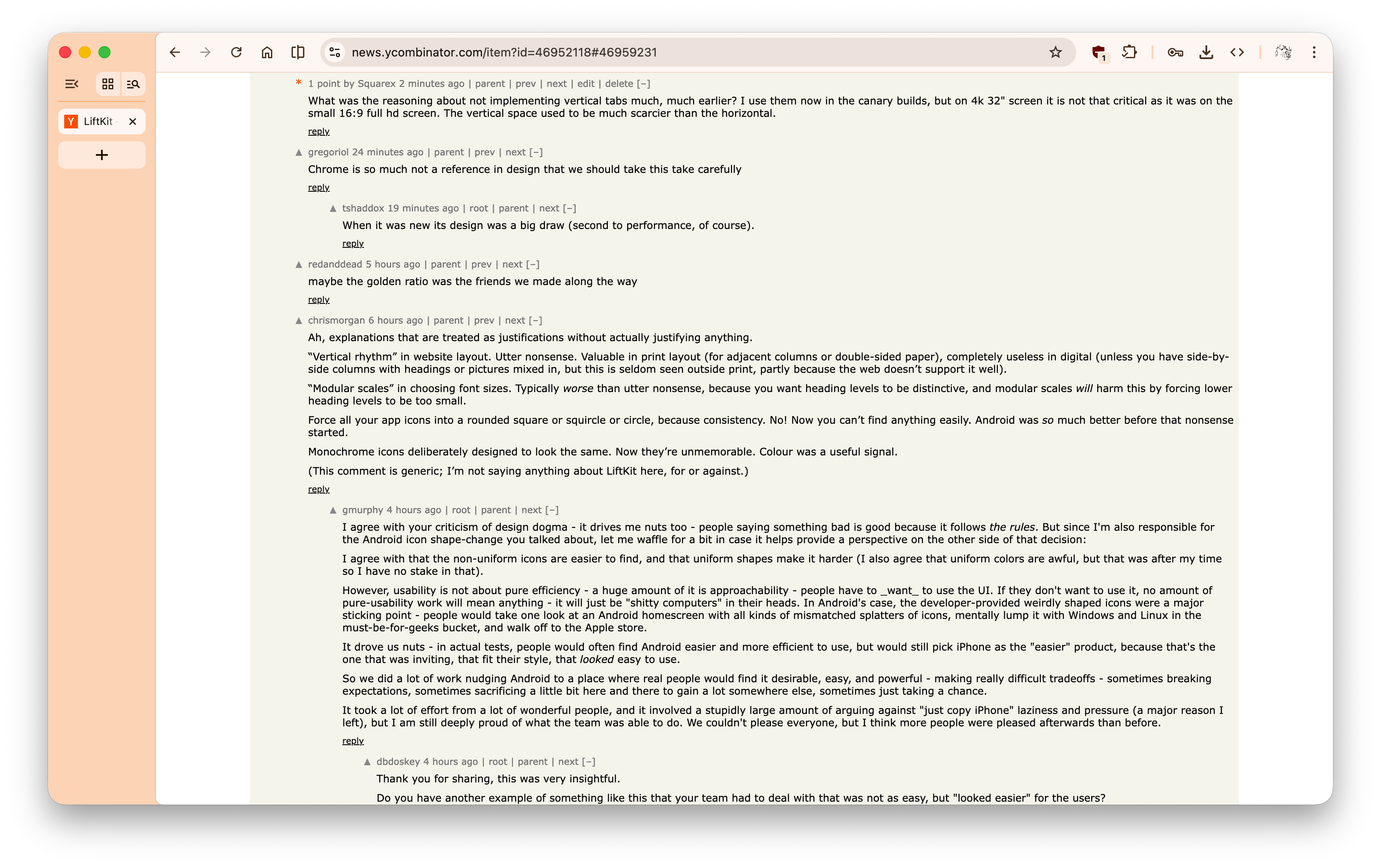
by Squarex
2/10/2026 at 12:46:49 PM
Chrome is so much not a reference in design that we should take this take carefullyby gregoriol
2/10/2026 at 12:51:24 PM
When it was new its design was a big draw (second to performance, of course).by tshaddox
2/10/2026 at 1:24:50 PM
Are you confusing modern Google Chrome with early Google Chrome, or did you dislike early Google Chrome?by Wowfunhappy
2/10/2026 at 1:17:34 PM
All other browser I've tried (firefox, vivaldi, edge, safari, atlas, many others) and all other programs with a tab-based UI I use (zed, vs code, sqlitebrowser) look worse.by amadeuspagel
2/10/2026 at 2:17:36 PM
> All other browser I've tried (firefox, vivaldi, edge, safari, atlas, many others) and all other programs with a tab-based UI I use (zed, vs code, sqlitebrowser) look worse.Both you and the poster could both be correct.
Looking good and being a poor interface are unrelated.
IOW, something could look absolutely beautiful and still have a nightmarish UI.
"Looking pretty" is subjective. Being a good UI is objective.
by lelanthran
2/10/2026 at 3:09:56 PM
Reminds me of how like 10 years ago there were the fanbois who wanted to do their cars in Material Design or tatto Material Design on their face and such.by PaulHoule
2/11/2026 at 7:43:40 PM
Yes, people who disagree with me about which program has the best implemention of a tab-based user interface remind of people who tattoo things on their face as well.by amadeuspagel
2/10/2026 at 1:18:49 PM
What don't you like about Chrome design?by xnx
2/10/2026 at 4:21:45 PM
It's not that there is anything to like or dislike: it's just that there is no "design" in it, nothing to referenceby gregoriol
2/10/2026 at 4:59:52 PM
If you're talking about graphic design, that's probably true. I'm talking about the thousands of design decisions the Chrome team made to decide exactly what to include and not to include, where to put things and how they appear, what words are used, and how features behave. Chrome is heavily and well designed in that regard. It's evident that everything was heavily considered and evaluated. I contrast Chrome to other apps and websites where it feels like the "designers" may not use the product at all.by xnx
2/10/2026 at 9:20:55 PM
Ironically many of the website’s examples look worse than what they compare against. Taste is personal, I guess.by port11
2/10/2026 at 8:35:18 PM
"lighting, rounding, color, and visual strength" along with "clarity, content-focused" etc. are used as hollow buzzwords just as much as "golden ratio"The whole minimalism/flat movement from iOS 7 and Google's Material and Microsoft's Metro crap was frankly a lazy and weak copout, a give-up on trying to make nice looking UI that could also be functional.
Why is it that sci-fi has always had such beautiful UI since Star Trek but the real world is still so boring?
by Razengan
