2/9/2026 at 5:29:43 PM
In The Cuckoo's Egg Cliff Stoll recounts an episode from the oral defense of his astrophysics PhD thesis. A bunch of people ask questions but one prof holds back until...""" “I’ve got just one question, Cliff,” he says, carving his way through the Eberhard-Faber. “Why is the sky blue?”
My mind is absolutely, profoundly blank. I have no idea. I look out the window at the sky with the primitive, uncomprehending wonder of a Neanderthal contemplating fire. I force myself to say something—anything. “Scattered light,” I reply. “Uh, yeah, scattered sunlight.”
“Could you be more specific?”
Well, words came from somewhere, out of some deep instinct of self-preservation. I babbled about the spectrum of sunlight, the upper atmosphere, and how light interacts with molecules of air.
“Could you be more specific?”
I’m describing how air molecules have dipole moments, the wave-particle duality of light, scribbling equations on the blackboard, and . . .
“Could you be more specific?”
An hour later, I’m sweating hard. His simple question—a five-year-old’s question—has drawn together oscillator theory, electricity and magnetism, thermodynamics, even quantum mechanics. Even in my miserable writhing, I admired the guy… """
by staplung
2/9/2026 at 7:44:04 PM
It also needs a bit of biology. Our eyes don't have a flat response over frequency, they're more sensitive to blue than violet. Violet gets scattered even more than blue, and the violet light does shift our perception of the color. But it does so less than it would if we had photoreceptors more sensitive to violet, so the resulting perceptual color depends not just on the intensity of the light at different frequencies but also on our particular biology. People with tritanopia (blue-yellow color blindness) don't have blue-sensitive cones (S cones) and thus to them there is no perceived blue. Not to mention the linguistic history of the word "blue" and why English uses "blue" instead of "青" or some other word, the questions around qualia & what it means to perceive color, etc.by SAI_Peregrinus
2/9/2026 at 11:47:00 PM
There are differences in receptor behavior across species, but they are understandably clustered around the parts of the spectrum in which sol is most luminous. An earth-like planet orbiting a different star would likely have evolved photoreceptor arrangements which match that star instead. So after scratching the biology itch we'll probably need to talk about fusion byproducts in sol-like stars.by __MatrixMan__
2/10/2026 at 3:59:25 AM
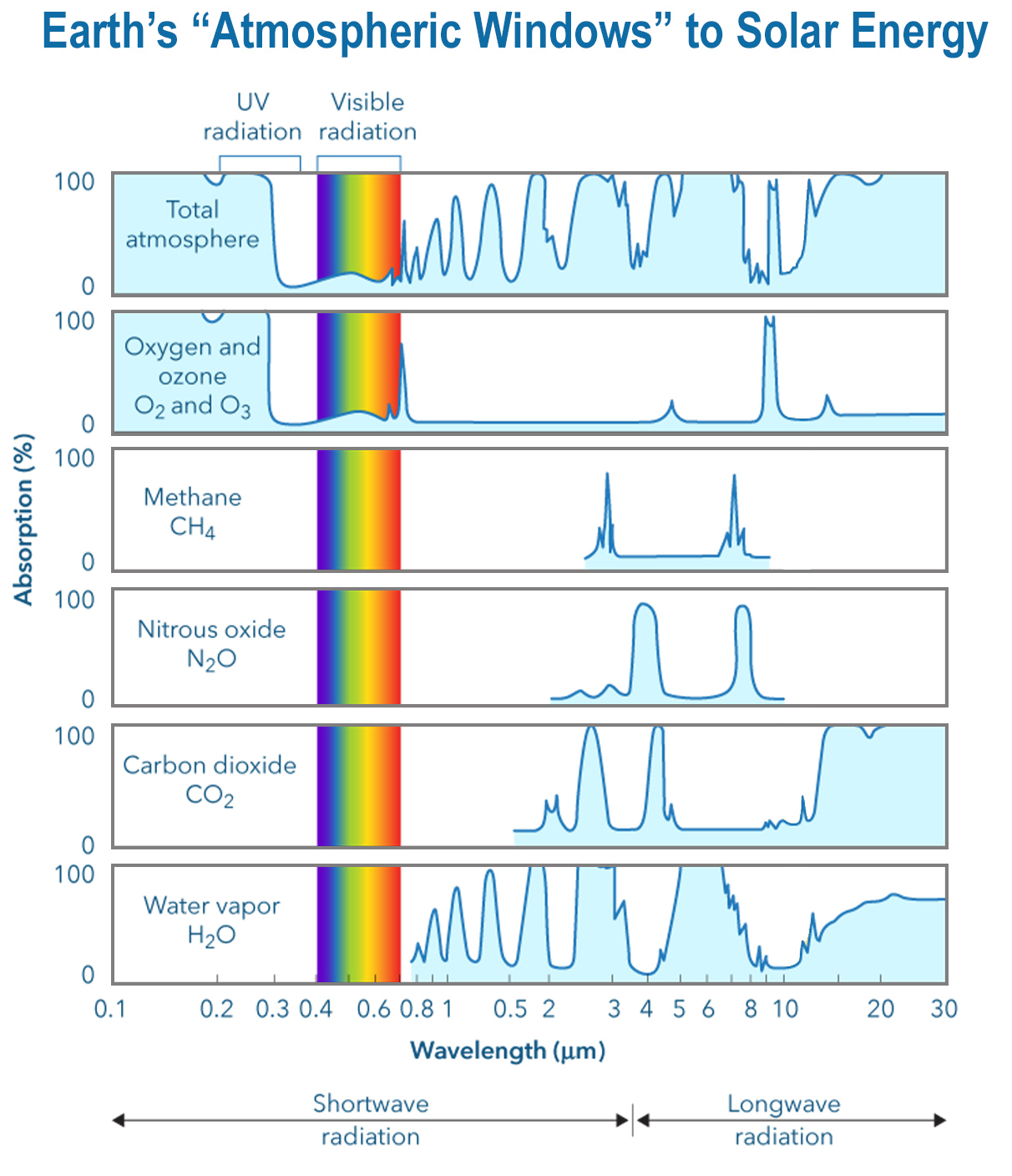
> they are understandably clustered around the parts of the spectrum in which sol [sun] is most luminousThat would be understandable but it’s not what’s going on: http://hyperphysics.phy-astr.gsu.edu/hbase/Chemical/watabs.h...
by kgwgk
2/10/2026 at 11:50:28 PM
I didn't know that about water, thanks.by __MatrixMan__
2/10/2026 at 9:26:46 AM
Ah - so I guess that's why snakes have pit sensors for infrared.by tim333
2/10/2026 at 5:04:57 PM
> An earth-like planet orbiting a different star would likely have evolved photoreceptor arrangements which match that star instead.No, not really- the limitation is chemical, not evolutionarily-driven. Earth is very well lit in infrared, but it's very difficult to make a chemical that is biologically useful for seeing infrared because the wavelengths are just too long. Its very challenging to do more than the most primitive kinds of sensing in infrared. If our sun was much dimmer, we would probably be blind, but if not our eyes would still not see in far infrared. Same goes for ultraviolet- the energy is too high and molecular bonds are too weak. Seeing in visible light is a reversible reaction, but ultraviolet wouldn't be.
What you're saying is true of ocean animals, especially in the deep sea. They don't see red very well or at all, but the evolutionary pressure against seeing red is not terribly high except very deep where food is very limited.
There also is evolutionary pressure on our vision, but it has nothing to do with the sun. We're twice as sensitive to green since it is so common and important, but green comes from photosynthesis and not from the color of the sun. In a way, we are most sensitive to the least important color of light- the color that is not absorbed by plants. The wasted, useless byproduct of sunlight is what lets us identify food.
Plus, we actually basically only see in blue and green. The overlap between rods and red/green cones is huge. "red" and "green" as we perceive them are mostly fabrications of our neural circuits- if we were seeing them how our photoreceptors actually receive light, all shades of green/red would be very strongly mixed together. All shades of red would look significantly green except for the very farthest reds, which would look very dark because of low sensitivity.
by hwillis
2/10/2026 at 1:23:57 PM
dogs see violet better, so "normally" our sky would be blue to them. But because their eyes have only two types of color receptor, they see violet as blue, and our sky is also blue to them.Same outcome, but for a different reason!
by jll29
2/9/2026 at 9:10:49 PM
The real question is, is the sky blue for everyone? Some creatures can see ultraviolet. Some lack color at all…by reactordev
2/10/2026 at 12:14:39 AM
Some animals have more cone types than humans, especially various birds, so would probably see a violet sky.We don't have this because common ancestor for all mammals lost all cones but one, perhaps due to being nocturnal, and a second was re-evolved as mammals became more dominant (after dinosaur extension). A third cone was evolved in primates due to a gene duplication that gave us our green cone
https://www.sciencedirect.com/science/article/pii/S004269890...
by daedrdev
2/10/2026 at 1:36:09 AM
maybe in 100M years we'll get a 4th cone or rod. Probably from nuclear mutation...by reactordev
2/10/2026 at 2:22:27 AM
We already have mutations, generally in women, for tetrachromaticism, who usually have male relatives with severe or moderate color blindness, in which the X chromosome encodes a different green cone. So they end up seeing red, strange-green, green, and blue, where strange-green is somewhere closer to red than green.Only a few on record but they tend to have absolutely insane color matching and color perception. One of note worked in the fashion industry and could match fabrics perfectly even in varying lighting (e.g. working under fluorescent but able to match colors that would stay matched in halogen/stage lighting)
by jaggederest
2/10/2026 at 3:06:09 AM
I have that already ;) it actually looks like muddy puke green than green. However, green stop lights look more “white” than green.Some reds look like brown. I hate reds. I’m not sure about the Pantone-like color matching but I definitely see different colors than most people. To the point where my flight license is restricted.
Dichromatic but not trichromatic.
by reactordev
2/12/2026 at 5:06:07 AM
Not sure if you'll see this but you should check color perception with any female relatives, they're much more likely than average to be tetrachromats!by jaggederest
2/10/2026 at 6:19:31 AM
how does dichromatism restricts flight license? no instrumental flights? no night flights? something about perceiving warning lights on some panels?by codesnik
2/10/2026 at 9:08:55 AM
All threeby reactordev
2/10/2026 at 1:11:32 PM
> maybe in 100M years we'll get a 4th cone or rod. Probably from nuclear mutation...There’s a Greg Egan short story (I think it’s ‘Seventh Sight’) where a bunch of formerly blind kids with cybernetic eyes hack the receptors to respond to wavelengths other than the traditional RGB. So perhaps it wont take millions of years.
by mr_toad
2/10/2026 at 2:19:42 AM
There's some evidence that tetrachromacy already exists in a few humans. If so we have the gene already. But why would it spread?by int_19h
2/10/2026 at 8:16:24 AM
fringe theory just for a bit of fun: since screen use 3 colors diodes, maybe people with tetrachromacy would be less addicted to screens, making them both more grounded in real life and marginally more successful, leading to them having more children?I have no idea how to test it. But in my heart I know that screens with RG, GB or RB color models would suck enough that any screen addiction would be cured instantly.
by lesostep
2/10/2026 at 9:10:13 AM
I wouldn’t be so sure, for a decade all we had was G and we used more and more of it until we died of dysentery outside Eagle River.by reactordev
2/10/2026 at 12:17:49 PM
You were supposed to ford the river!by fragmede
2/10/2026 at 2:54:15 PM
You know our supplies were:1 axle.
1 wheel.
1 bundle.
100 boxes of ammo.
10,000lbs of bear meat.
2lbs of squirrel meat.
We sank like a rock.
by reactordev
2/10/2026 at 9:17:09 AM
They need special screens with four colors and the internet updated to make it more interesting for the tetrachromatic.by tim333
2/10/2026 at 11:58:48 PM
this is true of many human mutations with the development of medical care, its not like we face evolutionary pressure for many thingsby daedrdev
2/9/2026 at 11:06:09 PM
I puttered on a color interactive where, to emphasize this distinction between world-spectra vs brain-color, you could swap in color deficiencies, a non-primate mammal ( dichromats), and a monochromat.by mncharity
2/10/2026 at 1:38:21 AM
this is fascinating because I'm red/green color deficient yet I have no problem seeing most reds or greens. I feel there's a "spectrum" of color that we all see and each of us is slightly different. My shade of green may not be your shade of green. Yet, when I point out my shade of green - it matches your shade of green because of our eyes. Even though we may be perceiving entirely different colors.by reactordev
2/10/2026 at 2:15:23 AM
Most colorblind people aren't dichromats, they're so-called anomalous trichromats. Basically, the genes coding opsins in your eyes have a number of functional sites that tune the spectral sensitivity. Those sites are tuned as far apart as they can be in color-normal humans. Anomalous trichromats usually have a genetic error that causes their opsins' sensitivity curves to overlap more, which manifests as reduced color sensitivity.by AlotOfReading
2/10/2026 at 3:17:59 AM
This occurs in other animals as well.by reactordev
2/11/2026 at 12:25:35 PM
Imagine a chromaticity diagram, but on a perceptual color space where long-range euclidean distance at least attempts to describe the magnitude of perceived difference (rather than the usual model artifacts) - so round-ish. Then decreasing perceived difference between red and green shows up as a smush to oval.by mncharity
2/10/2026 at 1:57:40 AM
How would Lieutenant Geordi La Forge from ST Next Generations see the sky with his visor?by goatlover
2/10/2026 at 3:19:05 AM
You know that scene with the Nexus ribbon? Probably a huge version of that. But it depends on what timeframe we’re talking. Visor Geordi or Eye Optics Geordi?by reactordev
2/9/2026 at 6:41:56 PM
"Could you be more specific" is a great question to find out more what the person knows and how they thing. You give an answer that, just due to the nature of knowledge and the limitation of language, has some black boxes. And "could you be more specific" is basically asking to go through the black boxes.Its like asking how does Java work or something like that? You can go from "The JVM interprets java byte code" to quite a lot of depth on how various parts work if you have enough knowledge.
by ecshafer
2/9/2026 at 7:15:20 PM
i used something like this in unstructured technical interviews all the time."you type a phrase into google search, you press enter, get some results. tell me, in technical detail, what happened in that chain of actions"
the diversity of replies is fascinating, you learn a lot about a "full stack" candidate this way.
Feynman's classic "Why?" chain: https://www.youtube.com/watch?v=36GT2zI8lVA
by leeoniya
2/9/2026 at 7:59:58 PM
I'd probably spend at least 20 minutes just to get through how the keyboard works, much more if it's a USB-HID device.by SAI_Peregrinus
2/9/2026 at 8:26:46 PM
Hah - that is exactly what I did. Someone asked me this question and after 5 minutes in the weeds of the debounce on the mouse click they said "look all we wanted was to find out if you'd ever heard of DNS, let's move on, that was great".by dmd
2/9/2026 at 8:56:29 PM
the good ones would usually follow up with, "how much detail do you _really_ want ;D"by leeoniya
2/10/2026 at 10:37:22 AM
I always wanted to talk about our lord and savior (BGP) but so far no one took the bait!by pas
2/10/2026 at 12:29:40 PM
There is a chapter on why the sky is blue in The Feynman Lectures : https://www.feynmanlectures.caltech.edu/I_32.htmlby mgemard
2/9/2026 at 11:12:08 PM
A great response is "What exactly do you want to know?", so we don't end up like Cliff giving answer after answer. In his case it was a great test question, but such a vague question is a horrible communication tactic if abused.by ASalazarMX
2/10/2026 at 4:49:37 AM
Having two older brothers who are famous trial lawyers, I can attest that it's both an effective line of questioning and a deeply infuriating one. What I learned is that up to a certain point, it's feigned ignorance probing whether one knows a principle behind a stated principle. Beyond that point, though, you can basically make shit up and they won't know the difference. Come to think of it, this is also the sleight-of-hand pulled by LLMs when you ask them for more and more detailed answers. The trick is knowing when your interrogator no longer knows the answer.[edit] Also, in my family, you'd ask Dad these questions. And if he didn't know the answer, he'd pull out the Britannica, and have you look it up, then go over it with you until he understood it well enough to explain it. "No short answers" was his motto. (He was also a trial lawyer). Most people are just not equipped to handle cross-examination, and it's scary for them... but the primary reason is that they never learned to admit when they don't know the answer.to a question, and that admitting you don't know is not a failing, but actually a strength, especially if it impels your curiosity to go find the answer.
by noduerme
2/9/2026 at 10:06:42 PM
It's reminds me of that scene from Fargo: "He was kinda funny lookin'" ... "Could ya be any more specific?"by HPsquared
2/11/2026 at 11:46:38 PM
A great story, though it seems a little odd to me since Rayleigh scattering was covered in my undergrad exoplanets course. I'd expect an astrophysics PhD to have a better first answer than "scattered sunlight".by Ferret7446
2/9/2026 at 7:51:55 PM
I am positively excited about the upcoming first generation of humans who will have all their questions answered, correctly and in the way they can best understand, and as often and many of them as they want – and what that is going to enable.by jstummbillig
2/9/2026 at 7:57:29 PM
The same anticipation of great things happening preceded the arrival of widely available internet, but all we really got was cat videos initially, and doomscrolling more recently. I don’t have much hope for great things anymore.by brabel
2/10/2026 at 4:16:00 AM
I just did a crash course on lingustics by reading through a bunch of highly specialized articles.30 years ago, just finding those articles would require spending many hours in the library (and that's if I'm lucky and the library has them).
It's definitely not just cat videos.
by int_19h
2/9/2026 at 11:15:14 PM
I saw a Microsoft talk decades back, that was a dispirited "the people of India could be buying educational materials and... but no, all the money is in ringtones". For some kinds of business perspective, ok I guess. But for others, and for civilizational change, what's going on in the tail can matter a lot. Does China become a US engineering/science peer in early 21st C absent an internet/WWW?by mncharity
2/10/2026 at 10:06:55 AM
Well, the thing is that the educational materials are largely free. That's why the people of India don't need to buy them.Isn't that a better world than one where the ringtones were free?
by eru
2/11/2026 at 12:48:33 PM
Ah, perhaps I should have said something like "educational materials, and apps, and other useful things" (disapproving judgement in the original).> Well, the thing is that the educational materials are largely free.
A triumph and fruition of these last decades of massive effort. Now we just need to deal with their quality (with commercial as bad as free). AI may help, by reducing barriers to content creation - you might for example, now more easily author an intro astronomy textbook, one that doesn't reinforce top-30 common misconceptions, something the most used (US; commercial) texts still don't manage.
by mncharity
2/11/2026 at 2:33:07 PM
I’m pretty curious. What are those too 30 misconceptions in US commercial astronomy texts? Is there a list somewhere? Or can you name some?by fivestones
2/11/2026 at 11:50:52 PM
Sigh. One impact of AI will hopefully be more readily available systemic survey papers. [1] might-or-not be a good place to start... but it's paywalled (by the National Science Teacher Association no less), and I don't quickly see preprints/scihub/etc. Here's an old unordered list for browsing[2], and a more recent one[3]. Trumper did a series of papers asking the same few questions of various populations, to give a feel for numbers - like half not knowing day-night cause. Most lists are on subsets of astronomy, and most info on frequency on short lists. So... it's a mess. As are textbook reviews. Key phrases are "astronomy education research" and "misconceptions".The one bit I explored was 'what color is the Sun (the ball)'. Asking first-tier astronomy graduate students became a hobby, as most get it wrong (except... for those who had taken a graduate seminar covering common misconceptions in astronomy education). So I libgen'ed the 10-ish most used intro astronomy textbooks in US according to some list. IIRC, it broke down roughly into thirds of: correct (white); didn't explicitly say but given surrounding photos, or "yellow" (as classification without clarification), there's no way students won't be misled; and explicitly incorrect (yellow). Hmm, bulk evaluation of textbooks against some criteria is another thing multi-modal models could help with.
(A musing aside re AI for systemic reviews. Creating one is a structured process. They have been very manpower intensive, so they aren't refreshed as often as is desired, nor consistently available. And at least in medicine ("X should be done in condition Y"), there's a potential for impact. I imagine close reads of papers isn't quite there yet. But maybe a human-AI hybrid process?)
[1] https://www.per-central.org/items/detail.cfm?ID=14009 [2] https://web.archive.org/web/20070209033543/http://www.physic... [3] appendix A of https://digitalcommons.library.umaine.edu/etd/2200/ [4] https://www.oranim.ac.il/sites/heb/SiteCollectionImages/pers...
by mncharity
2/13/2026 at 12:51:00 PM
s/systemic/systematic/g - oops.> Systematic reviews are rigorous, transparent, and reproducible research studies that synthesize all existing evidence on a specific topic to answer a focused question and minimize bias. Unlike narrative reviews, they use predefined eligibility criteria, comprehensive searching, and critical appraisal to evaluate primary literature, often employing meta-analysis for quantitative results. [goog ai overview, edited]
by mncharity
2/9/2026 at 9:11:27 PM
We got more than that. We got 24/7 surveillance.by reactordev
2/10/2026 at 9:18:25 AM
I grew up with Mr RogersGen Z grew up with Mr Beast
We are proper doomed mate.
by 6stringmerc
2/13/2026 at 1:06:38 AM
> who will have all their questions answered, correctly and in the way they can best understandHighly unlikely as the feedback cycle used to train LLMs will choke off all future learning.
In other words if AI bots consume and regurgitate everything you publish on the internet what is the incentive to publish anything? No one will read it except the bots. The training datasets will either become stale (no longer learning anything new because nothing new and useful is published) or actively poisoned (because only bad actors will bother to publish).
And the generation constantly fed mostly correct information by AI will implicitly trust it further making poisoning of the models a high-value target.
Very few people will be left who understand how to think and have the motivation to do so. Even fewer will have the motivation and the means to publish to others.
by xenadu02
2/10/2026 at 1:35:40 AM
I childishly looked for a historical quote on how we should all be doing science at home now. Google referred me to a gorgeous article written by Isaac Asimov: While computers and robots are doing the scut-work of society so that the world, in 2019, will seem more and more to be “running itself,” more and more human beings will find themselves living a life rich in leisure.
This does not mean leisure to do nothing, but leisure to do something one wants to do; to be free to engage in scientific research, in literature and the arts, to pursue out-of-the-way interests and fascinating hobbies of all kinds.
Unfortunately the link seems to contain some advertisements so perhaps google yourself to find a better source. I looked for a filetype:pdf but that didn't help me (although Gemini AI did helpfully summarise the same article).
We are definitely fortunate to live in a world with free access to information.
Unfortunately my skills at search are getting rusty.
by robocat
2/10/2026 at 3:22:25 AM
Sometime around 1992, I wrote a college essay on how the Internet was going to wipe out ignorance and enable true democracy...by lamontcg
2/10/2026 at 9:22:23 AM
Ah, crickets! Just got the two nouns in the wrong order..by fransje26
2/9/2026 at 10:59:00 PM
I presume you're referring to LLMs here, but if so, your presumption that their questions will be answered "correctly" seems a bit optimistic.by decimalenough
2/9/2026 at 11:27:58 PM
Does anyone have experience of early-childhood "Why?"-phase meets speech-enabled LLMs?Startup wise, there's old work on conversational agents for toddlers, language acquisition, etc. But pre‑literate developmental pedagogy, patient, adaptive, endlessly repetitive, responsive, fun... seems a potential fit for LLMs, and not much explored? Explain It Like I'm 2-4. Hmm, there's a 3-12 "Curio" Grok plushie.
by mncharity
2/9/2026 at 9:22:48 PM
... and due to that, people will not appreciate all the knowledge, we will take it as air - invisible but cut the access in a myriad ways and its a catastrophe.We value what we achieve with effort, I would say proportionally to energy put in (certainly true for me, thus I like harder efforts in activities and ie sport climbing).
by kakacik
2/9/2026 at 8:24:28 PM
Me too but I don't think these sorts of Solved Society endgames are likely to show up. Basically presents the same issue with a utopia.Progression and regression are always going to be at war with each other. There will always be humans that want to hurt instead of help, there will always be humans who TRY to help but ultimately hurt. There will always be misinformation, there will always be lies, and there will always be liars.
The good news is there will also always be people trying to pull humanity forwards, to help other people, to save lives, to eradicate disease, educate, and expose the truth.
I don't think society will ever be solved in the way you're saying because there will always be hurtful people, but there will also always be good people to keep up the fight.
by ryanmcbride
2/10/2026 at 9:17:42 AM
Hard truths are not desirable and I pity and envy your naitivity.by 6stringmerc
2/9/2026 at 10:00:50 PM
When is that going to be?by Starlevel004
2/10/2026 at 11:33:02 AM
What I love is that the question is child-simple but bottomlessby SwtCyber
2/10/2026 at 2:42:32 PM
I remember reading this - first thing I thought of too when I saw the headline.by hackeraccount