2/8/2026 at 6:14:05 PM
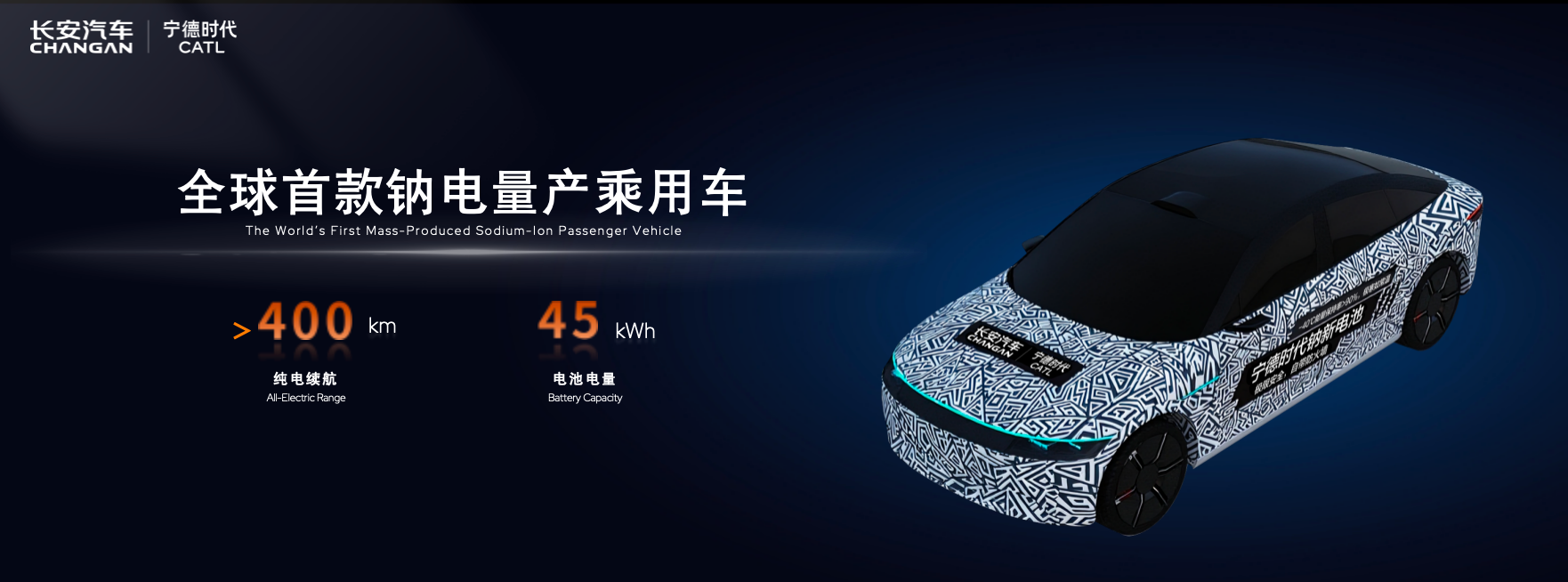
What I wanted to know from the article: The CATL Naxtra sodium-ion battery will debut in the Changan Nevo A06 sedan, delivering an estimated range of around 400 kilometers (249 miles) on the China Light-Duty Test Cycle.
It delivers 175 watt-hours per kilogram of energy density, which is lower than nickel-rich chemistries but roughly on par with LFPby letharion
2/8/2026 at 7:44:33 PM
Thanks, I wanted to know about price. Isn't that the main benefit of sodium-ion. On par energy density with LFP, but a lot cheaper.by johanvts
2/9/2026 at 1:17:53 AM
The main benefits are that Sodium is abundant, cheap and stores 30x the energy of Lithium per unit mass. The draw back is that when exposed to water it explodes with 30x the energy of Lithium. The other drawback is that it bursts into flame when exposed to air.Think of it this way, Sodium metal is abundant and cheap with 30x the energy storage (and energy transfer) of other solutions yet nobody has used it in almost any product ever (including as a coolant). The volatility of Sodium is why. Unless they have a solution to this, then I would be shorting whoever is insuring these batteries.
by hunterpayne
2/9/2026 at 1:35:31 AM
Sodium ion batteries use sodium ions, like in table salt. They correctly are not named metallic sodium batteries. They are less fire prone than lithium batteries, even in locations containing air.You should also consider shorting Morton [0]. They sell sodium, combined with chlorine, one of the nastiest elements around! And for products that go in people's homes! On food!
by margalabargala
2/9/2026 at 1:57:43 AM
This isn't correct. This is only true when the battery is first manufactured just like with Li-ion. Once the battery starts functioning, it is ionized metallic Sodium. All the volatility of Na but with corrosion too. There is no Chlorine nor any other halogen in there to engage in an ionic bond. In short, once the battery is functioning, the trick used to keep the Na in an ionic bond stops working (by design). After all, the ionic bond would prevent the battery from functioning.It should be noted that most manufactures aren't doing pure Na-ion. They are mixing in a little Na with the Li to stretch Li supplies and gather data on the impact of the increased volatility on safety. I wouldn't expect their first use to be in cars. I would expect them to be in grid stabilizing batteries.
by hunterpayne
2/9/2026 at 2:35:31 AM
I was sure you were wrong so I went and did some reading and, you're right. I'm wrong.I was thinking of the aqueous sodium ion batteries, which do not have the issues described. I thought those were the ones that are commercially available, but that's not the case.
by margalabargala
2/9/2026 at 2:41:04 AM
Kudos on being big enough and actually caring about accuracy.by hunterpayne
2/9/2026 at 8:58:18 AM
This chain is an example of why I love HN so much.by rkagerer
2/9/2026 at 7:42:33 AM
you deserve a high value metal medalby aixpert
2/9/2026 at 12:43:23 PM
Isn't there very little free sodium in such batteries? At any point in time most of it should be intercalated in one or the other electrode, no?by Tade0
2/9/2026 at 7:41:38 AM
Morton salt is currently owned by Stone Canyon Industries which is a holding company.by SapporoChris
2/9/2026 at 12:46:36 PM
In ancient times, salt developed an extraordinary reputation. Not only was it prized as a preservative, but it was a nutritious seasoning as well. Salt had great value, and much of that nutritional value could be ascribed to the trace minerals which it carried as it was mined or otherwise harvested.Nowadays, the manufacturers of refined table salt present you with a digusting proposition: sprinkle this worthless elemental sodium-chloride onto your food, because it is "salt" and they are 100% trading on its ancient reputation. Perhaps it is better to simply trample it underfoot?
Unfortunately, all the trace minerals are missing from refined salt. That pure white, homogeneous, translucent quality gives it away. The refining of salt is done purposefully, because the trace minerals are more valuable to supplement vendors.
All those trace minerals are separated out and sold out to companies who will assemble them into expensive dietary supplements. Your magnesium, and selenium, and zinc that you pay $30 a bottle for.
And that is also why sodium has such a nasty reputation in 2026. If you get CVD then you avoid sodium. If you get hypertension then you avoid sodium. Sodium is avoided like the plague. No physician will recommend sodium or table salt for a diet! Why should they? Adding sodium no longer introduces trace minerals or nutrition, it only introduces saltiness.
It is still possible to find unrefined salt. It may be sold as "sea salt" or "kosher salt" but you'll need to find it in transparent packaging. If it contains impurities that look like pepper or dirt, then it is unrefined. If it is imprinted with the obligatory fake warning about iodide, then it may be unrefined. (The mandatory FDA "iodide" warning is not only fake, it's misleading and downright malicious.)
Good luck with your salt! With love from your eponysterical HN noob!
by RupertSalt
2/10/2026 at 5:17:50 AM
You lifted most of your quote from https://www.navmi.co.in/difference-between-refined-salt-and-... without citing your source.However, the information is false. The amount of nutrients in unrefined salt is negligible. Yes it contains trace minerals but not in any significant quantity.
by SapporoChris
2/10/2026 at 6:49:24 AM
That's an outright and verifiable lie.I have never seen or visited that website ever in my life. Why would I? I wrote my comment completely originally, and your accusation of bad faith is, in itself, bad faith.
In fact, none of the content which I typed into my comment is found in that blog article. How and why did you even find it? Anyone else here can read and confirm that I copied nothing. I quoted nothing. I owe nothing to anyone. My comment is original and copyrighted by myself (c) 2026, all rights reserved.
With respect to the content or other materials you upload through the Site or share with other users or recipients (collectively, “User Content”), you represent and warrant that you own all right, title and interest in and to such User Content, including, without limitation, all copyrights and rights of publicity contained therein. By uploading any User Content you hereby grant and will grant Y Combinator and its affiliated companies a nonexclusive, worldwide, royalty free, fully paid up, transferable, sublicensable, perpetual, irrevocable license to copy, display, upload, perform, distribute, store, modify and otherwise use your User Content for any Y Combinator-related purpose in any form, medium or technology now known or later developed.
by RupertSalt
2/9/2026 at 7:56:18 AM
CATL has been producing Sodium-ion batteries since 2022. As CATL has continued to produce and introduce new Sodium-ion batteries, it appears they might have a solved the issue with volatility.If they have not solved the problem, I still wouldn't recommend shorting any companies. Shorting a stock and waiting for years for it to drop is not a great strategy.
by SapporoChris
2/10/2026 at 3:02:32 AM
Think of it this way, Sodium metal is abundant and cheap with 30x the energy storage (and energy transfer) of other solutions yet nobody has used it in almost any product ever (including as a coolant).Huh? See https://www.terrapower.com/natrium/ -- and it's not exactly a new idea.
Also not uncommon to use sodium-filled exhaust valves in car, motorcycle, and aircraft engines.
by CamperBob2
2/9/2026 at 12:39:00 AM
I thought the price differential was not going to happen as there was a serious drop in the price of Lithium over the past year; but I looked it up and the lithium price drop is more a 5 year trend, with the last few months having a sudden surge in the price.by jbm
2/9/2026 at 1:19:28 AM
Increased production of Lithium is why. However, that only drains the (very limited) reserves of Lithium more quickly. Currently we have about 75 years left of it at previous extraction rates. More could be found, that is unlikely.by hunterpayne
2/9/2026 at 5:30:51 AM
Draining lithium reserves isn't that important - batteries don't use up the lithium, once the battery dies you can just suck out all the lithium and re-use it (and battery electrolytes are ~100% lithium, compared to lithium ore/brine being anywhere from 0.1% to 15% lithium - an order of magnitude difference). And since modern batteries are more efficient than old batteries with the same amount of lithium, we effectively increase the circulating lithium capacity over time.In 75 years we won't need to extract more lithium - except the fraction needed to replace permanently-lost batteries.
Incidentally, you should be very careful when talking about "<resource> reserves", because the definition of a reserve is usually "<resource> that is profitable to extract" - and when we "run out", prices will go up and thus currently-unprofitable sources will become profitable, and POOF! Our <resource> reserves have increased, purely through the power of semantics.
Also, over the decades resource extraction becomes cheaper and thus more sources become profitable.
Personally though, I don't think any of that will matter -IMO the future is proton batteries, AKA Hydrogen batteries (which use an electrolyte of "ionic hydrogen", H+, which has 1 proton and 0 electrons - people claim lithium is the lightest metal, but it has 3x the protons of hydrogen). I think that the recent TABQ batteries, or something like it, will become commercially viable within 75 years (although who even knows what batteries will look like in the year 2101).
by Qwertious
2/9/2026 at 11:30:15 AM
Nobody has ever recycled Lithium, just reused the cells that lasted longer than average. We have no idea how to actually recycle Li. We don't even understand the physical mechanism that causes it to exhaust. We think if we just let it sit around for a few decades, it might just come back on it own. We don't know though.As for reserves, while you understand the economics you are missing the physics. For example, there is Li (and U) in the ocean. We don't extract Uranium from the ocean not only because it isn't economical, it isn't even energy efficient. This is because moving a billion tonnes of water takes more energy than the 3 tonnes of Uranium you would harvest from doing that. For Li, its takes just as much energy (and money) as its just as rare. In other words, there is a floor on that economic extraction argument specified by a positive EROEI (energy returned on energy invested).
by hunterpayne
2/9/2026 at 10:10:32 PM
Yes, we have. This is a well understood and fairy simple chemical process, you grind up non-working Lithium battery and split up the FOD from the metals then it's just basic chemical metal refining from here on out? When lithium is mined and extracted it goes through the exact same processes.If you have any other sources or information on why we can't recycle lithium please let me know. As far is battery failure goes it's a mechanical failure on a chemical level
by vablings
2/10/2026 at 4:56:30 AM
And the name of the company which is doing this?The Li that comes out of the process you describe wouldn't be recycled. It would still be mostly exhausted. Specifically, something we don't understand about the structure of their electrons causes the batteries made with such material to have a far lower capacity than if you used freshly mined Lithium. My source is a Material Engineering class at MIT.
by hunterpayne
2/11/2026 at 6:06:07 AM
We understand the structure of electrons very clearly in a lithium battery. That is the core operating principle of how a lithium ion battery works.The lithium ions are the chemical process that actually store the charge, They move from the anode to cathode in charge and discharge. The loss of these ions is what causes the degradation of the battery which is a function of entropy here. It is simply that the concise arrangement that we required for this electro-chemical to take place falls out of balance.
Entropy problem is easily solved by mashing a battery up and reconstituting it into a new battery.
To put this all simply this is all fairly basic chemistry, even if there was some kind of structure being created that has a high bond enthrall we can still undo that with enough energy.
If you could maybe share some research or other information to back up your claims other than you went to a class at MIT i would really appreciate it also the company i was saying is called Li Cycle
by vablings
2/9/2026 at 3:32:54 PM
what about the polymetallic nodules on the ocean floor, don't they contain Li? -- setting aside the environmental question, isn't that a vast untapped source?by insane_dreamer
2/9/2026 at 4:43:42 AM
I thought there were a few massive lithium sources found in the past few years like the one in Thailand which have significantly increased our estimates?by lovich
2/9/2026 at 5:29:57 AM
Sure, but by like 2 years. Lithium is rare. It sits between Cobalt and Scandium on the list of abundance in Earth's crust. And the vast majority comes from one place in South America.They are always revising estimates up and down a bit. But Li demand just keeps rising and rising. And a single grid scale battery takes 10 years of current Li-ion battery production worldwide to build.
So do we have enough Li at current rates, sure. We don't have anywhere near enough to do anything like replacing even a fraction of FFs with renewables. I guess that's the real headline here. That's why people are experimenting with Na-ion. Putting it in a production car today, that seems...what's the word...homicidal. Making a grid stabilization battery (not for backup) with large amounts of space between cabinets to see what happens, that seems more wise.
by hunterpayne
2/9/2026 at 7:24:58 AM
That 10yr per grid scale battery estimate seems high since we have built many grid scale batteries as well as millions of EVs in recent history.by kgc
2/9/2026 at 11:19:16 AM
We have many grid stabilization batteries. There are 0 grid scale backup systems. 1 year of worldwide Li-ion battery production could backup just California for about 90 minutes.by hunterpayne
2/9/2026 at 10:19:37 PM
There are virtually zero singular grid scale power systems these days. It is a mix of CCGT, Solar, Wind and Nuclear.by vablings
2/8/2026 at 8:09:05 PM
*potentially a lot cheaper.I've seen that repeated a lot but I still can't buy sodium batteries cheaper than lifepo...
by PunchyHamster
2/8/2026 at 8:25:26 PM
Sodium batteries don't yet have the scale that lifepo4 batteries have. I'd expect we will see them get cheaper.by wirybeige