2/6/2026 at 7:53:54 PM
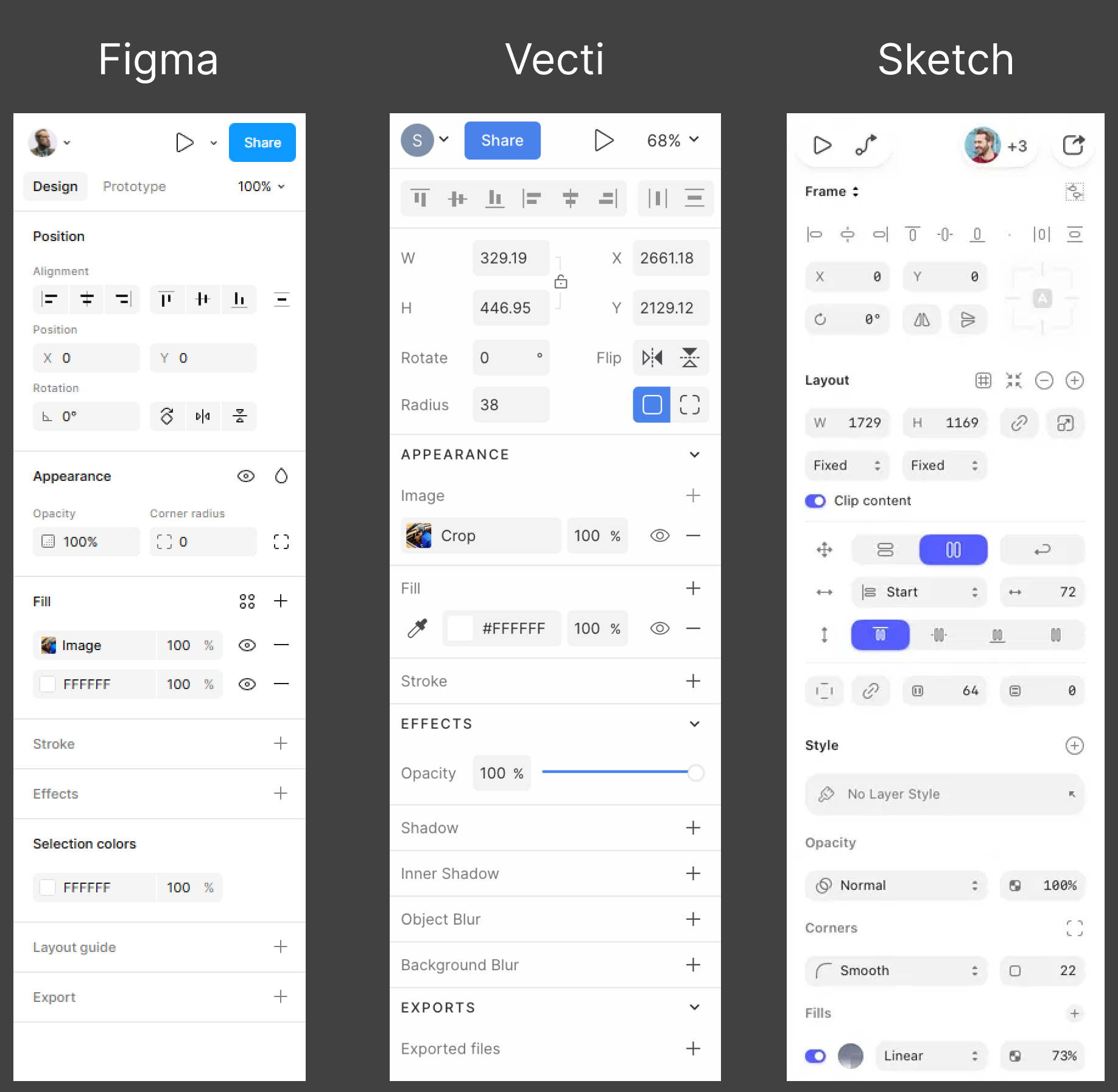
> I kept finding myself using a small amount of the features while the rest just mostly got in the way. So a few years ago I set out to build a design tool just like I wanted. So I built Vecti with what I actually need...Joel Spolsky said (I'm paraphrasing) that everybody only uses 20% of a given program's features, but the problem is that everyone is using a different 20%, so you can't ship an "unbloated" version and expect it to still work for most people.
So it looks like you've built something really cool, but I have to ask what makes you think that the features that are personally important to you are the same features that other potential users need? Since this clearly seems to be something you're trying to create a business out of rather than just a personal hobby project. I'm curious how you went about customer research and market validation for the specific subset of features that you chose to develop?
by crazygringo
2/6/2026 at 7:57:53 PM
I think a successful product strategy can be "build something you love, see if others love it too". If that's enough customers, you can judiciously expand out from there. The "fail honestly" method.I think the Apple II is one example of this.
by nielsbot
2/6/2026 at 8:11:38 PM
This is the best way to build products imo. I'm like this, and I've been accused of being very "vibes-based." However, that's a way more tractable way of shipping stuff instead of "well Jim said he wants X, but Amy said she wants Y" so you end up just kind of half-assing features because you think they might get you users, instead of just being passionately all-in into a very defined product vision (which is a very Jobsian way of doing things).It's also easier to run a feedback loop. If you implement Y, but Amy doesn't give you $5 a month, what are you going to do? Knock on her door? Users have no idea what they want half the time, anyway.
If you build a product and no one cares, it bruises the ego a bit more, sure, but if you self reflect, you can eek out your own bad assumptions, or bad implementation, or maybe a way to pivot that keeps your product ethos.
by dvt
2/6/2026 at 11:04:33 PM
In order for this to work, you have to possess good taste. Not everyone has it, and it often does not translate across domains.by linkregister
2/7/2026 at 1:04:40 AM
Good taste is an incredibly powerful differentiator in competitive markets like software. Seems like there’s 3-5 decent choices for darn near anything I need, and usually 1 smaller team has the product that stands head and shoulders above the rest.by nerdsniper
2/7/2026 at 2:32:40 AM
Unfortunately, good taste doesn’t matter for a successful software product.First let’s look at B2B, there the “user is not the buyer”. The buyer doesn’t care about “good taste” they care about a lot of other things.
(“Where is my SSO support for multiple users, I’m not going to have my IT department worry about tracking down usernames when Bob leaves)
https://news.ycombinator.com/item?id=46919794
Second, if you have the feature that people need or a service or network effect, they will suffer through a bad app - see every Electron app ever.
That “smaller team” may not be around in a year and if you are lucky, you’ll get an “Our Amazing Journey” blog post. Does this product export to a format that my design team can import into Figma if this product goes tits up?
by raw_anon_1111
2/7/2026 at 7:35:29 AM
If you want to do the proverbial “moving upmarket” then yeah you’re going to have this and a lot of other problems. Taste does not sell (let’s be nice and add “on its own”) in that segment.by Dansvidania
2/6/2026 at 8:29:19 PM
If ten people make focused tools covering different 20% subsets of the giant ones, there's a good chance of having a choice that matches what any given customer wants. And for most customers, that's going to be a better match than a big tool that does tons of other stuff they didn't want.by thfuran
2/7/2026 at 12:00:19 AM
How do the consumers find which of the dozen tools support the 20% they need?by dotancohen
2/7/2026 at 12:02:33 AM
By, get this, trying out the products. Revolutionary.by Zopieux
2/7/2026 at 12:46:59 AM
How about less snark?Especially when, who the heck has time for trying out a dozen products? That's at least a full day of work, which probably costs more than the software itself.
No, you just read a few reviews to find the best full price option and best budget option and figure out if the budget does what you need or not. And often go for full price just because you don't even know what features you'll need in 6 months which you don't need now, so safer to just learn the option that is the most future-proof.
by crazygringo
2/7/2026 at 7:43:00 AM
This post is about some highly interactive software with a lot of design decisions, and this thread is about finding whether or not your 20% feature niche is supported.Let's be real, unless some soul somehow had the same 20% as yours and left a review somewhere, you won't know if the features you need, or their implemention, fit your need until you try.
by Zopieux
2/7/2026 at 3:44:08 AM
You're right. Even across stuff I _really_ use it's hard to bring myself to try.Anecdotally I haven't tried Codex and use Claude Code. The day I try Codex will be when I hear from my friends/communities that it's much better. Same for IDEs, STT tools, etc
by ctxc
2/7/2026 at 5:28:53 AM
I tried codex on a whim when my Claude code rate limited me. Canceled my max subscription and stuck with codexby Aditya_Garg
2/7/2026 at 7:37:02 AM
It’s amusing how much of a difference in experience I hear about this. Almost hilarious if you take into account what this thread is discussing.by Dansvidania
2/7/2026 at 12:06:18 AM
“…good chance at having a match” might be a reach, as more use cases create a viable market.Are your customers selecting one of five features in your product, or choosing any twenty from among a hundred?
by cwmoore
2/6/2026 at 8:07:19 PM
>”you can judiciously expand out from there”Which is where the bulk of the other 80% of features come from. It’s a cycle.
You start as you describe, you expand, you end up with this enterprise monstrosity, everyone using a different 20%. New tool comes along, you start as you describe…
by reactordev
2/7/2026 at 12:22:44 AM
Assuming it's enterprise software.. then maybe?Hopefully you can afford to say "No" a lot.
by nielsbot
2/6/2026 at 8:44:38 PM
> Joel Spolsky said (I'm paraphrasing) that everybody only uses 20% of a given program's features, but the problem is that everyone is using a different 20%, so you can't ship an "unbloated" version and expect it to still work for most people.To me this is an argument for more apps that do less extremely well instead of a handful of apps that do everything poorly. There's nothing wrong with a tool that's honed for very specific user. They'll never hyperscale, but that's also fine.
Or then again maybe they can. Google Docs is plenty popular despite being closer to WordPad or TextEdit in terms of functionality than it is to MS Word.
by cosmic_cheese
2/7/2026 at 12:48:13 AM
Then you'll need interoperability of development artifacts to work with teams.by Hammershaft
2/7/2026 at 1:11:04 AM
opendoc remembers...by andrekandre
2/7/2026 at 2:33:41 AM
Nah it’s 2026, you have to have an MCP server.by raw_anon_1111
2/6/2026 at 11:34:28 PM
Every now and then I stumble on video game developers who have been chugging along for many years, even decades with a handful of dedicated fans. They make obscure niche games that play so well into that niche that they can sustain themselves. Honestly this is something I'd aspire to get to eventually, building a niche product that I love and that just enough people love that I could live sustainably on it, not trying to please anyone but a little collective of people who all agree on what the product should be.by TheGRS
2/7/2026 at 2:45:55 AM
Creeper World, am I right?by moritonal
2/7/2026 at 6:41:28 AM
He was talking about Excel. Google Sheets with a tiny fraction of Excel features destroyed Excel except for a tiny minority of hardcore finance and Windows users.by zaidf
2/6/2026 at 8:59:18 PM
A quick web search suggests that you are probably paraphrasing a newsletter [1] that Joel Spolsky published in 2001. He was talking about software like Excel (of which he was the Product Manager) and Word. Maybe a tool that is more focused on a narrower task (like UI design) can be less "bloated"?[1] https://www.joelonsoftware.com/2001/03/23/strategy-letter-iv...
by Alex63
2/6/2026 at 10:43:10 PM
Agree. This quote is being used out of context here. Niche software can and does succeed especially when it’s only supporting a single dev. This isn’t trying to dethrone an adobe product, or doesn’t need to.by conductr
2/7/2026 at 2:34:34 AM
A tool focusing on design is not “niche software” - every company of any size has designers. It’s trying to get professionals to use their software instead of Figma. Why would I move my team from an industry standard that they know or would be willing to learn because they know it will be important at their n+1 job?by raw_anon_1111
2/6/2026 at 8:48:14 PM
"everyone is using a different 20%"In my experience, what people use is very malleable to how easy/good the flows are they are presented with. Given 100 equal options, they might use 20, and nobody picks the same 20, but given 25 options, 20 of which present a very good experience, almost 90% will go with those 20 without complaints.
by PeterStuer
2/7/2026 at 5:38:18 AM
> what makes you think that the features that are personally important to you are the same features that other potential users need?Good question, what's the pitch:
“Vecti is a browser-based UI design tool built from the ground up with one core belief, that creators deserve tools built specifically for them. Better performance, better privacy, and better alignment with their actual needs. A tool that just works, built by someone who genuinely cares about the people using it.”
Hmm. Did founders of Balsamiq or Figma not care about the people using it? And who if not creators were they built for?
“Share & Present - Set viewer and editor permissions at the team or project level. When it's time to present … let your work shine.”
Oh, right, for the people who pay the creator.
by Terretta
2/6/2026 at 10:26:56 PM
Maybe the problem with software is feeling the need to satisfy 100% of users instead of being OK with "only" 20%. Not everything needs to be a min/max problem.by vitaflo
2/6/2026 at 11:25:09 PM
The point is that 20% of features doesn't satisfy even 20% of users. It's going to be only a tiny fraction of that because something like 99% of potential users are going to need at least one feature outside the 20%. And if a competitor has all the features they need, but you don't, then you lose the sale.by crazygringo
2/6/2026 at 11:17:06 PM
As long as the 20% is enough to sustain your company, sure. You might have to charge more, however. Luxury brands do this, for instance (fewer consumers is actually a strategic choice to make the product more exclusive). “Pro” products also do this (though often “pro” means more features, not fewer).by drob518
2/7/2026 at 6:49:09 AM
Assuming a big enough audience, that 20% can still be significant enough to build a business around.by phyzix5761
2/6/2026 at 11:36:20 PM
Could it be more people want Instagram instead of Photoshop? Take a picture, choose from one of 10 filters. Have a ~12 adjustable settings. Vs Photoshop's 1000s of options.Like lots of people prefer Trader Joes (limited selection) to a bigger super market
by socalgal2
2/7/2026 at 2:47:51 AM
> everybody only uses 20% of a given program's features, but the problem is that everyone is using a different 20%This is a phrase that gets repeated and it sounds clever. But it's completely at odds with statistics, specifically the normal distribution.
We should say, people use 80-90% the same features, and then there's a tail of less common features that only some people use but are very important to them.
This is why plugin systems for apps are so important. You can build an app that supports the 80% with a tightly designed set of core features, and if someone needs to go outside of those they can use/build a plugin.
by esperent
2/7/2026 at 2:10:29 AM
> what makes you think that the features that are personally important to you are the same features that other potential users need?I think this is a weird question. Sure he can't be the only soul in the world to need only those features. Those 20% people need gotta overlap. So I think a more generous way to read your question would be "what makes you think that the features that are personally important to you are the same features that the mass audience need?". If that's what you meant then I'd ask why appealing to the mass audience so important? Why maximize sales and risk making your product worse if the core of your product is to make things you care about?
by gchamonlive
2/6/2026 at 8:28:02 PM
I feel like HTML and CSS could remove 90% of the functionality and only affect 1% of developers, then we could get some actually good web browsers.by dlcarrier
2/6/2026 at 11:21:04 PM
The issue here is backwards compatibility with web pages that will never be updated. Nobody wants a browser that works with “most of the web.”by drob518
2/7/2026 at 2:38:35 AM
Well they did get rid of the blink taghttps://developer.mozilla.org/en-US/docs/Glossary/blink_elem...
And Gopher support…
by raw_anon_1111
2/7/2026 at 12:04:25 AM
For this was invented Quirks Mode.by dotancohen
2/7/2026 at 12:49:40 AM
Oh god. I world have been happy if I'd never heard that term again... flashbacks. :Pby crazygringo
2/6/2026 at 8:09:18 PM
Makes me wish more apps had feature togglesby james2doyle
2/7/2026 at 12:02:14 AM
VIM does this perfectly. Not a single feature is exposed to the user. Every feature the user might ever want is supported, they need just Google for which keyboard incantation to invoke it.by dotancohen
2/7/2026 at 3:52:01 AM
Or follow the directions on the startup screen and type :help.by goosejuice
2/6/2026 at 8:21:51 PM
The testing that would be required to support toggles would be for 2^n. I’m not sure that’s a good solution.by roberthahn
2/6/2026 at 8:25:38 PM
Makes me wish more apps followed the UNIX model of separating every feature into separate applications with well documented interfaces that only change when new features absolutely require it and otherwise are only updated for security patches.by dlcarrier
2/6/2026 at 8:30:28 PM
Yeah I like that idea too. Theres a lot of people who would have trouble with that approach though.by roberthahn
2/6/2026 at 8:47:26 PM
One common case I notice this is with FFMPEG. Everything that saves a video needs its own dialog with different settings. It would make a lot more sense if you had 1 single polished FFMPEG frontend that everyone just streamed data to.On the other hand, I'm afraid that if this did happen that FFMPEG frontend would look like a GNOME app and I would hate using it.
by AlienRobot
2/7/2026 at 5:02:39 AM
I'm just glad that we have one very polished backend, in FFMPEG itself.My favorite frontend is MPV, because I can generally forgo a GUI and just use single keystrokes to do everything.
by dlcarrier
2/6/2026 at 11:43:01 PM
This is something I like about lots of web apis.Want to generate a video, it's just a few lines of code. Want to connect the user's camera (with permission), it's just a few lines of code. Websockets? About 4 lines of code.
There could be 1000s of options for each of those but they mostly distilled it down to what most people need, and they're cross platform.
by socalgal2
2/6/2026 at 9:03:51 PM
Me, on the other hand, love ffmpeg, because I notice my ytdlp using it and my vlc player sometimes using it and I have two homemade powrshell scripts using it to convert flac to mp3 and whatever. I don't want to open a program and figure out it's UI for those things. It has a job, it does it well, you can sort of pipe things to it and I'm very happy.by mylastattempt
2/6/2026 at 9:12:38 PM
I'm not sure you understood what I mean. I'm talking about applications like Krita using FFMPEG to export their data as video. Sometimes they include their own FFMPEG instead of using FFMPEG installed in the system. Each of them has its own dialog. The only way to input custom settings for FFMPEG would be to export in a lossless video format and then reencode using FFMPEG, when you should be able to just "connect" a data stream to an FFMPEG frontend as the input and the frontend has all the options you might want to customize how that data is turned into a .mp4 file or .mov file.by AlienRobot
2/6/2026 at 9:54:24 PM
> The testing that would be required to support toggles would be for 2^nI don't think that's really true, unless the behavior of each toggle is tightly coupled to the behavior each other toggle.
Case in point - most mature apps nowadays do have hundreds of toggles for various settings and features.
by wavemode
2/7/2026 at 1:34:19 AM
I for one, would certainly prefer a wider ecosystem of _more refined_, less bloated tools.The current system of a near-monoculture of garbage sucks.
by FridgeSeal