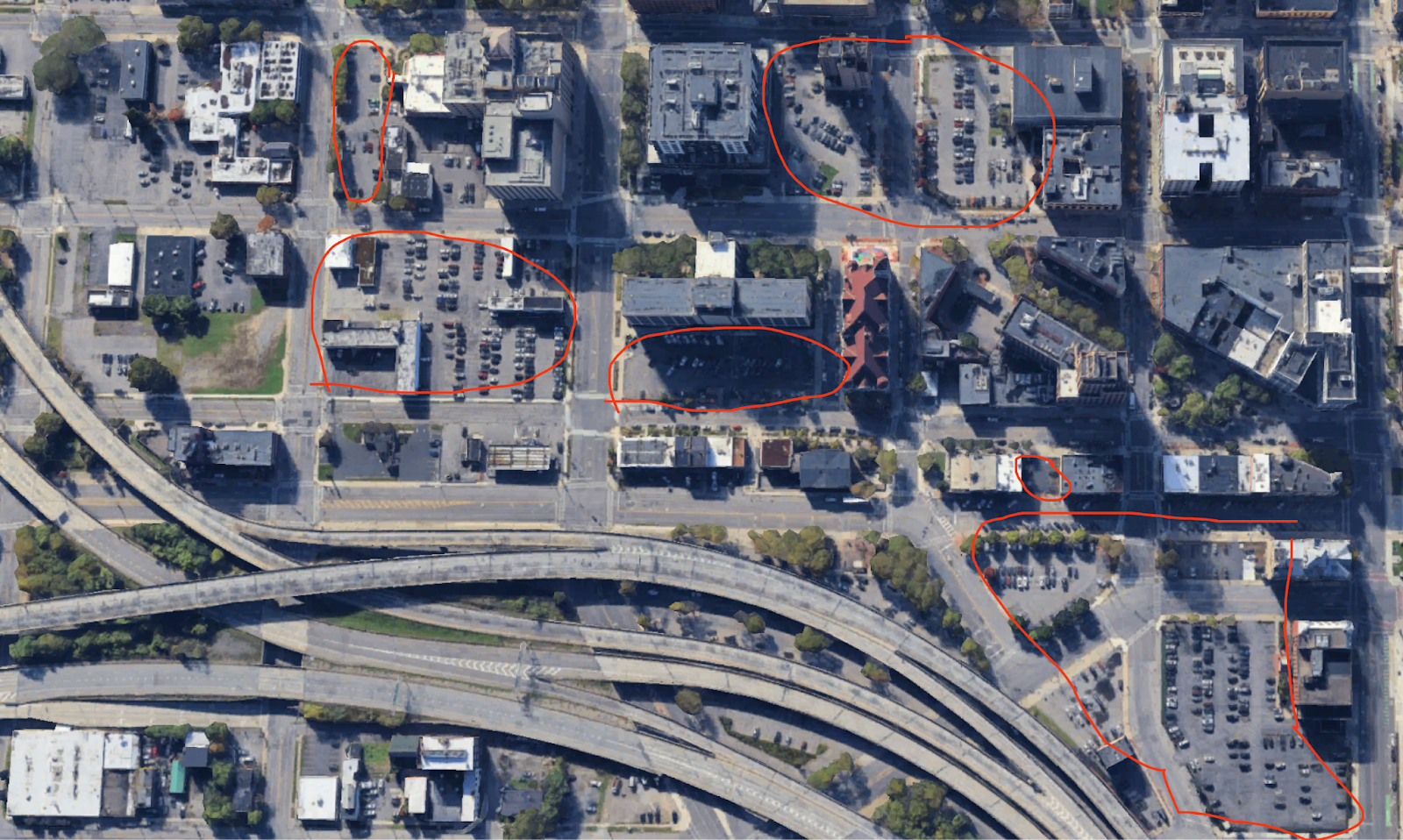
2/2/2026 at 7:46:36 PM
Parking minimums prevent developers from free-loading on a commons, that commons being street parking.So eliminating parking minimums by themselves will create nasty side effects.
But of course the correct answer to tragedy of the commons is pricing -- price the street parking appropriately and it won't be abused so you won't need worse solutions like parking minimums.
by bryanlarsen
2/2/2026 at 8:05:01 PM
Just a note - the parking minimums that are set themselves don’t necessarily correspond to the number of units built in the best way. So by artificially setting them you can windup with, as often seems the case, an oversupply of parking or in more rare cases an undersupply.But in addition to pricing street parking more appropriately, and some cities are doing so, shifting the load on to the common spaces is kind of what you want to see as a transit user because if it continues to be set at a minimum you just wind up building more parking lots, highways, and cars. But if “the market” decides the market can actually signal to government entities that we do indeed need and want more options.
Like you actually want to see new apartments in urban cores built without parking garages. Theoretically (and perhaps in practice) these new developments should also be cheaper and less theoretically they give sidewalks and bus routes and tram routes more users and thus more funding and support. That then alleviates pressure on existing highways and everybody wins except the obnoxious highway lobby and the revolving door that it operates with existing state departments of highways.
by ericmay
2/2/2026 at 7:51:11 PM
Or just do what the Japanese do - remove unlimited (and overnight) on-street parking in urban areas and require anyone owning a car to prove they have a private parking spot to house itby twelvechairs
2/3/2026 at 12:30:14 AM
That would be a good idea, but one of the main impediments is the fact that heavy regulations make underground concrete structures (and hence underground parking lots) very expensive, a lot more than in Europe or Asia, where it's often economical for even 3-5 story residential buildings to have underground parking space. That's the reason why developers push for on-street parking.by ragall
2/2/2026 at 11:18:30 PM
I think you're also forgetting the other aspect that allows this which is having readily available public transport.by dottjt
2/3/2026 at 4:46:44 AM
Most of Japan doesn't have excellent public transport.Car ownership is less common in most of the places in Japan with excellent public transport.
But I do like that each car legally requires its own parking spot. It is tricky to go to people's homes, because often extra parking is extremely limited or non-existent. It requires specific planning.
by mc3301
2/3/2026 at 4:13:23 PM
The more you subsidize automotive infrastructure, the more public transport will suffer for it.by alamortsubite
2/2/2026 at 8:33:45 PM
That's pretty drastic, and would probably only be the best alternative on a densely packed island. Seems like overkill for any other situation.by stronglikedan
2/2/2026 at 8:44:00 PM
Price parking appropriately and make people pay for it. If land is cheap, parking is cheap, so not a big deal. If land is expensive, then no freeloading on the streets, which can be put to better use anyways (sidewalks, bike lanes, outdoor cafes etc...)by seanmcdirmid
2/2/2026 at 8:53:55 PM
What do you mean freeloading? Do you know how many taxes do you pay to have a vehicle, gas, etc?by blell
2/3/2026 at 12:42:50 AM
The car registration and gas taxes don't even pay for a quarter of all road-infrastructure-related costs. It boggles the mind to see free street parking in places like NYC, where a more reasonable cost structure would be something like other cities around the world (and Canada) do: divide the territory in parking districts. Locals can buy a discounted annual pass for the district where their main residence is located (should not cost less than $400/month in a place like Manhattan), while elsewhere the rate should be at least $10-12/hour.by ragall
2/2/2026 at 10:41:45 PM
You're leaving your property on public land. How much would that land rent for?by triceratops
2/2/2026 at 9:13:36 PM
You perhaps pay tens of dollars per month. Is that enough to fully cover all externalized costs of owning that vehicle? No.by bryanlarsen
2/2/2026 at 9:25:50 PM
The government says yes. In fact, knowing the government, they probably get a huge surplus from my taxes. What makes you say no?by blell
2/2/2026 at 10:54:23 PM
You should look up how your local government pays for the kinds of local roads you can park on.If you live in the US, there's a very good chance that's coming from the property and sales tax everyone pays, not any tax on your vehicle.
by hamdingers
2/2/2026 at 10:51:54 PM
> probably only be the best alternative on a densely packed islandSo Manhattan or the San Francisco Peninsula?
I suspect the refusal to kowtow to car owners and the density are interrelated. Tokyo is more dense, in (small?) part, because there is far less space consumed by inanimate appliances.
by hamdingers
2/3/2026 at 12:02:54 AM
No, it's in very, very large part due to this. You can see it not just walking around, but especially when you go up in one of the tall buildings or in SkyTree tower and look at the city from above: you can't see any parking lots anywhere, and most of the roads are pretty small (there's some large boulevards, but not that many). Compare to any American city that was built up after the rise of the automobile and it's staggering how much space is wasted on cars in those cities.by shiroiuma
2/3/2026 at 4:48:57 AM
Covered multi-story parking lots.by mc3301
2/3/2026 at 6:37:53 PM
And those cost money. That is the crux here. Free parking is frankly insane. It became untenable in Amsterdam as early as the 1960s when most people could afford a car.If you want trees, a sidewalk and bike lanes something has got to give.
by PearlRiver
2/2/2026 at 8:08:26 PM
> Parking minimums prevent developers from free-loading on a commons, that commons being street parking.Another way of looking at it: parking minimums require developers to encroach upon a commons, that commons being land that could otherwise be used for more productive things than free parking.
by jakelazaroff
2/2/2026 at 8:23:27 PM
It's not a commons if they buy the land.by pclmulqdq
2/2/2026 at 8:29:53 PM
Of course it is — unproductive land use creates negative externalities that affect the entire surrounding community. It's like saying "a factory dumping waste into a river doesn't pollute the commons if the river runs through their property".The article explains this well:
> The office, filled with workers and transactions, generates far more in economic activity and value creation than its land value and, therefore, rises the highest. The apartment, where dozens of residents live, stands nearly as high. The rowhomes add steady, smaller value. But the parking lot does something different. It dips below the surface, shown as a red bar sinking into the ground.
> Why below ground? Because in economic terms, a parking lot doesn’t simply fail to add value; it actively subtracts value. Every year it sits idle, it consumes some of the most valuable land in the city.
> When valuable downtown land lies idle, it blocks the housing, jobs, and amenities that could exist there. The costs ripple outward: higher rents, longer commutes, fewer opportunities nearby. What could have been a productive part of the community instead becomes a hole in its fabric.
by jakelazaroff
2/2/2026 at 9:52:47 PM
> generates far more in economic activityThe LVT focus on profit above all else is why it is an unsatisfactory solution.
If the most important goal for every plot of land is to maximize its economic activity & tax revenue, that's going to be a miserable place to live.
All of the space uses that make a town nice to live in, are also underutilizing the land if the sole goal is to maximize economic activity.
Open space with native vegetation, parks, playgrounds, sports fields of all kinds like soccer fields, community pools, hiking trails.. all of that is wasted land if viewed through the lens of LVT maximization. All that space should be crammed full of high rise offices and apartments.
by jjav
2/3/2026 at 3:08:08 AM
LVTs focus is on maximizing land value, not profit. It just so happens that when a landowner maximizes the value a piece of their land provides, higher profits are almost guaranteed.It's also a bit of a mistake to view LVT solely through an economic lense. Sure, we quantify it through a dollar amount or a difference in profits, but the value in LVT comes from how individuals value the land as a whole. So you are absolutely correct that a place without native vegetation, parks, playgrounds, etc. is going to be valued less than a place with those amenities by a lot of people. But only if people value greenspace and amenities more than pure economic output, which is mostly the case when it comes to residential spaces.
If people value greenspace, than the land around said greenspace will have a higher value. LVT would then incentivize those land owners to maximize their value, which would obviously include not destroying or removing the greenspace. Instead of would (likely) be to densify housing, or convert existing buildings to mixed-use spaces.
by Based-A
2/3/2026 at 7:17:49 AM
> If people value greenspace, than the land around said greenspace will have a higher value. LVT would then incentivize those land owners to maximize their value, which would obviously include not destroying or removing the greenspace.This is where I believe LVT breaks down when faced with greedy reality.
In a perfect world, I totally agree with the above. That would be pretty awesome.
Could that ever happen in the real world of greedy corrupt politicians who never look further in time than the next election?
How do we assign monetary value to pleasant and beautiful things that provide quality of life? Like the parks and playgrounds and sports fields, etc etc. I'm sure there are studies, but the numbers are not as clear-cut and not as immediate as tax revenue this quarter, so they get ignored.
Each individual lot gets evaluated in isolation and the most profitable choice, individually, is to maximize revenue on that lot, so every lot ends up being a high rise concrete box, either offices or apartments. It would take a very brave politician to say let's look at the big picture long term, sacrifice some tax revenue today and build for a better quality of life because long term that will raise values more.
LVT is uncommon so a lot of it is argued in theory, but I suggest looking at a somewhat similar decision process happening in cities today, which relates to the homeless.
How are cities reacting to homeless? They fence off all the open green space and parks, rip out benches and bus stop roofs, eliminate all public bathrooms and so on. Making the area miserabe for everyone, destroying quality of life. Oh but it is difficult to measure quality of life, so they don't.
It would be much wiser for society as a whole to attend to the homeless and let us all have the open parks and benches and bathrooms, city life would be far more pleasant and long term also more profitable if cities can thrive instead of decay.
But that's not how politicians think or act, so I'm fairly sure it would be the same with LVT.
by jjav
2/3/2026 at 4:08:25 PM
Well I can't speak to the notion of corrupt politicians, but it's worth noting that if it's in the interests of the landowners, then they'd likely fight to keep anything that they feel would keep their value high. And especially if they started developing/investing in their land to maximize the potential return of the land. Anecdotally, I've seen individual homeowners stir up enough support in my major Canadian city to stop city councils from starting somewhat major development projects, so I don't think that it'd be as inevitable as you're making it out to be.It's also a mistake to say that a lot of land gets evaluated in isolation, because that's not even true with a the current property tax. You absolutely factor in the surrounding community and external factors when valuing a piece of land. Land in a downtown area is going to be inherently worth more than land on the periphery of a city due to the activity and potential of the land to generate economic activity.
To your point though, would you say that an apartment building next to a park (or even within several blocks of a park) is worth more than an apartment building with no park in proximity? I think most people would as well, therefore the apartment building with the park in proximity would have a higher value (which would extend to all land in proximity of the park), and thus the local government would be able to collect a higher tax dollar amount because of the park being there. Whereas maybe they could get a similar total amount by building another building, but why would a local government purposefully lower the amount of tax they'd collect on each plot of land? It's in the interest of the local government to maximize the value of the land within their jurisdiction to collect the highest amount of tax possible. Just like it's in the landowners interest to develop and invest in their land to get the highest return on their investment possible.
Re: homelessness, it would seem to me like a large group of people without housing would benefit from a system that incentivizes building more housing. Which LVT does. It would also encourage public spaces to be as ammenible as possible, so that the park is as appealing as possible in order to maximize the value for surrounding lots of land. At this point though we're talking second or even third order effects of LVT, which like you mentioned aren't super clear or even assured because LVT mostly remains in the theoretical. But if we have a sound theory, at this point why not try it and see what happens? Our current systems are very clearly failing us, so if we have ideas with sound reasoning, can things really get so much worse than they already are?
by Based-A
2/2/2026 at 10:06:08 PM
> Open space with native vegetation, parks, playgrounds, sports fields of all kinds like soccer fields, community pools, hiking trails.. all of that is wasted land if viewed through the lens of LVT maximization.No, because all of that would be open to the community. The waste is only if it was locked up for use by certain people.
by lotsofpulp
2/3/2026 at 7:23:54 AM
> Of course it is — unproductive land use creates negative externalities that affect the entire surrounding community.By definition “commons” means public land. So if they buy the land, it’s no longer commons.
And the claim that unproductive land use affects the commons is not a very informative statement.
Everything affects the commons, it’s inevitable of a world with more than 1 persons.
by refurb
2/2/2026 at 9:12:23 PM
The river dumping analogy is so bad it's laughable. Obviously you don't own the entire river when the river merely runs through your property nor do you own the ocean or the watershed, and property values surrounding yours go down by a measurable amount when you dump things in the river. What negative externalities does a parking lot create that an empty lot does not? Minimal noise from people pulling in and out? Extra walking time between lots that are built up? Some pollution from the cars? These are normal externalities from literally any building that might be there as well. You can see how this is a different class than a polluted river, and is literally immeasurable.With regards to the argument presented in the article, it's arguable that parking lots create value by making places accessible to more people. As such, a parking lot raises the property values and economic output of neighboring properties. I didn't see anything about that covered in the article, nor did I see any actual data. This is why chambers of commerce and the like support parking mandates, because they actually have positive externalities, not negative ones.
by pclmulqdq
2/2/2026 at 9:28:53 PM
> With regards to the argument presented in the article, it's arguable that parking lots create value by making places accessible to more people.I think it's arguable, but I think it's not the full picture. Let's look at downtown Columbus, Ohio where I live. With the parking lots that exist, there's less housing, which means that people move further away from where they work, creating traffic, creating highway construction costs, insurance, &c. I'm quite sure that creating a parking lot makes the location of my employer (well not mine literally) more valuable, but it does seem like it creates more costs. If those lots were, say, because it's a downtown location a 10-story building with 300 residents those people would be shopping downtown, going to restaurants and bars downtown, spending more time there, &c.
There are cases where a parking lot does create economic value, though I think those are more nuanced and limited. I'm not sure your point nor the one you were responding to, nor mine for that matter, are able to really calculate the economic costs of surface parking lots without taking into account factors like, well where the hell is the thing?
> As such, a parking lot raises the property values and economic output of neighboring properties.
Cherry-picking this comment. I'd add to what I wrote above, but I'd also add that I'm not sure that there is evidence to support this statement and if you take this to its quasi-logical extreme you wind up with your entire neighborhood just being one gigantic skyscraper with a Costco and doctors office inside surrounded by parking lots or something. And then the increased profit flows to Costco's shareholders which is fine, but for your local economy that's kind of bad versus having a variety of stores that can open and close. It's putting your eggs in one basket, so to speak.
by ericmay
2/2/2026 at 9:33:00 PM
Everything about city planning should generally be done in moderation. Including enough parking and enough residential space, but not too much or too little. A city consisting only of residential apartment blocks but no parking, transit, or stores will be a pretty terrible city as well.I assume that Syracuse or other similar tier-2-to-3 cities would be far worse off if you replaced all the parking with apartment buildings.
by pclmulqdq
2/2/2026 at 9:41:39 PM
Yea I think that's fair. I personally advocate for mixed-use medium level density over skyscrapers or the suburbs which are both not ideal either. Something more like European towns and villages but since it's America we can have a little bit larger homes. I live in that style of neighborhood today, and have a 2.5 story house and detached garage and back yard. Though it's not quite as dense as it should be, but zoning rules have recently changed to allow the main streets on the east and west side to build better density which will be great for everyone here. We can't have a grocery store really because the density isn't there. Tons of good restaurants and coffee shops and such.I've never been to Syracuse but with the university there and number of employees you may be right, but it really depends I think on the layout. In the US once you get away from college towns or smaller towns like you're describing and get into medium-sized American cities we really lack density and transportation and we pay out the ass for the poor planning and past destruction that took place. It's changing though.
by ericmay
2/2/2026 at 11:29:29 PM
>The river dumping analogy is so bad it's laughable.The frame of mind that brings such comparisons about is anything but funny in a world where all our votes count the same.
by cucumber3732842
2/2/2026 at 11:28:22 PM
>Of course it is — unproductive land use creates negative externalities that affect the entire surrounding community. It's like saying "a factory dumping waste into a river doesn't pollute the commons if the river runs through their property".Pretty damn rich to say such a thing when exactly this sort of hand wringing that brought this whole crap about.
"oh no, think about how the commons will be polluted if we don't compel people to build parking space". -some karen in 1970, probably
The right thing go do is back off the regulation. Let land owners do what they please. If that's a parking space (it almost certainly won't be in the overwhelming majority of cases) so be it. And then when there's enough demand parking garages will go up.
by cucumber3732842
2/3/2026 at 2:02:30 AM
I mean, yeah, that's exactly what I'm saying? End mandatory parking minimums, institute a land value tax and then let the market decide whether parking is truly a valuable use of space.by jakelazaroff
2/3/2026 at 12:07:22 AM
>The right thing go do is back off the regulation. Let land owners do what they please. If that's a parking space (it almost certainly won't be in the overwhelming majority of cases) so be it.This is exactly how it is here in Tokyo. People are free to build parking lots (or parking garages even) if they want. But they don't, except in rare cases, because it's far more profitable to build an apartment building or shop or some other building there. Though for apartments, they'll usually build a small parking lot (or garage for a big apartment building) and charge very high rent for residents who want to park their car there, which is a small minority of residents.
by shiroiuma
2/3/2026 at 4:59:38 PM
Once a city gets to the density of Tokyo with the transit of Tokyo, there's little reason to build parking. I would expect that in smaller cities around Tokyo, plenty of building owners choose to build parking.by pclmulqdq
2/2/2026 at 8:50:53 PM
Underutilized surface area of the Earth contributes to more resource, energy, and time consumption for everyone else in society to move around it.When ranking consumption such as large cars, flights, plastic toys, etc, space on the surface of the Earth, within an urban/suburban metro, is at the very top in terms of impact on others.
And it’s taxed the least.
by lotsofpulp
2/2/2026 at 8:02:12 PM
Even if on street parking were metered consistently and priced appropriately that's too divorced from the developer & their incentives to solve this. Parking after the building is sold is the definition of not the developer's problem, which is part of the reason we have parking regulations to begin with.A better solution might be to mandate parking minimums (to ensure the property is actually useful / not encroaching on the street) but not allowing "open air" spots to count to the minimum, meaning an open lot gets you nothing, a 2 level garage counts for half the spots, etc. Maybe tack on some credits for proximity to public transit while we're at it.
by kec
2/2/2026 at 10:13:23 PM
It is very much important to the developer - whoever buys the land wants to know that their employees and customers can get there. That means there needs to be enough parking, transit, or pedestrians. If it is in a car centrist area that won't buy if there isn't enough parking. Downtowns can get by with less parking only if there is great transit to bring people in. Developers are not stupid, they know that if there isn't enough parking property values go down.by bluGill
2/2/2026 at 10:42:08 PM
This is the root of the issue, which people often want to ignore - it's a class chicken'd egg problem.The "there is no parking at all" wonderlands can exist (even NOT counting artificial ones like Disneyland) - and the "everything is acres of parking and there's no street parking at all" also.
The question is how you get from one extreme to another - in a way that does NOT require you to redevelop the entire city Simcity style, nor puts onerous costs such that all development is stifled.
Part of it might be that if the parking lots/garages are not heavily used, or not used much, they'll "redevelop themselves" - but that likely requires making transit and other options better which is difficult, expensive, and often politically unsound.
by bombcar
2/2/2026 at 11:25:31 PM
Disneyland has one of the largest parking structures in the world.by gamblor956
2/3/2026 at 2:05:05 PM
But it isn't inside the park, making the inside car-free.by bluGill
2/3/2026 at 4:27:44 PM
Exactly - the only other example I could think of was https://en.wikipedia.org/wiki/Mackinac_Islandby bombcar
2/2/2026 at 8:41:44 PM
Get rid of street parking so drivers can't free load on the commons either, make parking something that you have to buy (with your rent or on your own) because it actually costs something.Also, you no longer have to worry about kids appearing into the street between parked cars that obscure their presence even near crosswalks (that cars park way too close to because they can't find parking elsewhere). Win-win.
by seanmcdirmid
2/2/2026 at 7:56:38 PM
If a developer builds in a way such that the demand for street parking outstrips supply, the street parking still has a cost, that cost is just expressed in time to find a spot, not dollars like you're suggesting. People unwilling to pay that time cost will find paid lots or not have a car (which is basically the dynamic in my building: people either pay $450 a month for a spot or they spend 10-15 minutes looking for a free street spot).In practice, of course, existing residents feel entitled to "their" street parking and get mad when a new building with new people contending for those spots is built but there's no logical reason to preference residents who have previously lived there. This is where politics rears its head though.
by benced
2/2/2026 at 7:59:51 PM
I completely agree with your comment, but would also like to add that many cities have restricted or stopped permitting the construction of above-surface parkades, further distorting the market.by nickff
2/2/2026 at 8:07:05 PM
> People unwilling to pay that time cost will find paid lots or not have a carIf we're talking about commercial properties and zones, people unwilling to pay that time cost just won't come to the area.
by pavel_lishin
2/2/2026 at 8:11:16 PM
This is correct which will incentivize the constructions of private lots etc (assuming the people you mentioned value their time more than the $ those lots cost). I don't see any reason you can't trust markets to address the supply of a commodity product.by benced
2/2/2026 at 8:48:42 PM
Exactly, it's not like a Target going up in an area with no parking minimums is going to be like "great our massive big box store won't need any parking!" They're just going to be incentivized to build enough parking to fill their store to levels they expect based on the massive amount of data they have, and not just some gut-feeling BS from the 60s in the parking minimums regulations "department store - 20 spots per 100sqft" or some bullshit.by wpm
2/2/2026 at 11:37:21 PM
Expensive parking and higher population density might even make pubic transportation commercially viable. Not having to walk a mile from the nearest stop / station could also make it actually convenient to people of all walks of life.by nine_k
2/3/2026 at 7:12:20 AM
People drive because it is convenient. If there are fewer parks it becomes less convenient and fewer people will drive. Why do we prioritise the convenience of those that want to park a car over those that need a place to live?by tmnvix
2/3/2026 at 12:09:45 AM
Make it illegal to use private vehicles in urban areas, except for on specific ingress/egress routes. Bolster public transit.Most drivers are using their car to scoot around 5-10 miles. Make them walk (yes not everyone can; they have friends and family, care workers, etc). Invest in infrastructure to backfill gaps that make walking onerous.
There was measurable improvement in air pollution during Covid lockdown. We'll hate it now but thank ourselves when we're 70 and a little less anxious about environmental collapse.
Cars are great for road trips but a massive pollution and burden on urban infrastructure.
Rip up superfluous sidewalks then (aka heat storage. Plus concrete is worse for joints) and leave the avenues/streets not designated for ingress and egress for bikes, small delivery vehicles, handicap accessibility.
by irinianianian
2/2/2026 at 8:08:02 PM
Changing street parking prices is a lot easier than changing buildings built with previous parking requirements.I'd say change the requirements first, then if there's a surge in street parking demand there will be natural pressure to raise prices.
by spankalee
2/2/2026 at 7:54:45 PM
But I have a bike and use public transit and don’t want parking driving up my cost of housing.by newsclues
2/2/2026 at 8:11:38 PM
You also don't want the streets you bike on to be clogged up with cars parking legally, parking illegally and circling the block continuously looking for parking.by bryanlarsen
2/2/2026 at 8:17:59 PM
Right, which is why the actual solution is mixed use development and a robust public transit system.Ultimately this is a geometry problem. Cars are by far the least space-efficient method of transporting people; eventually your roads just can't accommodate any more traffic. If there's enough demand to visit a given area then anything that doesn't minimize cars will just make things worse.
by jakelazaroff
2/2/2026 at 10:48:19 PM
> Cars are by far the least space-efficient method of transporting peopleNot true in practice even if true in theory; in many places the average full-size bus contains fewer people than would fit in a minivan.
The problem is you need 5-10 years of reliable public transit in an area before non-transit users begin to convert (or transit users begin to move in).
by bombcar
2/3/2026 at 3:04:00 PM
Or you can start with minivan buses, and switch to traditional one when minivans stopped being enough In my city less common routes are still purely minivan because why not. Some seasonal routes (more relevant in summer|winter) are also partially or full minivan.(sidenote: I'm pretty sure it started because few guys with minivans noticed that some areas were under-connected by buses and just started a business driving those routes back-and-forth on a schedule. Then some regulations were slapped on top. So it looks like public transport have tendency to spontaneously appear in denser areas)
by lesostep
2/3/2026 at 4:22:54 PM
These used to be called jitney cabs or https://en.wikipedia.org/wiki/Share_taxi#Jitney (basically, cabs that travel like busses) and are still common in many parts of the world.In Mexico it was always a decision of "do I walk a bit further to get the jitney and pay a bit more, but likely go faster (it stops picking up passengers when full and just goes until the first drop-off), or do I get on a bus sooner for cheaper but likely slower?"
by bombcar
2/2/2026 at 10:57:35 PM
If you myopically look at the instantaneous usage of infrastructure then you could argue that most roads are pointless because they are, on average, empty.The bus might have less than 5 people on it at any given moment you observe, but over its >2 hour route it transports dozens or hundreds of people between stops.
by hamdingers
2/3/2026 at 4:26:02 PM
Passenger-mile vs vehicle-mile is a useful metric (you can add driver-mile if you want, or cost-mile) but you can probably do something similar with some measurement of storage space, too.A full minivan ranks surprisingly high on all of them, which is one of the reasons it's disappointing that carpooling and such aren't discussed as much anymore.
by bombcar
2/2/2026 at 11:31:35 PM
Suburbs (with local amenities) with light rail connectivity into urban centres might actually be awesome.I really wish someone would be a modern city from scratch.
by newsclues
2/2/2026 at 9:13:52 PM
Cars are the most time efficient though, assuming you can find parking relatively quick.by mustyoshi
2/2/2026 at 9:30:54 PM
Depends on the trip. I've timed many trips bike vs. car in my city. Bike is usually faster (or very similar time) because the average speed through a city is actually pretty slow. There's a lot of "hurry up and wait" with cars (rush to get to the next red light) and on my bike I'm frequently passing long lines of cars stopped at lights.And parking is a time sink. There's a place in my city that has huge parking garages with lots of parking but you still have to drive through a few levels of the garage, park, and then walk back down a few flights of stairs, then walk to your destination. I just park my bike right outside of my destination with the wheel lock. Street parking is always awful in populated cities, and I never have to worry about it. I always park right at my destination, where ever it is.
In suburbia, cars are faster because the average distance per trip is a lot longer. But it's ironic that the reason why the average distance is longer is BECAUSE it was built for cars so everything gets spread out! Cars are a solution to a problem that they created.
by scottious
2/2/2026 at 9:23:14 PM
Not the case as density increases: once roads reach their capacity, space inefficiency quickly becomes time inefficiency. That's why some cities have started introducing congestion pricing.by jakelazaroff
2/2/2026 at 8:49:22 PM
They already are, and the more clogged the streets are the slower the cars are moving, so the safer it is for me. So actually, I don't mind.by wpm
2/2/2026 at 11:49:33 PM
For a cyclist high speed traffic is scary. Speed kills. Slow traffic –like, gridlocked car traffic– is freedom for a cyclist.by Fricken
2/2/2026 at 11:29:34 PM
Correct, I want others to use bikes, walk or transit for most urban travel, because it’s the best option as it’s cheap, fast, safe and convenient.by newsclues
2/2/2026 at 8:19:18 PM
Distribute the currency appropriately so that pricing won't be abused.by grokgrok